New Golf Rules for 2016

2012 CN Future Links Western - Golf CanadaThe rules of golf continue to evolve. The R&A, USGA and RCGA are constantly trying to improve golf by modifying, changing and adding rules in a 4 year cycle. As 2016 approaches, 4 major rule changes will add some common sense to golf and I think will reduce some of the frustration experienced by all golfers, at every level.

Thanks to Golf Canada for the below information. It was copied word for word from their website because trying to paraphrase the information would not be advantageous to anyone. Additionally, if you check the above link, there is video explaining each rule below.

Among the most significant of the changes in the 2016 edition of the Rules are the following:

  • Withdrawal of Rule on Ball Moving After Address – Rule 18-2b (Ball at Rest Moved by Player, Partner, Caddie or Equipment) has been withdrawn. This means that if a ball at rest moves after the player addresses it, the player is no longer automatically deemed to have caused the ball to move. A one-stroke penalty under Rule 18-2 will be applied only when the facts show that the player has caused the ball to move.
  • Limited Exception to Disqualification Penalty for Submission of Incorrect Score Card – A new exception has been introduced to Rule 6-6d (Wrong Score for Hole) to provide that a player is not disqualified for returning a lower score for a hole than actually taken as a result of failing to include penalty strokes that the player did not know were incurred before returning the score card. Instead, the player incurs the penalty under the Rule that was breached and must add an additional penalty of two strokes for the score card error. In all other cases in which a player returns a score for any hole lower than actually taken, the penalty will continue to be disqualification.
  • Modification of Penalty for a Single Impermissible Use of Artificial Devices or Equipment – The penalty for a player’s first breach of Rule 14-3 (Artificial Devices, Unusual Equipment and Abnormal Use of Equipment) during the round has been reduced from disqualification to loss of hole in match play or two strokes in stroke play. The penalty for any subsequent breach of Rule 14-3 will continue to be disqualification.
  • Prohibition on Anchoring the Club While Making a Stroke – As announced in May 2013, the new Rule 14-1b (Anchoring the Club) prohibits anchoring the club either “directly” or by use of an “anchor point” in making a stroke. The penalty is loss of hole in match play or two strokes in stroke play.

There are many more rule changes that I will address in the upcoming months, but for now, these 4 rules make the top of my list. I am grateful for Golf Canada’s efforts to explain the rules of golf in terms everyone can understand.

I am a grateful golfer! See you on the links!

 

Rules of Golf – Immovable Obstructions

Knowing the rules of golf are important for any player who has aspirations of being a better golfer. The rules, especially in competition, can work to advantage or against your understanding of how to apply the rules is fuzzy. I read the rules yearly and I am often asked for an interpretation when an unusual situation arises.

On the fence at Black Bear Ridge Golf Course.

On the fence at Black Bear Ridge Golf Course.

While playing at Black Bear Ridge Golf Club last year, my friend Jean hit his ball into the woods. The woods were to the left and not near the boundary of the golf course. As you can see, the woods were pretty open, but the fence was perpendicular to the fairway! This was an old fence, but there were no makings suggesting it was a hazard or ground under repair.

If you look closely, Jean is pointing at his ball that came to rest on the bottom rail of the fence. We search for quite a while and finally we were able to find it in this odd position. The question that came up was, “Now what?”

Under Rule 24-1 – Immovable Obstructions, our interpretation was that the fence should not have been there or be considered a hazard. It is man-made and be classed as a building or a sign post. The exact rule reads as follows:

An immovable obstruction is an artificial object on the course that cannot be
moved (e.g., a building) or cannot readily be moved (e.g., a firmly embedded
direction post). Objects defining out-of-bounds are not treated as obstructions.
An abnormal ground condition is casual water, ground under repair or a
hole, cast or runway made by a burrowing animal, a reptile or a bird.
Except when the ball is in a water hazard, relief without penalty is available from
immovable obstructions and abnormal ground conditions when the condition
physically interferes with the lie of the ball, your stance or your swing. You
may lift the ball and drop it within one club-length of the nearest point of relief
(see Definition of “Nearest Point of Relief”), but not nearer the hole than the
nearest point of relief (see diagram below). If the ball is on the putting green, it
is placed at the nearest point of relief, which may be off the putting green.

Determining Jean was entitled to a free drop was the easy part. The next question was where should he take his full relief. Following the fence, the nearest point of relief was at the edge of the woods almost in the rough! This drop location was of great benefit because he now had a shot at the green.

Yes, this does sound strange, but we also had to consider the definition of ‘nearest point of relief’. Basically, without going into a long explanation, the immoveable obstruction must not impede the player after they take relief.

In this unique situation, we had to follow the fence to the end, establish his relief position, and then allow his one club length no closer to the hole! If we went in the other direction, the nearest point of relief would have been farther than the direction we chose.

In this case, knowing the rules was very beneficial for Jean. Of course, his playing partners had to agree and this is what we decided.

What do you think? Did we make the right call according to the rules?

I am a grateful golfer! See you on the links!
Ground Under Repair – Rule 25

Down the left side of the fairway on the fifth hole of our course, a large areas is marked as ground under repair. Due to storms late last year and the lack of time to clean up the mess, our managing committee has declared this area as Ground Under Repair. It is a well know local rule and the area is marked by a white line.

rules_official_new_webRecently, I was playing a round of golf with my usual friends and one of us hit their ball into this area. We searched and searched, but we did not find the ball. As the default rule guy, they asked me for a ruling. I stated that since we did not find the ball, it had to be declared lost, and he had to go back to the tee to rehit.

Well, I started thinking and after a bit of research, I found out that I was wrong.

According for Rule 25-1c, my friend was able to take a free drop, without penalty. Here is how the rule reads:

Ball in Abnormal Ground Condition Not Found
It is a question of fact whether a ball that has not been found after having
been struck toward an abnormal ground condition is in such a condition. In
order to apply this Rule, it must be known or virtually certain that the ball
is in the abnormal ground condition. In the absence of such knowledge or
certainty, the player must proceed under Rule 27-1.

If it is known or virtually certain that a ball that has not been found is in an
abnormal ground condition, the player may take relief under this Rule. If he
elects to do so, the spot where the ball last crossed the outermost limits of
the abnormal ground condition must be determined and, for the purpose of
applying this Rule, the ball is deemed to lie at this spot and the player must
proceed as follows:

(i)  Through the Green: If the ball last crossed the outermost limits of the
abnormal ground condition at a spot through the green, the player may
substitute another ball, without penalty, and take relief as prescribed in
Rule 25-1b(i).

(ii)  In a Bunker: If the ball last crossed the outermost limits of the abnormal
ground condition at a spot in a bunker, the player may substitute another
ball, without penalty, and take relief as prescribed in Rule 25-1b(ii).
(iii) In a Water Hazard (including a Lateral Water Hazard): If the ball last
crossed the outermost limits of the abnormal ground condition at a spot
in a water hazard, the player is not entitled to relief without penalty. The
player must proceed under Rule 26-1.

(iv)  On the Putting Green: If the ball last crossed the outermost limits of the
abnormal ground condition at a spot on the putting green, the player may
substitute another ball, without penalty, and take relief as prescribed in
Rule 25-1b(iii)

Basically, not remembering and my playing partner not knowing the rules cost him 2 stokes. I will rectify this error this morning as we play our weekly round. With an important tournament approaching, I will have to reread the rules and make sure I am aware of all their nuances.

Rules are important in golf. They even the playing field, only if players actually know them. Have you read the rule so of golf lately? If so, how long ago?

I am a grateful golfer! See you on the links!
Double Hit in Golf – Rule 14-4

Rule 14-4

Watch out for the double hit!

Today was an interesting round. There were many ups and downs, but I encountered a situation that I have not seen in about 150 rounds of golf. It is truly a rare thing and it happened twice in the same round!

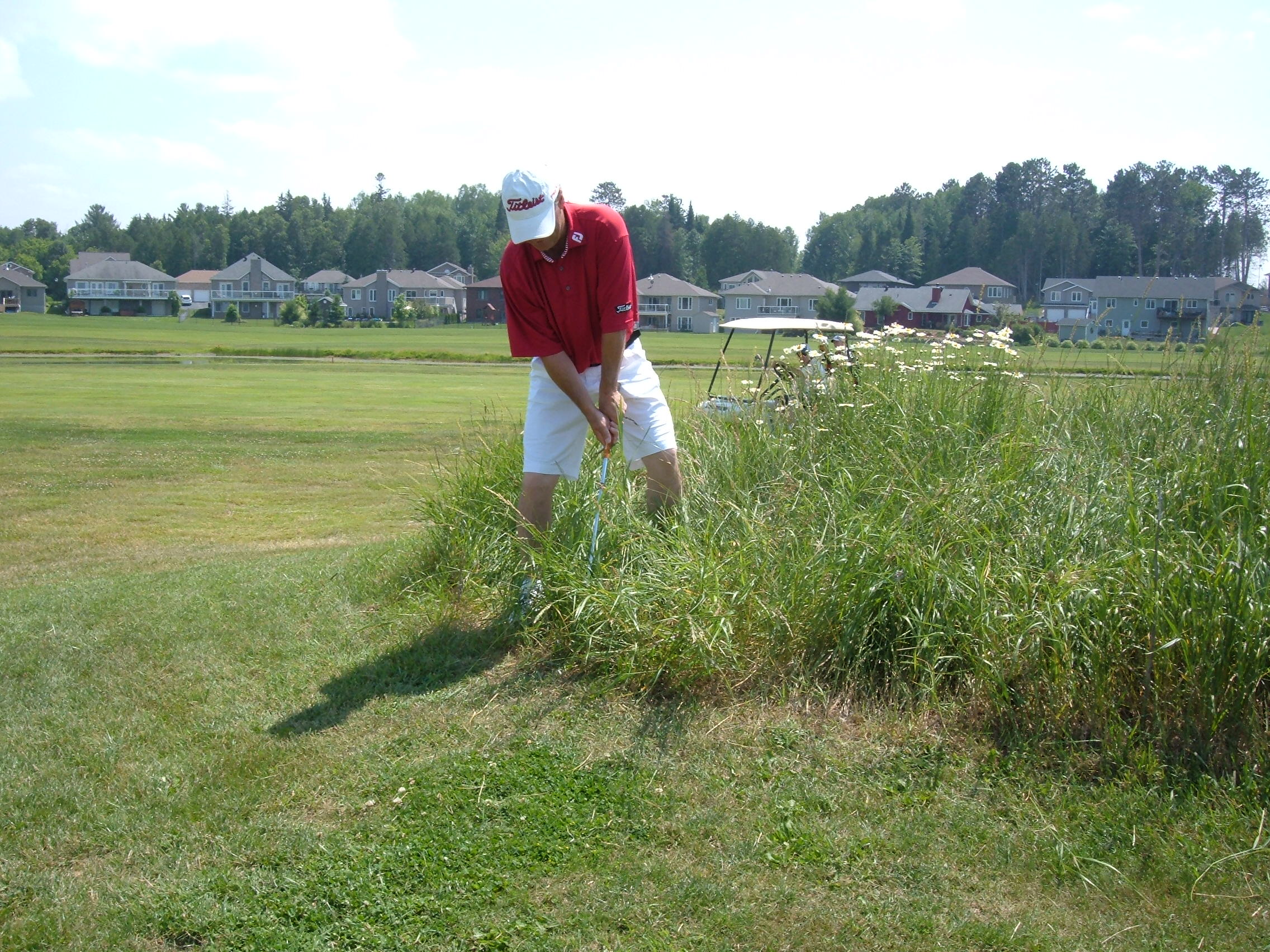
On the third hole, I was playing the ball out of the long grass to beside the green. There was not much room to get my club down on the ball to make a clean hit, so I tried a scoop like shot. I used a steep down swing, mixed with a steep up swing to try to pop the ball out of the long wet grass. As I made contact with the ball, my follow through felt strange. Almost as if I was carrying the ball and helping it to the hole.

After completing the hole, I asked my playing partners what they thought. One thought I hit the ball twice. And another thought that I scooped the ball and contacted the ball only once – but for a longer than normal time. Now understand that all of this happens in milliseconds, but it was quite noticeable that something strange happened. Not knowing exactly what had happened, I called the double hit ruling on myself at the fourth tee box.

The other situation happened on the 16th hole. One of my playing partners, Mike, obviously struck the ball twice as he followed through on his short chip shot. His lie was similar to mine on the third hole and the ball did not pop out as quickly as he anticipated. So, he hit the ball again at about knee level. He also called the double hit on himself.

Rule 14-4 is very clear. Striking the Ball More Than Once – If a player’s club strikes the ball more than once in the course of a stroke, the player must count the stroke and add a penalty stroke, making two strokes in all.

Both Mike and I ended up with a double on our respective holes and walked away a little disappointed, but clear that a rules infraction had occurred.

Now here is the rub. On my shot, one of my playing partners suggested that I did not hit the ball twice, but scooped the ball. Such that the ball stayed in contact with the club head longer, but did not leave until part way through my follow through. I tried to find a ruling or anything to suggest this was legal or illegal. I cannot find anything.

So readers, I need some help. Has anyone had this happen to them before? If so, what is the ruling? Any feedback or similar story would be great. I am curious to know what you think?

I am a grateful golfer! See you on the links!

Animal Hazards in Golf

In golf, animal hazards are not as uncommon as most people think. Sometimes, interference by an animal can make you laugh or cause disbelief, but it will never cost you strokes.

Rule 18 – Ball at Rest Moved.

Rule 18-1. By Outside Agency – If a ball at rest is moved by an outside agency, there is no penalty and the ball must be replaced.

This video was sent to me by a friend. Enjoy!

I am a grateful golfer! See you on the links…..very soon!