Golf Rules – Play the Ball Where It Lies

‘Play the ball where it lies’ is a fundamental rule in golf. It prevents players from using a foot wedge or other ingenious methods to improve their playing position. During competition, I completely agree with this rule; however when playing of fun, I have to admit that I am a bit more lenient.

Back to being in competition. Recently, I received a picture from Golf Meme that I thought was pretty funny. I placed it on my Facebook page so others could share in my amusement. After a short while, I began to think about the rule that governed this situation. Unless you have read the rule book, the solution might not be all that simple.

Here is the situation:
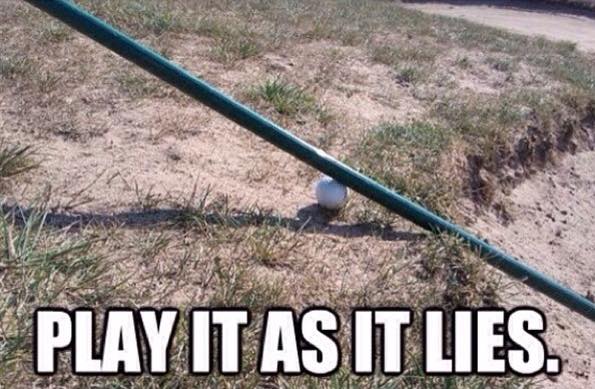
Play it Where it Lies - Rule 24.1

There are many questions to pose for this picture. If you are asking yourself what to do, some of the questions might sound something like:

  1. Do I have to play the ball where it lies?
  2. Can I move the rake?
  3. Can I move the rake without penalty?
  4. What happens if my ball moves?
  5. Is anyone looking? A foot wedge would do the trick!

It is not unusual for golfers to find themselves next too, behind, on, in or touching objects on the golf course. The trick is to know which objects can be moved and which cannot. For this answer we must read:

Movable Obstructions (Rule 24-1)
Movable obstructions (i.e., artificial movable objects such as rakes, bottles, etc.) located anywhere may be moved without penalty. If the ball moves as a result, it must be replaced without penalty.

If a ball is in or on a movable obstruction, the ball may be lifted, the obstruction removed and the ball dropped, without penalty, on the spot directly under where the ball lay on the obstruction, except that on the putting green, the ball is placed on that spot. Rules of Golf – Golf Canada

According to the above rule, any player can move the rake without fear of receiving a stroke penalty. In a tournament, knowing this rule could be the difference between winning or losing your flight. If the ball moves, just place it back and keep playing.

A word of advice, always tell your playing partner what you’re doing to prevent any confusion or possible perception you are doing something wrong!

Reading and understanding the rules of golf are important. I carry a copy with me when ever I play. If you do not have a copy, maybe Santa can bring you one for Christmas.

I am a grateful golfer! See you on the links!

Following The Rules of Golf

Do you follow the rules of golf?  In past blogs, I have talked about specific rules on gopher holes, replacing your golf ball, some of my unwritten rules, new rules for 2014, and many more.  However, it never really occurred to me if everyone actually follows the rules.

Rules of golf

There are many places on the web to find the latest rules and my favorite is the Golf Canada.  I always read the rules several times before hitting the links to refresh my memory on the nuances of play in competition.

However, do you really follow all the rules of golf? I believe that most players follow most of the rules most of the time when just playing for fun.  I believe that most of the players follow all the rules most of the time in competition.  However, here is the hook, I also believe that most players follow all the rules they know all the time all the time in competition.

Well, unfortunately, my last statement is more the norm than most think.  If you do not believe me, ask your playing partners about the Rule 17-1 Tending the Flagstick or Rule 23 – Loose Impediments or Rule 28 – Unplayable Ball.  Chances are they do not know the rule or only part of it.  This lack of knowledge can cost strokes in a tournament or match play event.

Most players honestly want to follow the rules.  Unfortunately, many have not actually read them.  They listen to their playing partners – who likely have not read all the rules either – and blindly play.  This approach is okay except if you have any aspirations of playing in competition.  At that point, you are playing with competitors who likely know the rules and will enforce them without hesitation.

If answered yes to the first question – I will follow that up with, Do you know all the rules? Golf season is quickly approaching and as part of my pre-season routine, reading the golf rules is important to my preparation for an outstanding golf season!  On a side note, even though I read the rules several times, I always care an up to date version of the golf rules just in case I need it during a match.

I am a grateful golfer!  See you on the links!

New Golf Rules

Announced today are decisions about the rules of golf for 2014 and beyond. According to the USGA and R&A, “decisions” are updated every two years and the actual Rules of Golf are updated every four years.  The ability to change the rules of golf to adapt to its evolving nature is extremely important.  Most weekend golfers are less concerned about the real rules, but if you have a wish to play in any competition, knowing or not knowing the rules will affect your score.


This year, some of the decisions address important aspects of the game and some of the more trivial areas. I will let you decide.  All decisions below taken from the tsn.ca website. The first decision deals with those who analyse video and call into the tournaments to report a rules infraction. Decision 18/4 outlines that a player will not be penalized when “enhanced technological evidence” shows that a ball moved, it will not be deemed to have moved if not “reasonably discernible to the naked eye at the time.”  The ever-increasing involvement of arm-chair golfers forced this decision.  This is a good rule, because it puts the onus on the player to be his own referee – exactly where it should be!

Storm CloudsDecision 14-3/18 allows players to use smart phones to access weather reports. The new decision also clarifies that players are permitted access to information on the threat of an approaching storm for their own safety.  This rule is more for the amateur than the professional.  Being caught many times in questionable weather that turned into a storm makes this decision a smart idea.  Actually, I did not know it was against the rules…go figure.

Decision 25-2/0.5 was revised to clarify when a golf ball is embedded. Officials have noticed an increased in tour players asking for relief, and a debate on whether the ball has broken through the soil. The revised decision will be accompanied by illustrations.  Ok, I am sure there will be many who suggest that is really not an issue, however, if you hit the ball hit like the pros and play on soft courses, embedded golf balls does pose a problem. Not 100% sure this decision will fix the issue, but time will tell.

Decision 27-2a/1.5 was revised to allow players to go forward 50 yards without losing their right to return to play a provisional ball.  Okay, I know Phil Mickelson walked 120 yards to the green, fixed the pin and almost jugged it, but really.  You know someone is going to count the steps and determine the yardage by the players gait and…..well I think you get the point!

The rules of golf are ever evolving.  It is good for the game to keep up with new technology and course design. I am not convinced that some rule changes are driven by the golfing industry, but that is a discussion for another day.  A great website on the rules of golf is found at http://www.rulesofgolf.ca/.

What do you think of the new decisions?

I am a grateful golfer!  See you on the links!

Gopher It!

Reading the 2012 Royal Canadian Golf Association rule book as part of my preseason ritual, I came across rule 25-1, Immovable Obstructions and Abnormal Ground Conditions. This particular rule is unique, however it did directly impact a tournament I won back in 2009.

In Canada, the military has an inter-base golf competition to decide a Regional Champion.  Additionally, the top five male and top two female low gross players of this 54 hole tournament are selected to represent the region at a National Championship.  It is something I look forward too as part of my golfing season.  Now back to my story.

caddyshackgopherAfter the first day, the competition was pretty close with only six strokes separating the top 12 players.  On the second day, I was playing in the last group coming up to the narrow par 5, 16th hole.  This hole was difficult because the green was elevated about 10 feet above the fairway and had a steep front face.  Each player elected to lay up and had about 100 yards into the green on their third shot.

Last player in our group hit a high 52 degree wedge that hit directly in the middle of the face of the green…..AND DISAPPEARED!  Yes, disappeared completely.  Each of the players looked at each other in complete confusion.  Not sure what happened, the player decided to play a provisional because no one saw it bounce and to save time.

As we approached the green we all walked to the exact same spot without discussion.  At the spot was four gopher holes!  We look around the green and could not find the players ball.  I took my sand wedge and stuck in each hole and pulled out seven balls….no I am not  kidding!  Unfortunately, none were his.  We pulled out the rule book (because I always carry one) and read rule 25-1.

We all agreed that the ball went into a gopher hole and could not find it.  Because he hit a provisional, we suggested he play a ball with no penalty as directed by the rule and play his provisional ball; then we would ask the rules official after the round.  He ended up with a par with the drop ball and a 7 with the provisional ball.  Unfortunately, the rules official did not really know the rules of golf, so we as a group decided to allow the drop ball as the one to count towards his score.

After much debate, most players (even those close in the hunt to make the top 5 for the regional team) agreed with our decision and we moved on.  As it turned out, the player did not make the team, but was the first alternate.

To this day, I am confident we made the correct decision.  Here is why:

  • All three players walked to the same spot on the face of the green;
  • There were four gopher holes within three feet of where we marked the ball;
  • We were only 100 yards away so tracking the ball was extremely easy;
  • I collected 7 balls from the gopher holes, so balls have landed there before; and
  • After discussion in the club house, we all agreed that it was correct interpretation of the rule.

So knowing the rules is very important to golf.  It is difficult to interpret them some times, but it can have an impact on any match.  This is my story, how would you have called it?

I am a grateful golfer!  See you on the links!

Saving One Stroke on a Penalty

While watching The Masters on the weekend, it was very obvious that caddies make a concerted effort not to leave the players bags anywhere in their line of sight.  Originally, I thought it was a mental thing, but there appears to be a practical reason for their efforts.

According to the RCGA, rule 19-2. Ball in Motion Deflected or Stopped By Player, Partner, Caddie or Equipment states:

If a player’s ball is accidentally deflected or stopped by himself, his partner or either of their caddies or equipment, the player incurs a penalty of one stroke. The ball must be played as it lies, except when it comes to rest in or on the player’s, his partner’s or either of their caddies’ clothes or equipment, in which case the ball must through the green or in a hazard be dropped, or on the putting green be placed, as near as possible to the spot directly under the place where the ball came to rest in or on the article, but not nearer the hole.

After reading this rule, golfers will receive a one-stroke penalty for saving steps.  I knew the rule (actually thought it was a two-stroke penalty) and never paid attention during my regular games.  How many golfers leave their bag in the field of play, then grab a driver and walk to the tee?  How many golfers hit out of the woods or a hazard towards the general direction of their equipment because they were saving time and steps?  If you are like me, I do this every round.  At the Laurentide Golf Course in Sturgeon Falls, Ontario, Canada, it is easy to leave your bag in the next holes fairway.

I was told a funny story many years back by a friend in this similar situation.  He was in a foursome playing their Saturday morning game and the leader of that game was up to hit.  Of course the jokes were flying and they were pestering each other as all good friends do.  Well, the leader of the group hit a line drive off the tee towards all their bags (about 75 yards out).  As the ball made contact, each of the players looked at each other with concern because they could not determine whose bag it actually hit.  After the others hit with no incident, the four friends walked towards their equipment.  The first guy there started to laugh out loud.  As the others approached, he pointed to the leaders bag and showed him a hole in the side of his bag of where the ball went right through.  To make it more painful, the group assessed him a two-stroke penalty instead of one.  The leader was obviously upset and went on to lose their Saturday’s game.  Talk about putting salt in one’s wounds!  I am not sure if that extra penalty stroked caused him to loose the match, but if it did, this situation would be a great reason to read the rules of golf every year!

I have left my bag in the field of play for years and never came close to hitting it.  However, while playing in a tournament I can honestly tell you that my friends story 20 years ago has prompted me to I make sure my equipment is brought to every tee, place my bag well away from the green, and not is any where close when hitting out of the woods.  I am not sure if it ever saved me strokes, however I can tell you for certain it has never cost me any.

Reading the rules is important every year.  Already I have saved myself a one-penalty stroke by reading rule 19-2.  Anybody out there ever hit their  golf equipment?

I am a grateful golfer!  See you on the links!