When to Fix Your Swing

Fixing a SwingWhen is the best time to fix your swing?  Each year, I pick one thing to fix about my swing, how I approach the game, my grip, my stance, etc.  I examine my successes and challenges from the previous year and then decide which skill I want to improve (fix).

For example, I felt my wedge play this year was not where it needs to be….so next year, I will devote more time using my 60 degree wedge around the green and my 52 degree wedge from 100 yards.  I will still work on the other parts of my swing, but I will purposely work on my wedge play.  So when is the best time to practice!

Ian Hardie at golfhabits.com has an article with a very cool line – ‘Does your mechanic fix your car while you’re driving on the highway?’  This is an awesome statement.  My take on this analogy is that playing around of golf, even with some better than you, is not the place to try to fix something.  It never really works.

At eHow.com, the article says, “Do people take cover when you come to the tee? Did your last set of golf balls head for the Bermuda Triangle? It’s time to visit the driving range and work on your swing. You should bring a friend who’s an experienced golfer that can watch you and observe what part of the golf swing you need to improve.”  The first step to fixing a problem is to get off the links.

From GOLFTIPS.com, LPGA player Paige MacKenzie says: On practicing vs. playing – “The range is where you work on your golf swing; the course is where you go to play…”  Again, most high level players understand that it is extremely difficult to change anything on the course.

Ultimately, it really comes down to time.  Most amateurs do not have the hours required to spend on the range to improve their game.  We want to play, have fun, and dream about getting better.  I would suggest that if we took just 1 hour a week and practiced something, our game would drastically improve!

See you on the links.
Golfing in the Off Season!

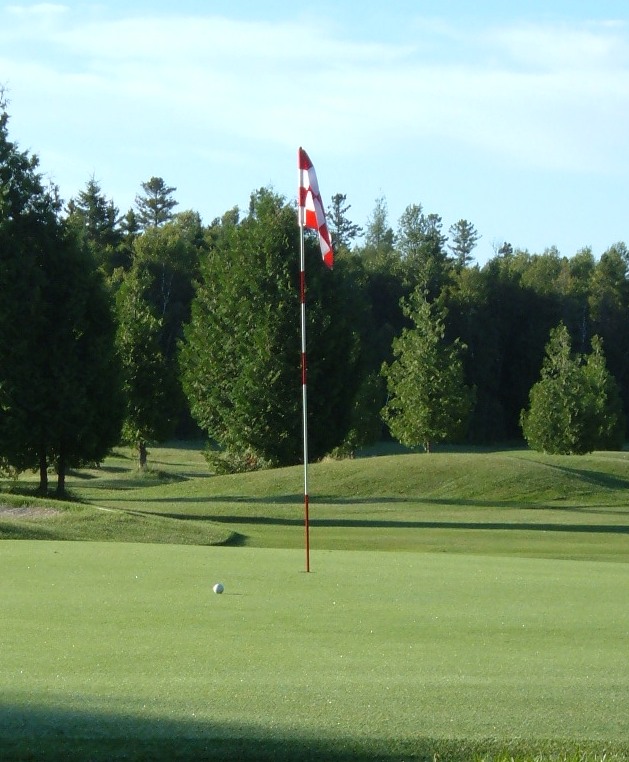
Ball Close to HoleI bet you are wondering what I mean by golfing in the off-season!  Some may think I mean taking a trip down south or some place exotic to play a few rounds of golf in the dead of winter.  Well, that is not what I mean at all.  Golfing in the off Season is not about playing golf, but preparing for next year.

At info.com, “Golfers can improve their balance and posture while increasing the strength and technicality of their golf swing” by staying active and adopting an exercise program.  They offer several exercises and programs that will help any golfer prepare for next year.

Sports Fitness Advisor suggests that “strength, power, flexibility, balance, core stability, body awareness, even endurance… they’re all physical traits that every consistent golfer (even the fair-weather players) must possess. The golf industry is littered with gadgets and gimmicks for increasing accuracy and shot distance. Yet for all their claims and guarantees most remain independently unproven.”  I believe that an overall approach to fitness will improve your game better than any piece of equipment.

Greg Norman “The Shark” says that “as you achieve higher levels of fitness, you can generate more power with less effort, thereby producing a smoother swing with greater club head speed. You will develop more force without forcing the action, which is essential for long and consistent drives.”  He also provides a program to become physically stronger  to effortlessly achieve success in all aspects of your golf game.

Ian Hardie at Golf Habits.com has identified in his article “Are you running out of steam” that most amateurs do not perform as well on the last 6 holes compared to the first 6.  I totally agree with him.  A round of golf lasts for 4 hours.  Those of us that walk and carry our clubs can attest to the fact that we get tired near the end of a round.  I suggest that success down the stretch can be attributed to your physical condition.

Golfing in the off-season is about training and preparing for next season.  I would suggest that now is the time to start.  See you in the gym!

Is There a Difference in Grips?

Recently we discussed the importance of grips.  So now what?  Which grip should I choose?  What brand?  What type?  Is there really a difference in grips?  These are all very important questions that every golfer has asked at one time or another.

Lampkin out lines why people want to regrip their clubs.  They suggest that GOLFERS TYPICALLY REGRIP FOR 4 REASONS:

  • To fit their grips to their particular hand size
  • To achieve the desired feel for their playing preference and climate conditions
  • To simply replace their favorite grips that have become worn
  • To upgrade to a more premium and longer lasting grip

How does someone determine if their grips are worn?  Lampkin gives suggestions on what are some of the tell-tale signs of wear?  These signs are:

  • Smooth, hard surfaces
  • Cracks
  • Shiny patches
  • Wear spots, especially where the thumbs make contact
  • Faded or bare spots on grips that have been painted or have logos
  • Insufficient tack

Golf Pride has great videos and tools to choose the proper grip, size and type of grip.  There are lots of tools to help determine the right grip for you; ultimately, it is a matter of what feels best.  It really is the only way to decide what will work best for your swing and intended results.

Golf.com suggests that there are three things to keep in mind when choosing a grip:  material, diameter and style.  They make an excellent suggestion to choose your favorite club and experiment by regripping and practicing with it.  This is inexpensive and will allow you to find the right grip for your game.

TourWrap_StandardBlack2G - Image from: http://www.golfpride.com/Grips/Default.aspx?cat=noncord&grip=tourwrapI have used many grips through the years.  I have used full cord, half cord, chamois,  rubber, ribbed and wrap type grips.  Presently, I use a mid-sized tour wrap golf pride grip.  I do not wear a glove and use this grip because of the feel and comfort.  The only draw back is that I should change the grips twice a year, but have resisted and only replace them once a year.

Grips are important and ensuring your equipment is in top-notched shape will go a long way to improving your overall game.  See you on the links!

Having Fun With Golf!

Golf and Coffee

Having fun with golf is the really why the game was invented.  Seeking enjoyment in any part of our lives is truly important to one’s well-being.  Many golfers find ways to enhance their time on the links but inventing new games, playing from different tees, playing in fun tournaments, and just socializing with your friends.

Golf Digest has an article with 18 different ways to have fun playing golf.  Several different authors quickly outline their views on how to spread joy in your game.  My favourite is by Stina Sternberg who suggests you throw out the score card.  It takes pressure off the player and allows them to try different shots without worrying about hurting your score.

Personally, the best way to enjoy golf is to play early in the morning, carrying a cup of coffee, and playing with a friends.  During that time, we can use a foot wedge, mulligans, and do-overs.  I also have my fail safe way of spreading joy.  The 30-second rule!

The 30 second rule can be used by anyone.  If you hit the ball off the tee – well if you miss hit the ball of the tee; run, pick up your ball and put it back on the tee within 30 seconds, the stroke does not count.  You will be surprised how happy it makes everyone.

Overall, golf is all about fun.  There are many ways to enjoy your round and using your imagination is the best way.  See you on the links!


Grips – Are They Really Important?

Image from:  http://www.pga.com/golf-equipment/golf-pride/selecting-right-golf-gripsIf you talk to any serious golfer about their grips, you will find that they believe proper grips are important to their performance.  For years I never changed my grips….I mean never.  The grips would be old, worn, dried up, and cracked.  I never thought that it was important and I changed my grips when I changed my clubs.  Man, what a mistake!

Golfsmith.com suggests that: “Independent studies show that golfers who play 18 holes per week should change their grips at least once per year. Similar studies show that golfers who have been playing with worn grips show immediate improvement in their scores after regripping – some as much as 3-4 strokes difference.”

EZ Golf Grips suggest that “Some professional golfers may regrip every month or so.  That is a little strong for us amateurs, but it points out that they recognize that any worn spots on their grips could cost a stroke…and that means a loss of cash for them.”

Golf Canada Magazine article by David Hearn stated that changing you grips every 20 rounds or so is the way to go.  Wear and tear does cause challenges in your swing.

At PGA.com, the discussion goes further from when to change your grips; to which grip to choose for which club.  It is very interesting and does open many other questions.

Ultimately the choice is yours, but I suggest that if you golf twice a week or more, changing your clubs at least once a year is important.  Besides if you do not have proper equipment, how are you going to GRIP IT AND RIP IT!

How often do you change your golf grips?