Hey Bubba, Whats Happening?

Bubba Watson won his first tournament of the 2015 PGA Golf Season. As the PGA expands it market, the HSBC Championship is the second professional event to thrill the Asian golfing fans. To add to the excitement Bubba Watson’s crazy finish on the last hole to force a playoff  with Tim Clark is something that will make the highlight reel as one of the top 10 shots of the year.

Following up his miraculous bunker shot, Watson closed out Tim Clark on the first playoff hole by sinking a long putt. His eagle on the 18th hole helped him leap-frog Rickie Fowler, Graeme McDowell and Hiroshi Iwata. In typical Bubba fashion, his flare for fantastic shots is why he is a top draw at any golfing event! Take his miracle hook shot in the 2012 Masters!

http://www.weiunderpar.com/post/aerial-map-of-bubba-watsons-mind-blowing-shot-at-the-masters

2012 Masters – Bubba Watson’s miracle hook shot!

As the golfing world continues to be enamored with Rory McIlroy, Rickie Fowler, Graeme McDowell, Jordan Spieth and Patrick Reed, Bubba Watson continues to pop up periodically to proclaim that he should not be forgotten. Ranked number 7 in the world, Bubba Watson’s consistent play is more than enough to stay atop of the golfing world for quite some time.

Creating a charity called ‘Bubba & Friends Drive to a Million’ in 2012, Watson is making a difference in his community. “PING is supporting the “Bubba & Friends Drive to a Million” by donating $300 for every drive he hits 300 yards or more (up to 300 drives) in 2012.” The total number was 37 – 300+ yard drives. Yup, 37 drives, just amazing!

Best known for his booming drives, Bubba Watson’s scramble game is often overlooked. Periodically, he displays his superpowers by seeing shots that only Seve Ballesteros, Tiger Woods and Phil Mickelson could see. He continually thrills crowds by holing out from the 200 yards, hitting his driver off the fairway, or holing out a bunker shot to force a playoff in a tournament.

Bubba Watson is a fan favorite. He continues to thrill fans with his devil-may-care approach to golf. Personally, I like watching him play, mostly because of the way he attacks the golf course. He shows no fear, at least on the surface, and maneuvers around a course like a rally racer “off-roading” their way through the back woods of Canada! Bubba Watson is fun to watch and definitely worth the price of admission.

I am a grateful golfer! See you on the links!

Picking a Golf Club to Improve Your Game

Recently, Josh from Golf is Mental commented on my blog called “Golf Technology – Helping or Hurting”; his statement really hit home for me! I have not stopped thinking about it and thought it would be a great topic to talk about.

Josh stated:

If companies started to market equipment that will help them hit “insanely” buttery chips and splashing out “ridiculous” sand shots, if they practice, I bet the average handicap might start to come down.

His point is very profound. The current trend in golf is to add distance to every club. Particularly, the driver and its many variations is catching the most attention in the media. Hitting the ball further is definitely an asset, but clubs that make “buttery chips” would possibly sell more than the driver. Or would it?

DSCF7212I have talked about hitting the ball further off the tee several times in the past, but all the articles were about technique not technology. There is no question that hitting the ball further is a tremendous asset! Watching players like Bubba Watson, Rory McIlroy, and Phil Mickelson smash the ball 270 yards with a three wood and land just off the green is amazing….not because they missed the green, but the confidence in their short game. Most of the time, they coolly walk to their ball and hit a “buttery chip” for the up and down! Is that not worth a few extra dollars if we could buy a club that could do that more often than not?

Or, is there more interest in being able to hit your 5 iron 190 yards for an approach shot? Or, hitting a 9 iron 160 yards as you go pin hunting? Or hitting the 3-hybrid 240 yards to the center of the green? Or…..I think you get my point!

Personally, I would pay extra for a wedge that would guarantee an up and down from 15 yards 6 times out of 10. If a club could be invented that would guarantee 25 yards on my irons…I would buy them! If the golf companies could offer a guarantee such that their irons would never slice….they would be in my bag. Of course we know that it would be impossible for companies to make these claims, however it is good to dream.

So here is my question, if a golf company could create that one club and guarantee its success, which club would you choose and why?

I am a grateful golfer! See you on the links!
See What I See

Before the Masters took over the golfing world, we were discussing what to look for when approaching your golf ball. This topic is much debated, but often overlooked by higher handicap players. It is important to aware of your surroundings when playing golf because it is a big part of course management.

As discussed in Seeing Whats Important and See to Believing there are many factors to consider before making any golf shot.  As a recap, this is what we identified so far:

  1. What is your yardage?
  2. What is the wind doing?
  3. How does the ground feel?
  4. Is there an elevation change between your ball and the green?
  5. What is the temperature like? Is it humid?
  6. Do you believe what you see and visualize what you want?

So far these points only account for about half of the things I look for when approaching my ball. Adjusting for these above points will help lower your score. Yet, there are still more!

Is the ball above or below your feet? After watching the Masters, it becomes very clear that a flat lie is rare in golf. It is important to understand the adjustments required when hitting from an uneven lie. If the ball is above your feet, grip down on the club a little and lean forward so your weight is in your toes.  With the ball above your feet, players have a tendency to hit left or draw the ball (for right-handed players). If the ball is below your feet, flex you knees a bit more and put your weight in your heels. Have a quieter lower body when you swing to prevent lifting up on the shot. Balls below your feet have a tendency to go right (for right-handed players)

Are you hitting uphill or downhill? When hitting the ball uphill the general rule is to take one more club to adjust for the changes in the loft of the club caused by the angle of the hill. Play the ball slightly forward in our stance. Shot it uphill have a tendency to go left or draw (for right-handed players). When hitting the downhill, the general rule is to take one less club for the same reasons and an uphill lie. Place the ball back in your stance and do not over-swing. Downhill shots have a tendency to go right or slice (for a right-handed player). Regardless if your swing is uphill or downhill, try to swing the club parallel to the slope of the hill. This will help ensure crisp contact.

This video by Ben Austin is about 7 minutes long, but worth watching to understand the challenges when hitting a ball from an uneven lie.

Did you hit the fairway or the first cut?  If you are on the fairway, congratulations! Remember the other points we discussed. If your ball is in the first cut; pay attention. Most of the time, when the ball is in the first cut it has an increased chance to be a flyer. The first cut of grass acts like a natural tee and enables most players to get a cleaner hit on the ball. As a result, the ball travels 10-15 yards further than expected. If the ball is lying in the first cut, consider going down a club to adjust for the flyer lie.

There are so many things to consider when approaching a golf ball. Many experienced players go through a checklist of things that could influence their shot. After watching Bubba Watson and Jordan Spieth approach each shot with precision, a check list of variables may be just what is needed to lower your score!

I am a grateful golfer!  See you on the links!

The Masters – What I Learned

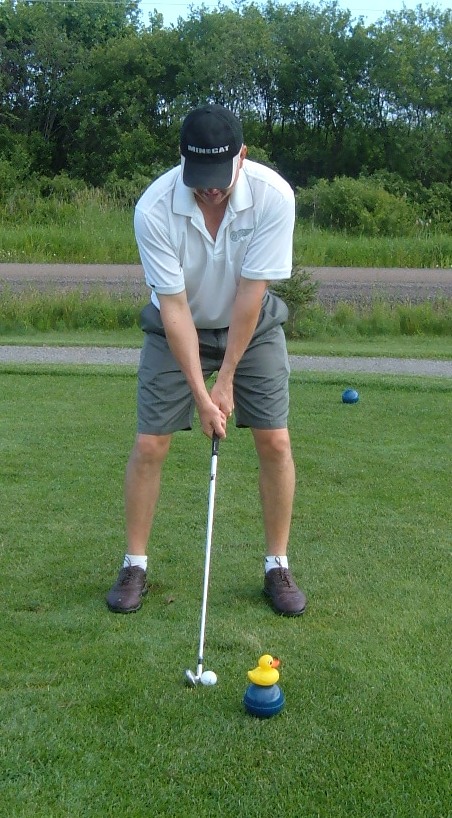
Jim with a DuckThe 2014 Masters is in the books. For golfing enthusiasts, the first Major did not disappoint. Many pundits discussed the lack of charge by the players chasing Bubba Watson, but that is a discussion for another day. Personally, I did enjoy watching the professionals navigate a difficult course under ideal weather conditions. With no flat surface on Augusta National, many of the players used unique and creative shots to try to tame the beast.

Every time I watch a professional tournament, I expect to see something that will help improve my game. Sometimes it is big changes and others times it is the finer points of how to play specific shots that catches my attention. The Masters was no different. Therefore, I thought I would share what I learned at this years Masters that will improve my game:

Course Management. I have discussed this topic before, actually three times, but the recent Masters showed me something different. Course management is about setting up the next shot and playing to the strengths of your game, however it is now important to include making up for miss hits. Many of the players were forced to change their thought process during a hole due to hitting the ball in the wrong spot. Watching the top players adjust, like Watson on the 15th hole, changed how I look at course management!

Chipping or Putting. How many times did we hear the announcers talk about chipping or putting around the green? They made it quite clear that there are two schools as seen throughout the tournament. The older and more experienced players (Couples, Jimenez, Mickelson) chipped; the younger more adventurous players (Spieth, Blixt, McIlroy) putted. This whole issue will be addressed a future blog, but personally, I lean towards chipping….but I am an older more experience player!

Length Rules. Distance off the tee has always been important. After watching many of the players on the past weekend, it reinforces the thought that length rules. Hitting it long opens so many options for a player’s next shot. Bubba Watson’s drive on the 13th hole was an eye opener. Understanding that being closer to the green on your second shot is better, it is unbelievable the difference distance makes; therefore, as my season progresses one of my goals will be to hit the ball longer off the tee.

The three points are subtle, but are important. If you have the opportunity to watch the replay of the 2014 Masters maybe you will notice aspects of golf that will help your game. Maybe you have noticed something already, if you have, share – everyone is listening.

I am a grateful golfer!  See you on the links!


The Masters – Super Sunday

mastersCongratulations to Bubba Watson for his commanding win at the 2014 Masters.  He joins an élite group of 16 other green jacket winners!

Unfortunately, unlike other golfing pundits, I would not rate this year’s final round as exciting as years past. There were no late charges, no last minute collapses, no dramatic shots from out of the cabbage (OK this one might be a stretch) or no misinterpretation of the rules!  I am sure others are going through their Rolodex of events to call me crazy, but maybe…wait, in need help, I have fallen into the Masters media hype!

All joking aside, the 2014 Masters did live up to its billing.  We were witness to many position changes, notable players missing the cut, many first-time Masters players performing very well, and many senior players standing up to be counted. All the players navigated Augusta National to the best of their abilities against a monster of a course.

Bubba Watson did exactly what any 54-hole leader should do; he shot -3 and took the green jacket.  He did not panic, made some great shots, putted well and stayed composed through his 5 hours on the links.  Augusta National tried to put pressure on Watson; however on the final day, the course was the only one.  Watson responded by making the right shot at the right time – fantastic Bubba Watson style course management!

Jordan Spieth played well. It is difficult playing in the last group of any Major. The pressure of playing in the last group on the final day of the Masters is unimaginable to an amateur. His composure is noteworthy. Unfortunately, he could not capitalize on his many opportunities to apply pressure on Watson during the back nine. Regardless, he finished tied for second (with another Masters first-timer) and will be a player to watch in the future!

Other players shot low scores on the last day, but were too far back to apply any pressure on the leaders. Players like Joost Luiten had the low round of the day of -5; Stewart Cink shot -4; Rory McIlroy and Bernhard Langer shot -3; all were great rounds and they should be commended for their performance, however it was a case of to little too late.

Overall, it was an exciting four days. This years Masters is in the books and we all look forward to next April.

I am a grateful golfer!  See you on the links!