Jumping to Confusion

Lost and Confused SignpostHave you ever walked up to your ball with a club already in your hand before you actually looked at what was going on around you? This usually happens when a player is familiar with the course and draws conclusion before their next shot. We are all guilty of it, but is it really a case of familiarity or confusion?

One of the major challenges to members of a golf course is familiarity. Many players use the same club off the same tee all the time. Next they walk to their ball with the exact distance in mind; then select their club because it is the one they always use! After shooting the same score over and over, they question what is wrong!

Complacency on the golf course is a real challenge for most players. It causes them to stop thinking and to play golf on autopilot. Playing without thinking is the root of many challenges for amateurs. Having a preset plan on each hole stagnates the development of the famous Jack Nicklaus course management, degrades the Seve Ballesteros shot ingenuity, and limits their Lee Trevino’s love of the game!

Ultimately, by jumping to confusion players limit their ability to lower their score. Fortunately, there is a fix to this quagmire – change your approach to playing your favorite course. Instead of using your driver, use your three wood off the tee. Instead of bashing the ball each time, play to your favorite distance to the green. Instead of pin hunting, shoot for the middle of the green. There are many fixes, the real approach is just deciding to make a change.

As Jack Nicklaus says: Success depends almost entirely on how effectively you learn to manage the game’s two ultimate adversaries: the course and yourself. The only thing that a player can control is themselves; so instead of jumping to confusion, try something different. Only you can decide what changes are required, but changes are required if you want to lower your score!

I am a grateful golfer! See you on the links!

Conquering Your Ego

ego2-drhannanA follow-up to my last post about ego, the email below is from my best buddy in the UK. Among other things, he and I have share the passion for golf. He moved to the UK a couple of years ago and has focused on his game. Only recently has he noticed the improvements in all areas of his game.  He is his story:

“This is an interesting dilemma for sure.  I know that I would NOT be willing to have higher scores, shorter drives etc over the short term for longer term gain.

However….

Because the course is open all year here, I made the decision in Dec to do exactly what you are talking about in the blog.  I changed grip (very difficult at first); I changed my position at address to be 3 inches off front foot for all clubs except driver (this was also difficult, however now is great); and I changed my attitude towards course management by hitting driver on all holes that were 380 plus (this proved to be the hardest thing as I hit lots of balls in unplayable areas and was forced to play 3 off the tee). Lastly, I changed my ball position while putting (this proved to improve putting numbers immediately)

Now…..

Things are great as I had the extra few months of practice to try all of these things.  It was frustrating for sure, however most of these months I was playing alone and had lots of opportunities to hit many shots without holding up others.  

Grip change has been the greatest change for me as it ensured that my hands (therefore club face) are square at impact.  I have learned that the back of my front hand is simply the club gave – where this hand points so does the club face at impact. Not many draws or hooks any more and certainly there are no slices.  Sometimes I find myself aligned incorrectly when playing other courses, however normally the ball flies on a straight path right or left and not due to hook or slice – I can accept this, however it is rare at my home course as I know where every tee box location fits my address position.

Having the few extra months has been like a 4 month practice session, however if I had the Canadian golf season, I would be reluctant to change anything – perhaps one thing of this magnitude each year.

I was scoring well at the end of the 2013 competition season and I hope the practice pays off for 2014.  First stable ford was 40 points, which grabbed me second place (31 competitors with full handicap allowance)

Looking forward to my six strokes aside so I can be competitive with you.”

What a great story! His tale is not uncommon for all golfers wanting to play better. He actually took steps, endured the frustration, and as a result is playing better. I am not sure I want to give him any strokes next time we play, but that will be negotiated at the time. I think the word sandbag may be floated around regardless of what we decide.

Interestingly, my friend said that if it was not for playing year round, he would not likely have made as many changes to be a better player. I can appreciate his point, but would counter that the process would be slower and possibly less painful. A big thank you to my buddy for sharing his story!

Conquering your ego always starts the same way….make the decision to change! The rest is just details.

I am a grateful golfer! See you on the links!
The Masters – What I Learned

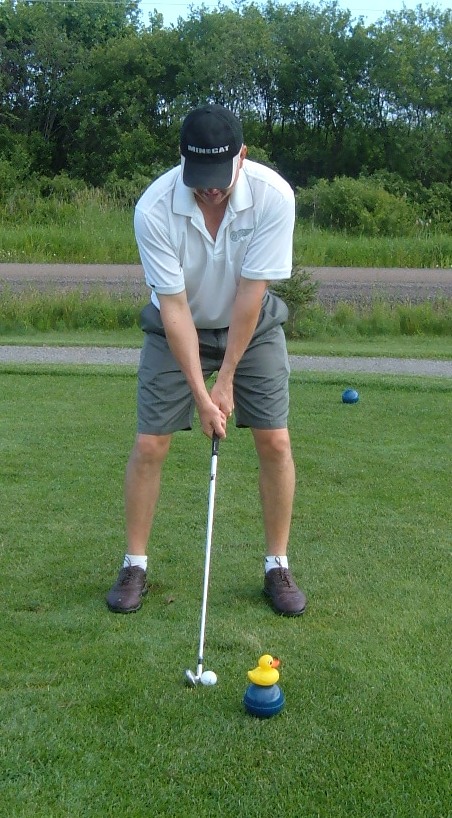
Jim with a DuckThe 2014 Masters is in the books. For golfing enthusiasts, the first Major did not disappoint. Many pundits discussed the lack of charge by the players chasing Bubba Watson, but that is a discussion for another day. Personally, I did enjoy watching the professionals navigate a difficult course under ideal weather conditions. With no flat surface on Augusta National, many of the players used unique and creative shots to try to tame the beast.

Every time I watch a professional tournament, I expect to see something that will help improve my game. Sometimes it is big changes and others times it is the finer points of how to play specific shots that catches my attention. The Masters was no different. Therefore, I thought I would share what I learned at this years Masters that will improve my game:

Course Management. I have discussed this topic before, actually three times, but the recent Masters showed me something different. Course management is about setting up the next shot and playing to the strengths of your game, however it is now important to include making up for miss hits. Many of the players were forced to change their thought process during a hole due to hitting the ball in the wrong spot. Watching the top players adjust, like Watson on the 15th hole, changed how I look at course management!

Chipping or Putting. How many times did we hear the announcers talk about chipping or putting around the green? They made it quite clear that there are two schools as seen throughout the tournament. The older and more experienced players (Couples, Jimenez, Mickelson) chipped; the younger more adventurous players (Spieth, Blixt, McIlroy) putted. This whole issue will be addressed a future blog, but personally, I lean towards chipping….but I am an older more experience player!

Length Rules. Distance off the tee has always been important. After watching many of the players on the past weekend, it reinforces the thought that length rules. Hitting it long opens so many options for a player’s next shot. Bubba Watson’s drive on the 13th hole was an eye opener. Understanding that being closer to the green on your second shot is better, it is unbelievable the difference distance makes; therefore, as my season progresses one of my goals will be to hit the ball longer off the tee.

The three points are subtle, but are important. If you have the opportunity to watch the replay of the 2014 Masters maybe you will notice aspects of golf that will help your game. Maybe you have noticed something already, if you have, share – everyone is listening.

I am a grateful golfer!  See you on the links!

 

Masters – Tough First Day

Day one of the Masters is over. All the pundits are frantically justifying why their pick is not at the top of the leaderboard. They are talking about the wind, the pressure, their starting position, nagging injuries, etc, etc, etc. The performance of any professional during the Masters will vary depending on an infinite number of reasons.  But, there was always one factor that never changes!

Before I go into the one constant of the Masters, I thought I would share some interesting highlights of the 2014 first round.  Interestingly, it was what everyone expected and it was nothing like anyone expected.  Here is what I found interesting:

Back to the original point – the one constant of all the Masters is the course!  Golf monthly has a great overview of each hole that is worth checking out. However, that is not what I noticed.

Augusta National ArchiveThe only flat section at Augusta National Golf Club is the practice area and tee boxes!

As I watched the players navigate around the course, not one of them had a flat lie. Not one!  In the fairway, the ball was above or below their feet.  The hazards on the course are sculpted perfectly. The announcers constantly talked about the quick breaks and how important it is to be on the right side of the hole! The course is a monster and course management will be the deciding factor to who wins this weekend! Augusta National Golf Course is truly a gem and the next three rounds are going to be exciting.

I am a grateful golfer!  See you on the links…..soon!

The Ability to Score

Putting to Win!Do you have the ability to score in golf?

This question has many dimensions.  Each player will have a different answer on which aspect of golf is important enough to enable them to consistently score lower.  This question has nothing to do with establishing a handicap or periodically having a great round.  No, this is not course management either; although course management is extremely important!  The question focuses on consistently identifying moments in a round where strokes can be saved.

How exactly does an amateur golfer excel at identifying these important moments?  To understand the ability to score, answer the following questions:

  • When looking at a shot from the middle of fairway, do you examine all your options?
  • When in the rough, do you look at the grain of the grass before selecting a club?
  • When just off the green, do you use different wedges depending on the slope of the green?
  • When on the tee, do you visualize how to play the entire hole?
  • When on the green, do you understand the importance of a lag putt?
  • On your approach shot, do you focus on more than just yardage before club selection?

If you answered yes to these questions, then you have the ability to score in golf.  The mental aspect of the game is equally, if not more important than being able to hit the ball a country mile.  Focused attention to the finer points of playing golf will definitely lower your score.

If you’re wondering how to gain this skill, well it starts by asking the above questions. This was not an all-inclusive list, but the start of the many finer points that élite golfers pay attention to while walking the links.

So, I ask again; Do you have the ability to score in golf?

I am a grateful golfer!  See you on the links!