A Tradition Like No Other

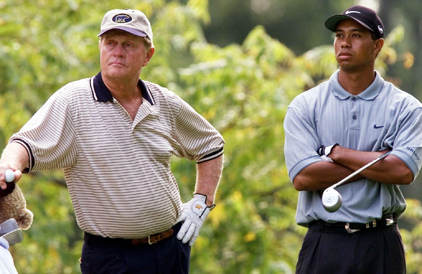
MastersWhat makes The Masters more than just a golf tournament!  Is it that Tiger Woods and Jack Nicklaus are the youngest first time and two-time champions respectively!  That Jack Nicklaus has won 6 green jackets.  That in 1935, Gene Sarazen’s double eagle on 15th hole coined “the shot heard ‘round the world”!  There are only four wire-to-wire champions. That the oldest Masters champion is golf’s great Jack Nicklaus at age 46.  Phil Mickelson’s shot from behind a tree on the 13th hole to 5 feet from the pin.  Regardless of the event, it is easy to see why this tournament captures the eye of the golfing world, as millions of viewers will be glued to the TV waiting for history to unfold!

What else makes The Masters great?

Announced on 07 April 2013, the new initiative of the Drive, Chip and Putt Championship that will conclude at Augusta National Golf Club in 2014 will that create excitement for all junior golfers.  This year-long event will provide young men and woman golfers between the ages of 7-15 an opportunity to play at one of the world’s most prestigious course.

How will the spot light shine on the 14-year-old Chinese golfing prodigy  Tianlang Guan?  He is the youngest player ever to qualify for the Masters.  This week he played with Tiger Woods, Dustin Johnson, Ben Crenshaw, and Tom Watson; what a fantastic opportunity for this young man!

The Masters has donated over 18 million dollars to the Augusta, Georgia, area!  A portion of the donation goes to charities selected by Augusta National Golf Club employees.  Talk about giving back.

The Masters Tournament captures the golfing world for 4 days like no other.  It provides hopes, dreams, heartaches, and triumphs in the space of seconds.  Competing in The Masters is a dream for many golfers.  In this year’s Masters, 6 amateurs are fulfilling their hopes and dreams.  Regardless, all players will relish in this rare opportunity and are psyched and ready to claim the green jacket.

So, who are the favorites, the dark horses or the up-and-comers ready to break out. Many websites cover such a topic and if your interested check out some of my favorites:  Lets Talk GolfAdamSarson.comGolf Dweeb, and White Dragon Golf.

Not to be left out, the following are the The Grateful Golfer’s picks for this year’s Masters:

  1. Rory McIlroy – he is the best golfer in the world regardless of the world rankings and is ready for his first Green Jacket.
  2. Phil Mickelson – you can never count out Lefty.  The Masters is a tournament made for his game.
  3. Keegan Bradley – if his putter gets hot – look out!
  4. Brent Snedeker – he has the game to challenge all pros!  A very streaky player.  Good Dark horse pick.
  5. Mike Weir – Because he is Canadian!

“A Tradition Like No Other”, coined by Jim Nantz of CBS Sports, definitely sums up all aspects of The Masters.  It is a tournament rich in tradition and is the most anticipated sporting event in the world!  Enjoy the weekend!

May I Play Through!

Ever hear the words, “Excuse me, May I Play Through!”  Most courses want foursomes to play their round in approximately 4 hours.  This is a reasonable pace and it allows everyone to enjoy his or her time on the links.  Unfortunately, this is not always possible and golf etiquette suggests that when a hole behind, either speed up or let the group behind play through.

Image from:  http://www.yourgolftravel.com/19th-hole/2013/02/08/end-of-slow-play-hurray/There are many definitions of playing through.  A reasonable definition is allowing a faster group to proceed through a slower group if the hole ahead of the slower group is open (having no golfers playing it).  The USGA suggests that it is best if the slower group invites the faster group to play through; however it is not uncommon for the faster group to politely ask the play through.

The Royal and Ancient Golf Club talks about the pace of play and how to move quicker around the links and is a very good ready, but that discussion is for another day.

How exactly does a faster group play through.  Of course, there are no written rules, but after discussion with many amateur golfers (who live this experience routinely), the following seems to be a consensus.

The first thing is to identity that your group is playing slowly and it is time to let the group behind play through.  This may seem like an obvious statement, but some amateur players, to the chagrin of those waiting, just do not get it.  I suggest your read the stories at about.com / golf about poor etiquette and slow play if you think that the first step is too obvious!

Second, once the decision is made to let them go through, which hole is best to expedite the passing.  Many players say a par 3 is best; others suggest a par 4 or 5.  I recommend a par 5 because it allows for the two groups and the groups behind to keep moving.  If a par 5 is not possible, then a par 4 is your next best option.  Lastly, a par 3.

Third, the best place is at the tee box.  While waiting for the other group to arrive, the slow group should all tee off.  Then, the fater group should tee off as well.  I know, most of you are saying that there are 8 ball is play, but not for long.

Fourth, everyone walks to his or her ball.  This is important; everyone walks to his or her ball.  The slow group will wait at their ball until the faster group hits and gets out of range.  Then the slow group will proceed as normal.  This important step is often overlooked and if not followed, usually causes congestion for the groups coming up behind.

If on a par 3 and already in play, the slow group should wave the faster group forward.  After the faster group has hit, the slow group should putt out until the faster group arrives.  Then, the slow group should stop; allow the faster group to finish.  Once finished, the slow group should finish and proceed to the next tee box.  Usually, the faster group is gone and the slow group has a very short, if any, wait on the tee box.

A couple of questions that are continually asked about lower handicappers and professionals.  If the round of golf is supposed to be 4 hours, why does it take “the good players” 5-6 hours to play around of golf?  When “the good players” are taking their time, they never seem hurried by the Marshall; why is that?  How come “the good players” are less likely to let faster amateurs play through…ego maybe?

It is important to understand the allowing faster groups to pass through is golf etiquette for everyone!  It does not mean that things have gone wrong with your game, but it does suggest that learning to play a little faster may be in your future.  Additionally, the above simple process will ensure that everyone enjoys their round of golf and within a reasonable time.

I am a grateful golfer!  See you on the links!

Managing Expectations

Managing expectations has a tremendous impact on everyone’s life.  We may not know it, but it can elicit various responses that will shape our mood, outlook, and attitude of day-to-day events.

Recently, I played in a curling fun-spiel.  It consisted of 30 teams of various skill levels.  On our team, I was the most experienced as I had curled a couple of times before.  So we set out our expectations early; contribute as much as possible and don’t get hurt!  As we played through each game, we laughed, poked fun, and made some great shots.  Our light-hearted approach landed as runner-ups to the fun-spiel champions.  We managed our expectations early and thus had a fantastic day!  Others who expected to do better have a different view of that days events.

Image from: http://en.wikipedia.org/wiki/Albert_EinsteinManaging expectations also applies in golf.  How we feel about our latest round is directly related to how we expected to play that day.  How many of us have shot 100 or 90 or 80 or 70 and felt we had a fantastic round.  We exceeded our expectations of that day and felt awesome about our golf game.  After playing well last time, we shoot the same score and walked off disappointed, frustrated and wondering what went wrong.  Most of the time, nothing went wrong, we just expected to do better!

So how can managing expectations improve our score?  I think it is important to always expect more out of our game, but as Albert Einstein defined Insanity: doing the same thing over and over again and expecting different results.  To properly manage expectations, it is important to understand your strengths and weaknesses and what we can actually achieve.  Additionally, it is important to do something by working on our putting, chipping, pitching, etc.  Then and only then can we really manage our expectations properly.  

To expect something different from your game is a good thing, but working at your game is equally important.  How do you manage your expectations?

I am a grateful golfer!  See you on the links!

What is Your Favorite Club

What is your favorite club?  You know, that one club that no matter where the ball lies, no matter what is between the ball and the hole or which way the wind is blowing you are almost assured of a great shot.  Everyone has one, but which is yours?

Cleveland Launcher 7-ironIt is important to have an answer to this question.  It is definitely a shot saver!  The old adage of “take your medicine” when you play a poor shot is really important.  Because most often you will use your favorite club to get you out of trouble. Playing many rounds of golf each year, I have found that using my favorite shot to set up my next shot or putt is vital to my success.

In my case, it is my Cleveland Launcher 7-iron.  I am so confident from 150 yards with this club, that no matter where my ball lies, I can manufacture a shot.  I feel I can hood it, punch it, chip it, loft it, or just nuke it with a high degree of success.  It really is my favorite club.

I remember breaking 70 last year at my home course where my 7-iron saved my bacon.  I was on the 9th hole and hit my ball directly behind a huge tree (that is in the middle of the fairway, but that is another discussion) 150 yards from the green  At that time, I was 1 under and feeling great about my round.  Unfortunately, I could not go over the tree, so I decided to go around it.  I hooded my 7-iron; played a low sweeping hook around the tree and rolled the ball on to the middle of the elevated green like it was nothing.  I was so confident that I could make this shot with my 7-iron I did not even hesitate.  As a result, I finished 1 under for the front and 1 under for the back (par 71 course).  It was my second best round of the year…..thank you 7-iron!

Through the years, I have played Nike, Ping, Wilson, and Spalding clubs, and regardless of the brand my 7-iron has always been my favorite club.

Everyone has a favorite club….which is yours?

I am a grateful golfer!  See you on the links!

Comparing the Old with the New

Today, an article from The Unpolished Putter caught my attention.  It originally started on the subject of the top 16 golfers in the world and who could win a match play competition between them.  I will let you to read the article called Ben Hogan – An Insight Into A Legend for the results.  But this well written article sparked an idea in my mind about the comparison of the old with the new golfers.

When comparing old to new golfers it is important to keep in mind that it cannot be a straight comparison.  There are so many variables that it is almost impossible to derive a conclusive answer.  Here are some of the aspects that need to be taken in to account when trying to determine the greatest golfer of all time:

Clubs – the technology today is far better than 50 years ago.  Although Andrew Rice suggests that the actual club makes very little difference when the “sweet spot” is hit, the “sweet spot” is considerably larger now and thus clubs are more forgiving.

Ball – The golf ball  has changed significantly over the years.  Knetgolf.com provides the history of the golf ball and its composition is outline.  Technology in this area has out distance all other areas of golf.  The golf ball has been the single greatest advantage to the modern-day golfer.

Career Longevity – How successful was the player’s career?  How long did they play?  More importantly, what was his winning percentage?  This area can be a little tricky.  Today’s upward and mobile society allows players to compete in golf tournaments all over the world.  Players can move across the country in less than a day.  This is a huge advantage over golfers even 50 years ago.  Of course players must still win, but they also have more opportunities to be successful.

Image from:  http://www.linkslifegolf.com/These are three areas that make the comparison between old and new golfers.  Regardless, players like Sam Snead, Ben Hogan, Bobby Jones, Harry Vardon, Francis Ouimet, Jack Nicklaus, Arnold Palmer, Phil Mickelson, Sir Nick Faldo, Tiger Woods are all great golfers within their own right.  Is it really possible to compare them?

On a final note, most amateurs are not really influenced by these great golfers.  They are influenced by the person who introduces them to the game, a friend, local pro, or some person they randomly meet on the course.  For me it was my Dad, he introduced me to this great game, taught me etiquette  and showed me a few tricks!  Maybe these are people are the greatest players of all time, but never won a Major!

I am a grateful golfer.  See you on the links!