2014 – A New Beginning

2014 is upon us.  My imagination is abound with the endless possibilities!

Have you ever noticed that if you look backward in time it seems to disappeared in a blink of an eye.  As you look forward, time is appears slow.  Don’t get me wrong, I like to remember the great times in the past, but looking to the future and creating each day anew is quite exciting.

As 2014 approaches it provides: an opportunity to make positive changes, an opportunity to embrace hope, and an opportunity for new beginnings.  I do not make New Year’s resolutions because I believe each day is an opportunity to make the changes we want….however, I have found that the best way to make any change lies in the decision to want to change.

As the golfing year unfolds, I have made my first step to change.  In an attempt to expand my golfing message, I have moved The Grateful Golfer Facebook Page.  If you search the same name under Facebook I am sure you you will find it   I want to use Facebook to its full capacity and under a page I was quite limited.  I am hoping this will be seamless, but as I have discovered that nothing works exactly as we hope when trying new things.

The techno challenges apply to golf as well.  As we embrace the new year, it is time to try new things; work on areas of our game that really needs fixing…..in my case a little change will go a long way.  This year, my biggest goal is to add more distance off the tee and in the fairway with my woods.  2014 is going to be a great year….it is time to start!  My first step is to expand my knowledge.  As the year unfolds, I am sure other goals will arise, for now, one major change is enough.

Thank you to everyone who continues to follow The Grateful Golfer.  I hope to continue to offer tips, advice and maybe make you laugh in the new year.

I am a grateful golfer!  2014 is a new beginning.  Happy New Year!

Golf and Darts

Golf is a game of precision, patience and skill.  It takes hours of practice, practice and more practice to be considered an outstanding player.  A golfer trying to break any number of milestones will attest that golf is not easy.

Darts, the unwitting spectator will suggest is just the opposite.  It is a game that requires little skill and can be played almost anywhere.

Interestingly, I suggest that golf and darts have many common challenges and to be skilled at both is more difficult that one may think.

Both sports require players to follow certain rules or etiquette.  In darts, no Player or Member shall act in a manner which may reasonably be considered to be prejudicial to the interests or standing of the DRA or which could reasonably be considered to injure or discredit the DRA or bring the game of darts into disrepute.  In golf, the same basic rule applies.

Golf uses cool terms like bogey, birdie, lag putt, big dog, chili dip, and shank.

Darts uses terms like Bed & Breakfast, Diddle for the Middle, Mugs Away, Robin Hood, Ton, and Sunset Strip.  

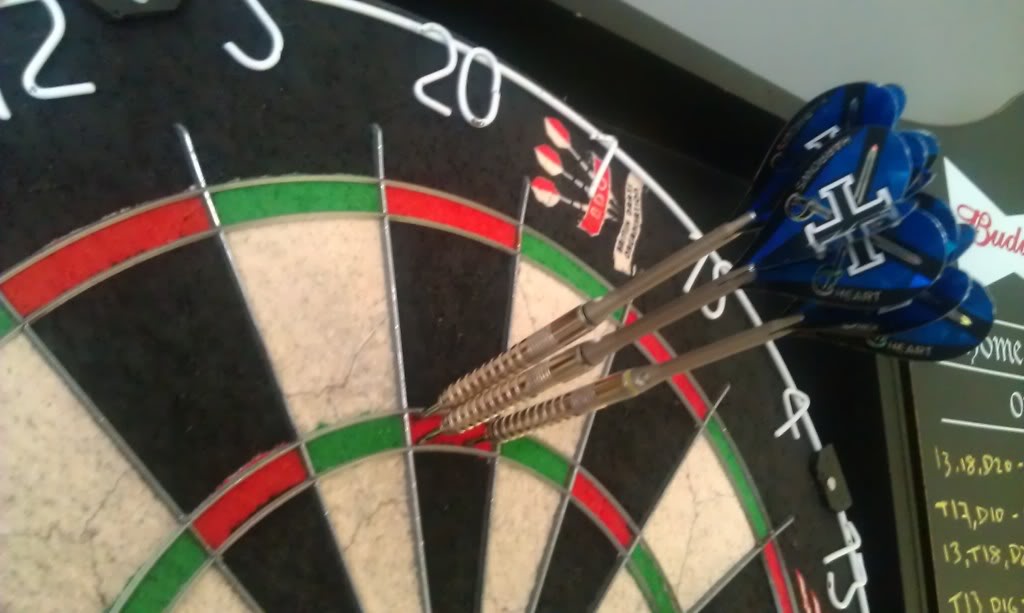
180 Darts

Score of 180

Golf is played with friends – so is darts.

Drinking while playing darts is fun for some (actually encouraged) – the same for golf.

Finally, the elusive shot in golf happens rarely (hole in one) – same for darts (score of 180 with three darts)!  Well they are extremely rare for us amateurs.

Regardless what you may think, golf and darts are just fun to play.  Both offer unique opportunities to excel and enjoy the company of other players.  My suggestion would be that if you have never played either, then give it a try!  You never know how much fun you are missing.

I am a grateful golfer!  See you on the links!

New Golf Rules

Announced today are decisions about the rules of golf for 2014 and beyond. According to the USGA and R&A, “decisions” are updated every two years and the actual Rules of Golf are updated every four years.  The ability to change the rules of golf to adapt to its evolving nature is extremely important.  Most weekend golfers are less concerned about the real rules, but if you have a wish to play in any competition, knowing or not knowing the rules will affect your score.


This year, some of the decisions address important aspects of the game and some of the more trivial areas. I will let you decide.  All decisions below taken from the tsn.ca website. The first decision deals with those who analyse video and call into the tournaments to report a rules infraction. Decision 18/4 outlines that a player will not be penalized when “enhanced technological evidence” shows that a ball moved, it will not be deemed to have moved if not “reasonably discernible to the naked eye at the time.”  The ever-increasing involvement of arm-chair golfers forced this decision.  This is a good rule, because it puts the onus on the player to be his own referee – exactly where it should be!

Storm CloudsDecision 14-3/18 allows players to use smart phones to access weather reports. The new decision also clarifies that players are permitted access to information on the threat of an approaching storm for their own safety.  This rule is more for the amateur than the professional.  Being caught many times in questionable weather that turned into a storm makes this decision a smart idea.  Actually, I did not know it was against the rules…go figure.

Decision 25-2/0.5 was revised to clarify when a golf ball is embedded. Officials have noticed an increased in tour players asking for relief, and a debate on whether the ball has broken through the soil. The revised decision will be accompanied by illustrations.  Ok, I am sure there will be many who suggest that is really not an issue, however, if you hit the ball hit like the pros and play on soft courses, embedded golf balls does pose a problem. Not 100% sure this decision will fix the issue, but time will tell.

Decision 27-2a/1.5 was revised to allow players to go forward 50 yards without losing their right to return to play a provisional ball.  Okay, I know Phil Mickelson walked 120 yards to the green, fixed the pin and almost jugged it, but really.  You know someone is going to count the steps and determine the yardage by the players gait and…..well I think you get the point!

The rules of golf are ever evolving.  It is good for the game to keep up with new technology and course design. I am not convinced that some rule changes are driven by the golfing industry, but that is a discussion for another day.  A great website on the rules of golf is found at http://www.rulesofgolf.ca/.

What do you think of the new decisions?

I am a grateful golfer!  See you on the links!

Steel Vs Graphite

As I put my clubs away for the winter, yes this is a sad day, I notice that half of my clubs have steel shafts and half are graphite.  I know from earlier research that there are benefits to both but, I could not quite remember which was which.  Therefore, after a bit of searching, this is what I came up:

Image from:  http://www.americangolf.com/blog/golf-equipment/steel-vs-graphite-shafts/

Steel shafts are:

  • heavier, therefore produce less vibration during contact;
  • generally more accurate because they have less flexibility;
  • cheaper to replace; and
  • generally have better feel when making contact.

Graphite shafts are:

  • lighter, therefore generate more club head speed – thus more distance;
  • going to last as long as steel clubs if maintained properly; and
  • transmit few vibrations to hands on miss hits.


There really is no right answer.  For those who would like a verbal explanation, the following video sums the steel vs graphite issue up quite well.

Regardless on which shaft you decide to use, it is important that you are confident with your choice.  I use graphite for my long irons (hybrids) and woods and steel for my short irons and wedges.  I find this combination provides me with maximum distance and feel to score low and have fun.

I am a grateful golfer!  See you on the links!

Reading The Signs

Reading obvious signs in life are very important!  Sometimes, it can mean the difference between life and death.  Not trying to be dramatic, in golf if can mean the difference between a good score and a great score.

Yesterday, I returned from my vacation.  It was a long drive home and we decided to leave in the middle of the night to make sure we made it back home at a reasonable time.  After about three hours into the trip, we were the first to come across a single vehicle accident. The vehicle was on its roof and the driver was thrown from the car and was lying in the middle of the road.  He was banged up pretty bad, but fortunately he was alive. (Our prayers go out to him for a quick and healthy recovery.)  Unfortunately, he was lying in the middle of the road.  It took some time, but my wife and I managed to call 911, secure the scene and get the injured person off the middle of the road.  Fortunately, everything worked out alright, but it was quite scary for a while.
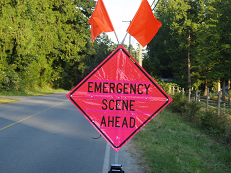
Emergency-scene-ahead-sign

Read the Sign!

During the time when the ambulance, transport safety personnel and the police arrived is the focus of this blog.  Being so dark, I had my hazard flashers on and was pulled off to the side of the road.  As the first car arrived, I stood in front of my headlights and waved like a frantic mad man.  I did not want to leave the injured guy, but he was still in the middle of the road and I was afraid the drive would not stop in time.  Fortunately, the drive saw me and slowed down enough to realize the serious and dangerous situation.  I asked him to back up and stop traffic until the ambulance arrived.  He willing helped.  After ten cars were stopped, some became impatient, regardless of the potential dangers, drove around the accident scene and left. Thanks for the help!

First on the scene, the ambulance arrived and took the guy to the hospital.  Then, more impatient people drove over broken glass, around debris, and basically ignored all the signs of danger.  Next on the scene was a highway safety guy.  He turned all his hazard lights on (this is the guys you see with the big yellow lights at highway construction sites telling us to slow down or move to a particular lane) and he put out large danger signs about 100 yards up the road.  This is when I felt the most in danger.  People were speeding up to the site and applied the brakes in the last 10 yards!  Some did not even slow down until they say the overturned vehicle, then realized it was dangerous!  A couple did slow down, and I thank them for following the hazard signs.  The high safety guy said that most people did not follow the signs and potentially increase the risk of even more injuries.  WOW, I would not have believed it, until I saw it!

A big thanks to all the emergency response people who put their lives at risk everyday! We can do our part by reading and following the signs!

So how does this scary situation apply to golf?  Great question!  There are many times golfers have great rounds going and lose focus about what is happening around them. They become so engrossed in their own shot, they forget to read the signs of possible hazards that can really affect their score.  It has happened to everyone, but the top players try to reduce impact of the hazards by remaining focused and reading the signs.

Image from: http://globalnews.ca/news/793798/life-on-the-edge-things-to-consider-if-you-live-on-a-golf-course/

Here are a few signs that most golfers should pay attention too if they want to score well:

  • Sign:  The ball flight his moving left to right or is short more than anticipated.  Tip:  Look at the tops of the trees before making a shot.  Most golfers, when playing well, have a tendency not to look up.  The movement of the leaves will show how strong the wind is blowing and in what direction.
  • Sign:  A player cannot reach the green or the risk/reward is too high.  Tip:  Selecting a club to set up your next shot is very important.  Most amateurs have a “grip it and rip it” attitude.  They hit the ball as far as possible all the time; not thinking about what distance will be left or stance they will have for the next shot.  Sometimes, it is easier to hit a bit shorter to have a better shot into the green.
  • Sign:  The pin is in a real tough position, tucked behind a bunker or very close to the edge of the green.  Tip:  The shot before your approach shot is the important stroke. This shot will allow you to set up the most advantageous angle into the green.  The proper approach angle will reduce strokes and instill confidence when hunting for pins.
  • Sign:  The greens are not rolling the same throughout your round.  Tip:  Be aware that the greens change given the time of day.  As your game progress, the speed and break of the green will change.  Early morning changes are caused by the greens drying out; late day changes are caused by the grass following the sun, thereby changing the grain of the green.

Reading the signs in life and golf will have a direct impact on the outcome.  It is important to be aware of what is happening around you and read the signs to make sure you stay ahead of any changes that could affect your golf game.  Golf is a dynamic game that always provides the signs that can result in great scores.  You just have to read and follow them.

I am a grateful golfer!  See you on the links!