Stop Breaking These Simple Rules

As an avid golfer, I think I know the rules of golf pretty well. I have read them several times through the years and have passed the level 1 rules test. I would not consider myself an expert, yet many will default to my decisions when playing. Having said this, there are seven simple rules that most of my playing partners ignore because it will make their game easier and they will incur less penalty strokes. During a friendly, I could not care less. However, during a tournament I care a great deal!

There are seven simple rules outlined by Hanna Holden that many amateurs either do not know or ignore when playing golfer. There are two specifically that I will talk about after the video because one I did not know and the other is the most common. Take a look:

The rule I did not know was repairing the line in front of your ball before the shot. Walking through the sand trap was an extreme example, however I did not know you cannot rake the sand before playing your shot. I have actually walked through a sand trap in the past, but cannot remember if I raked before or after my shot. It makes sense after I thought about it because if I missed my shot and landed in the sand trap my lie would likely be improved. So, after contemplation, I think this is a good rule.

The second rule is picking the nicest point of relief not the nearest. This happens all the time because many of my playing partners think that nicest is actually the nearest. I agree with Hanna that sometimes relief does not actually offer an opportunity to hit the ball. I have had this discussion with many players over the years while playing in a tournament. They were not happy with my interpretation, but when they asked the rules official after the tournament they found out I was correct. It did not make them any happier, but at least the stopped giving me the stink eye.

Understand the rules of golf is important. As I have stated in many other articles, knowledge of the rules will save you strokes! The will not help you create a better swing, but they will save you from compounding your mistake. Which of the seven rules above do you see broken more often than not?

I am a grateful golfer! See you on the links!
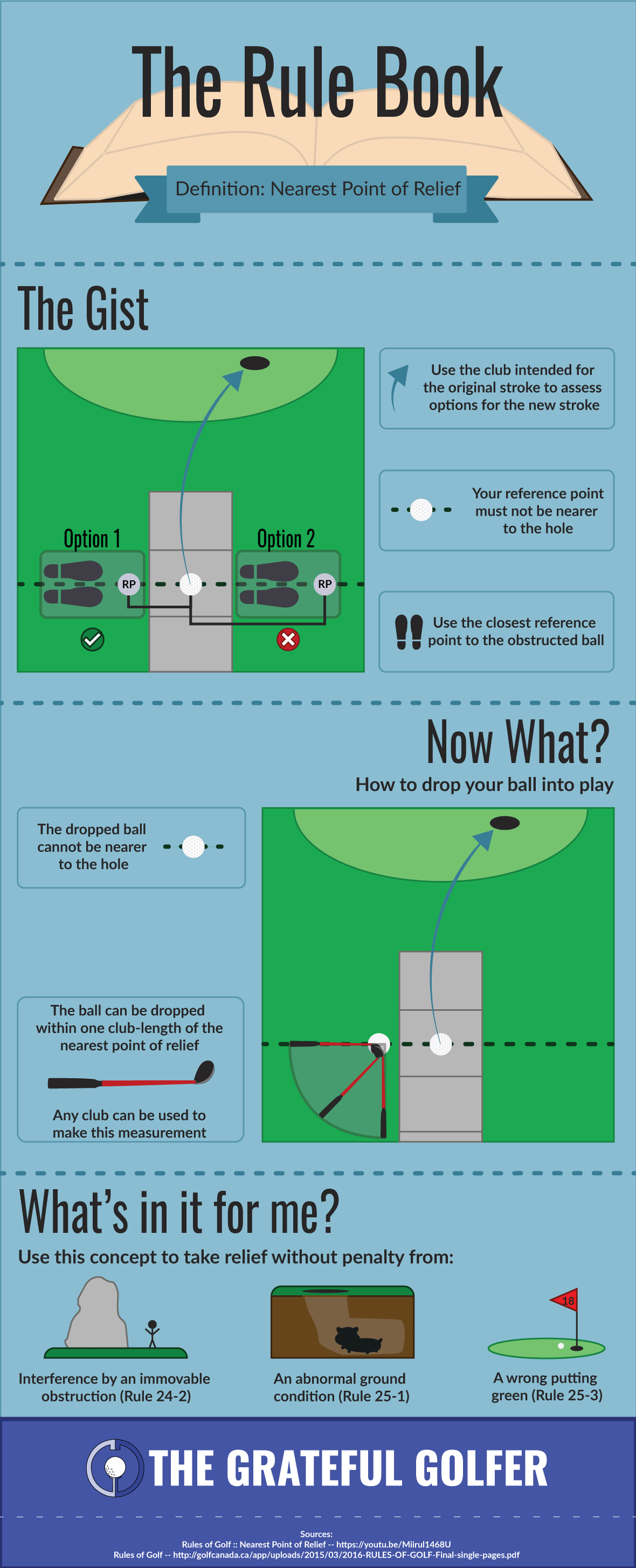
Golf Infographic: Nearest Point of Relief

One of my more popular posts explains the concept of Nearest Point of Relief. It is an important stroke saver that many players do not quite understand. Therefore, in addition to my previous post, here is an infographic that I think will help.

GG-rule-book-infographic-PONR

If you have ever played a round of golf, understanding the concept of the nearest point of relief is important!

I am a grateful golfer! See you on the links!

Golf Rules: Nearest Point of Relief

I cannot count the number of times I am asked about the rules of golf. What is really surprising is that most of those times, the requests happen during a tournament. Normally, I am not fussed about citing the rules, but when it comes to the “nearest point of relief”, I generally have to referee as well.

Most players do not mind taking relief, but they generally try to interpret the rule to gain an unfair advantage. I will always assume they are honestly misinterpreting the rule, but sometimes I am just not sure. So for those who are unsure, I thought it would be great to review this rule.

The “nearest point of relief” is the reference point for taking relief without penalty from interference by an immovable obstruction (Rule 24-2), an abnormal ground condition (Rule 25-1) or a wrong putting green (Rule 25-3).(Golf Canada)

It is the point on the course nearest to where the ball lies:

(i) that is not nearer the hole, and
(ii) where, if the ball were so positioned, no interference by the condition from which relief is sought would exist for the stroke the player would have made from the original position if the condition were not there.

Note: In order to determine the nearest point of relief accurately, the player should use the club with which he would have made his next stroke if the condition were not there to simulate the address position, direction of play and swing for such a stroke.

If you are still not sure, here is that diagram that might help.

Nearest Point of Relief

At last, I found a video that perfectly explains how to take relief:

The “nearest point of relief” is the most misunderstood rule in golf. This and all rules of golf can help or hurt your game. Understanding how to interpret rules properly will help your game and lower your scores!

I am a grateful golfer! See you on the links!

Rules of Golf – Immovable Obstructions

Knowing the rules of golf are important for any player who has aspirations of being a better golfer. The rules, especially in competition, can work to advantage or against your understanding of how to apply the rules is fuzzy. I read the rules yearly and I am often asked for an interpretation when an unusual situation arises.

On the fence at Black Bear Ridge Golf Course.

On the fence at Black Bear Ridge Golf Course.

While playing at Black Bear Ridge Golf Club last year, my friend Jean hit his ball into the woods. The woods were to the left and not near the boundary of the golf course. As you can see, the woods were pretty open, but the fence was perpendicular to the fairway! This was an old fence, but there were no makings suggesting it was a hazard or ground under repair.

If you look closely, Jean is pointing at his ball that came to rest on the bottom rail of the fence. We search for quite a while and finally we were able to find it in this odd position. The question that came up was, “Now what?”

Under Rule 24-1 – Immovable Obstructions, our interpretation was that the fence should not have been there or be considered a hazard. It is man-made and be classed as a building or a sign post. The exact rule reads as follows:

An immovable obstruction is an artificial object on the course that cannot be
moved (e.g., a building) or cannot readily be moved (e.g., a firmly embedded
direction post). Objects defining out-of-bounds are not treated as obstructions.
An abnormal ground condition is casual water, ground under repair or a
hole, cast or runway made by a burrowing animal, a reptile or a bird.
Except when the ball is in a water hazard, relief without penalty is available from
immovable obstructions and abnormal ground conditions when the condition
physically interferes with the lie of the ball, your stance or your swing. You
may lift the ball and drop it within one club-length of the nearest point of relief
(see Definition of “Nearest Point of Relief”), but not nearer the hole than the
nearest point of relief (see diagram below). If the ball is on the putting green, it
is placed at the nearest point of relief, which may be off the putting green.

Determining Jean was entitled to a free drop was the easy part. The next question was where should he take his full relief. Following the fence, the nearest point of relief was at the edge of the woods almost in the rough! This drop location was of great benefit because he now had a shot at the green.

Yes, this does sound strange, but we also had to consider the definition of ‘nearest point of relief’. Basically, without going into a long explanation, the immoveable obstruction must not impede the player after they take relief.

In this unique situation, we had to follow the fence to the end, establish his relief position, and then allow his one club length no closer to the hole! If we went in the other direction, the nearest point of relief would have been farther than the direction we chose.

In this case, knowing the rules was very beneficial for Jean. Of course, his playing partners had to agree and this is what we decided.

What do you think? Did we make the right call according to the rules?

I am a grateful golfer! See you on the links!