Keeping Your Composure!

Young DeerKeeping your composure when the wheels fall off is the most difficult skill in golf.  All of us have played the front nine as if we were pros.  We start to count things up, figure that we are going to set a personal recorded…..the poof, our game comes crashing to earth.

I am sure many of you are thinking….yeah too many times.  So how does an amateur keep their composure when things are falling apart.  This does not mean showing zero emotion like Jason Dufner;  it means keeping calm like Rory Mcilroy during the 2011 Masters.  Staying focused when the whole world is falling down around you.  So what to do?

The great Bobby Jones referred to composure when he said that “Competitive golf is played mainly on a five-and-a-half-inch course, the space between your ears.”  I have read many different methods to keep your composure and I have my several techniques.

One technique is to laugh and smile at my silly shot.  I do not hop around like a fool, but smile to myself and give a little chuckle.  I find that I remain calm and I can easily refocus and prepare for my next shot.

Another technique is to say my name to myself like I am correcting something.  It is sharp, quick and allows me to move on without carrying pent up emotions.

Lastly, I walk to my ball, look around at the beautiful surroundings, the sun shining, the birds singing, the gratitude of being able to play golf in an awesome country….I feel calm already.  I guess you get my point.

The one thing in common with all three techniques is they quickly eliminate the negative focus of making a bad shot and focuses on the positive aspect of playing the game.  Golf is meant to challenge your inner sportsman and remaining calm and enjoying your time on the links will only enhance your inner pro.  I am a grateful golfer;  see you on the links!
Course Management – Not Just for Pros

I was reading a blog by Ian Hardie at GolfHabits.com on a chance to look into the future.  He outlines a way to know where the pins are located on the holes soon to play.  It is brilliant and will definitely lower your score.  His blog makes me think of how anyone can use course management to navigate your way around the links.  As a grateful golfer, I appreciate any advice I can get to improve my score.

I believe that everyone should think about how they are going to play their next round.  How many of us play 30-40 rounds on the same course; play it exactly the same way every time; with the same results.  We all know Albert Einstein’s definition of insanity:  doing the same thing over and over and expecting different results.  Maybe it is time to think about the percentages and try something different.

If you Google course management, you will find many suggestions on how to effectively play your round and lower your score.  Not to be out done, I have a couple of suggestions as well.

As per my earlier post, I believe that greens in regulation is the most important stat.  To achieve this try the following:  First, determine your most dependable and favorite club to hit into the green in regulation.  Second, and if possible, hit off the tee to the distance that allows you to hit your most dependable club.  If that means hitting a 3 iron (hybrid) off the tee; then try it.  On a par 5, do not bash your second shot as far as you can, hit a club that puts you at the right distance.  They use your favorite club, put it on the green and lower your score.

Try using a 7 iron off the tee for the entire round.  It will change your perspective on the course and it forces you to think of a different way to play the round.  It may not lower your score, but it will change the way you think.  As Vincent Peale says:  Change your thoughts and you change your world.

Lastly, play off a different tee.  If you always play the whites, blues, reds or golds, try playing of a different set.  You will be forced to think of new ways to play your favorite course.  It will not hurt your handicap, long-term score or your ego!  I have found that by playing a different set of tees allows me to think instead of just hitting the same club all the time and hoping I eventually lower my score.

Course management is very important.  It is for everyone and will help you lower your score.  What do you think?  Is it really worth trying a new way to play the same course to improve your score?

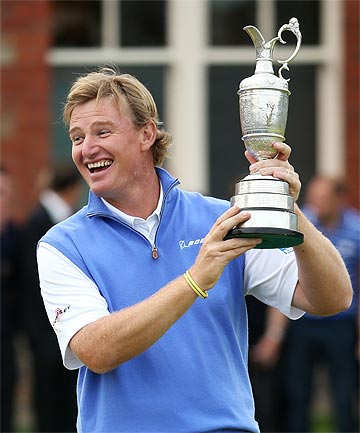
How Did Ernie Els Win the British Open?

Ernie Els image from http://static.stuff.co.nz/1342983795/482/7328482.jpgWhat a fantastic finish to the British Open!  I found it quite interesting as I watched Ernie Els coolly play the final 6 holes in heroic fashion.  He did not play tight, conservative or out of control.  The final putt on the 18th hole was clutch and I was very happy that one of my favorites played well done the stretch.  But how did Ernie Els really win the British Open?

Was it that all the players trying to catch Adam Scott did not execute according to their game plan?  Did Adam Scott figure he had the tournament all wrapped up on the 14th hole?  I would suggest that neither of these situations are the answer.  It was greens in regulation that won the tournament.

For the first time in tournament history someone outside the top 20 in putting for the tournament won.  This is an amazing stat for sure.  Ernie Els was number one in greens in regulation for the tournament, which proved to be the decisive advantage the other players could not match.  Many would say, so what?  It is only a stat.  “Ernie Els is leading the field in greens in regulation, not so much on the greens,” Strange said. “None of the last 11 winners of this tournament have finished outside of the top 20 in total putts. Ernie ranks 75th currently in putts.”

Well let me put it another way; how low would your score be if you were putting for birdie 75% of the time during your round of golf.  That means that on 14 holes you are putting to lower your overall score to par!  I would take that every round.  There are many stats in golf and one could argue that greens in regulation is not as important as say putting; however, Ernie Els proved that maybe it is.

My question to you is what is the most important stat?  I would be interested to hear what you have to think!

Preparing for Tournament Play

I have just returned from a 54 hole regional tournament.  It was fantastic and I thoroughly enjoyed my time on the links.  Unfortunately, I did not qualify for the national tournament, but maybe next year!

During my time at the Garrison Golf and Curling Club, I had time to think and wonder why I was not performing to my expectations.  I wondered if I practiced my chipping and putting enough; did I play in enough tough conditions; was a physically fit; or did I mentally prepare properly?  After much debate, I determined that my mental preparation was lacking.

I believe that pre-tournament preparation is as important, if not more important, than our physical preparation.  Obviously, the physical preparation includes chipping, putting, hitting balls, and playing rule enforced rounds of golf.  However, the most overlooked aspect of tournament preparation is the mental game.

At the Mental Game of Golf, it outlines many aspects that are very important to success on the links.  They state in their blog on the mental game three aspects that I agree with to significantly improve your performance during a competition.  They are: establish your rhythm, mentally preview your round, and have a game plan.  These are three aspects of the game I have used for years and believe they significantly improve performance.  Playing during the tournament I realized I was not as prepared as I could have been; well next year I will be ready!  I am a grateful golfer!

Golf is both a physically and mentally demanding game.  A mentally strong player will be able to navigate the course easier and with more precision.  There is no doubt in my mind that proper preparation will help everyone meet their expectations.

How do you prepare for tournaments?