Ground Under Repair – Rule 25

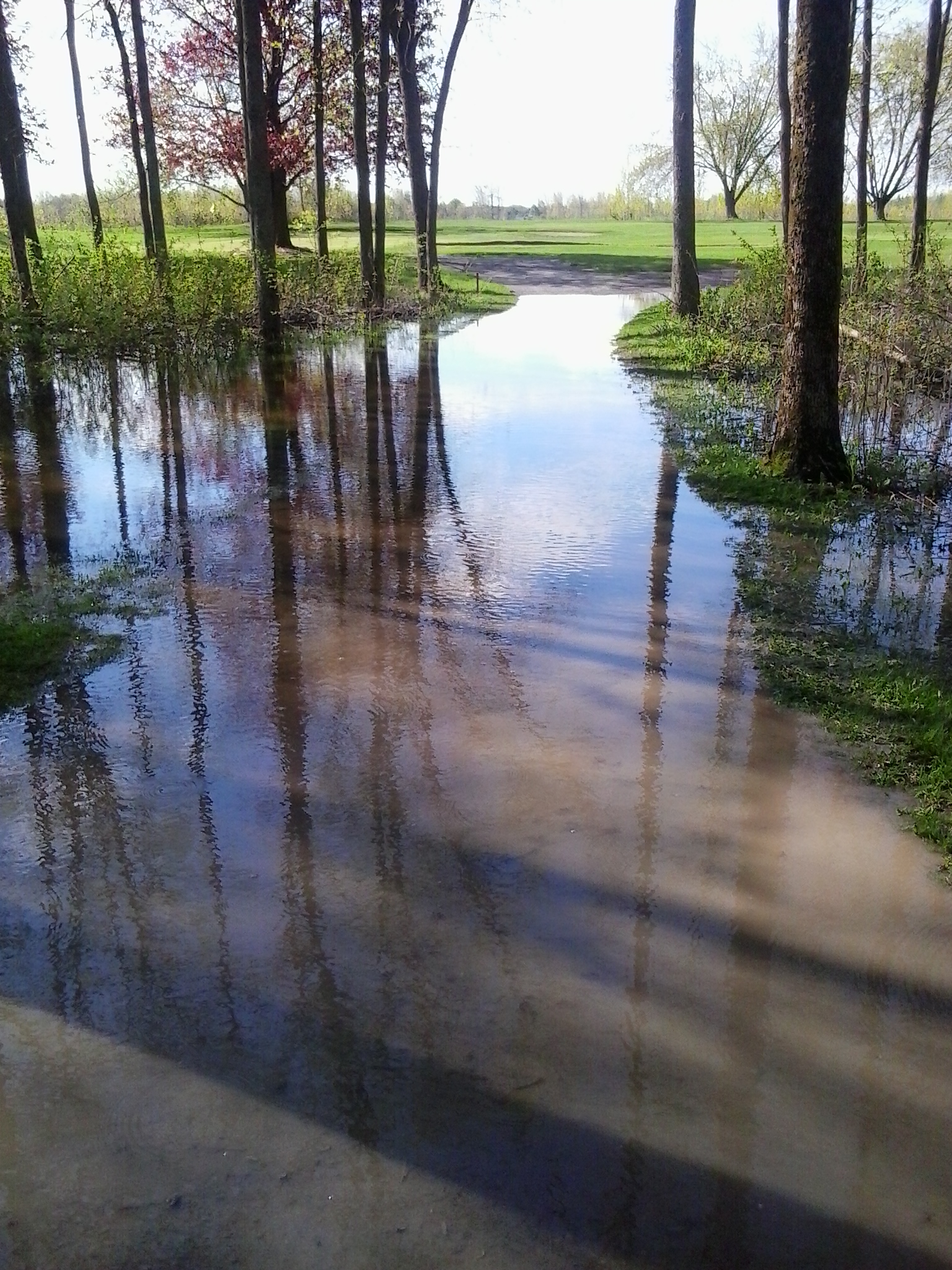
Down the left side of the fairway on the fifth hole of our course, a large areas is marked as ground under repair. Due to storms late last year and the lack of time to clean up the mess, our managing committee has declared this area as Ground Under Repair. It is a well know local rule and the area is marked by a white line.
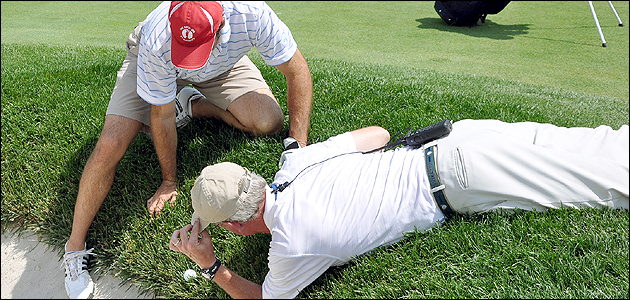
rules_official_new_webRecently, I was playing a round of golf with my usual friends and one of us hit their ball into this area. We searched and searched, but we did not find the ball. As the default rule guy, they asked me for a ruling. I stated that since we did not find the ball, it had to be declared lost, and he had to go back to the tee to rehit.

Well, I started thinking and after a bit of research, I found out that I was wrong.

According for Rule 25-1c, my friend was able to take a free drop, without penalty. Here is how the rule reads:

Ball in Abnormal Ground Condition Not Found
It is a question of fact whether a ball that has not been found after having
been struck toward an abnormal ground condition is in such a condition. In
order to apply this Rule, it must be known or virtually certain that the ball
is in the abnormal ground condition. In the absence of such knowledge or
certainty, the player must proceed under Rule 27-1.

If it is known or virtually certain that a ball that has not been found is in an
abnormal ground condition, the player may take relief under this Rule. If he
elects to do so, the spot where the ball last crossed the outermost limits of
the abnormal ground condition must be determined and, for the purpose of
applying this Rule, the ball is deemed to lie at this spot and the player must
proceed as follows:

(i)  Through the Green: If the ball last crossed the outermost limits of the
abnormal ground condition at a spot through the green, the player may
substitute another ball, without penalty, and take relief as prescribed in
Rule 25-1b(i).

(ii)  In a Bunker: If the ball last crossed the outermost limits of the abnormal
ground condition at a spot in a bunker, the player may substitute another
ball, without penalty, and take relief as prescribed in Rule 25-1b(ii).
(iii) In a Water Hazard (including a Lateral Water Hazard): If the ball last
crossed the outermost limits of the abnormal ground condition at a spot
in a water hazard, the player is not entitled to relief without penalty. The
player must proceed under Rule 26-1.

(iv)  On the Putting Green: If the ball last crossed the outermost limits of the
abnormal ground condition at a spot on the putting green, the player may
substitute another ball, without penalty, and take relief as prescribed in
Rule 25-1b(iii)

Basically, not remembering and my playing partner not knowing the rules cost him 2 stokes. I will rectify this error this morning as we play our weekly round. With an important tournament approaching, I will have to reread the rules and make sure I am aware of all their nuances.

Rules are important in golf. They even the playing field, only if players actually know them. Have you read the rule so of golf lately? If so, how long ago?

I am a grateful golfer! See you on the links!

Water in the Bunker! Really?

The rules of golf are sometimes strange and difficult to understand. They seem written by someone who takes pleasure in trying to stump the average golfer with language and interpretations that just do not make any sense. Last year while competing at the Ontario Military Regional Golf Tournament, one particular rule actually changed the score of many of the competitors.

Storming at Garrison Golf CourseOn day one, torrential rains soaked the Garrison Golf and Curling Club in Kingston, Ontario, Canada, for four hours making it almost unplayable. After a further delay of two hours, the officials decided we could start our competition with some local rules.

The first was lift clean and place ‘through the greens’. “Through the green’’ is the whole area of the course except: for the teeing ground and putting green of the hole being played and all hazards on the course. So basically anywhere on the course, even the woods!

The second and more important rule change was that all bunkers were out of play. If your ball landed in the bunker, the player could remove the ball and keeping the point of where the ball came to rest in line with the pin, go back as far as they wanted. After discussion with the players after the round, this was a very popular decision.

The second day was slightly different. Although the course was still extremely wet, the rules officials did not invoke any local rules and the decision was made to play the ball where it lies. This is where knowing the rules was very important!

Many of the bunkers still had water in them from the previous day. Some were still completely filled. Many of the players were dismayed with the decision to keep the bunkers in play and no less than three players had to take a one stroke penalty for an unplayable lie within the bunker.

Water In the Bunker

Water in the Bunker! Now What?

But wait you say! If the ball is in the bunker underwater, would that not be considered casual water? The answer is yes! It is considered casual water and in this case falls under rule 25-1 Abnormal Ground Conditions. Under the relief part of this rule, the interpretation is:

(ii)  In a Bunker: If the ball is in a bunker, the player must lift the ball and drop it either:

(a) Without penalty, in accordance with Clause (i) above, except that the nearest point of relief must be in the bunker and the ball must be dropped in the bunker or, if complete relief is impossible, as near as possible to the spot where the ball lay, but not nearer the hole, on a part of the course in the bunker that affords maximum available relief from the condition; or
(b)  Under penalty of one stroke, outside the bunker keeping the point where the ball lay directly between the hole and the spot on which the ball is dropped, with no limit to how far behind the bunker the ball may be dropped.

I had to use this rule once during the competition and fortunately I was able to drop the ball in the bunker without a penalty stroke. Many of the players complained about the different rules they had to use during the first two days of the tournament and the most popular was rule 25-1. In the clubhouse after each round, I was amused by the many discussions starting with the question, “What about….”

Know the rules in golf is very important. They are meant to even the playing field, but only if you understand what they mean. As a player with over 35 years experience, I reread the rules at the beginning of every season. I helps remind me of the subtle nuances of golf. I also enjoy talking about the rules and hearing the different interpretation from other players, it only makes me smarter about the game I love to play.

I am a grateful golfer! See you on the links!

Casual Water?

Before I delve deeper into my article, I want to send a huge shout out to the Roundel Glen Golf Course staff for managing the flood conditions and keeping the course open today. We are all grateful for your efforts!

Today Rule 25-1 was without doubt the most important rule while on the links today. Before outlining the effects of this rule on today’s round, it is important to understand what it means. Golf Canada states that “Abnormal Ground Conditions – An “abnormal ground condition” is any casual water, ground under repair or hole, cast or runway on the course made by a burrowing animal, a reptile or a bird.” “Casual water’’ is any temporary accumulation of water on the course that is not in a water hazard and is visible before or after the player takes his stance. Snow and natural ice, other than frost, are either casual water or loose impediments, at the option of the player. Manufactured ice is an obstruction.
Dew and frost are not casual water. A ball is in casual water when it lies in or any part of it touches the casual water. Okay, I think you get my point.

IMG_20140517_074007

Fourth hole, looking back to the tee. Three wood off the tee clears the water. Normally this area has no water at all!

Roundel Glen experienced flooding from three days of hard rain. Over 20% of the course was under water and an additional 30% was extremely soggy. The amount of water on the course almost made it unplayable. However, that was not the case and I am grateful to have hit the links today.

IMG_20140517_091547

Walking between the 12th and 13th hole!

The water posed many challenges. There was no extra roll on any shots (so most of us were 20 yards shorter off the tee!), all approach shots were from soggy ground which resulted in deep divots, and the ball plugged on most shots. Lift, clean, and place was definitely an asset today.

Rule 25-1 allowed us to move the ball to dry-ish ground. Sometimes the nearest point of relief was 30 yards from where the ball came to rest. The difficulty, in some cases, was to find relief without going closer to the hole. Regardless, we were able to find relief and play a great round.

A couple other challenges  included the temperature at tee off time. It was a nippy 6 degrees Celsius (43 degrees F). It did warm up on the back nine, but four layers of clothing was required initially. The cold weather turned our golf balls to rocks so carry was a challenge. Finally, it took longer to loosen up during the round than normal! Overall, many difficulties were faced today, but regardless of their impact on our games, we had a great time and are looking forward to playing again on Sunday!

IMG_20140517_082721A couple highlights: On the 7th hole, I found myself behind a tree. It was the most interesting shot of the day. Keeping in mind that the tree was directly in front of my ball, I also had to consider the soft ground, wet soggy landing area, and a quick sloping green. Drawing my 7 iron, I kept the ball low and did not worry about the pin (which was behind the tree). After two hops, my ball landed on the green and rolled 10 feet past the pin. Unfortunately, I missed my par putt, but was happy to walk away with a bogey.

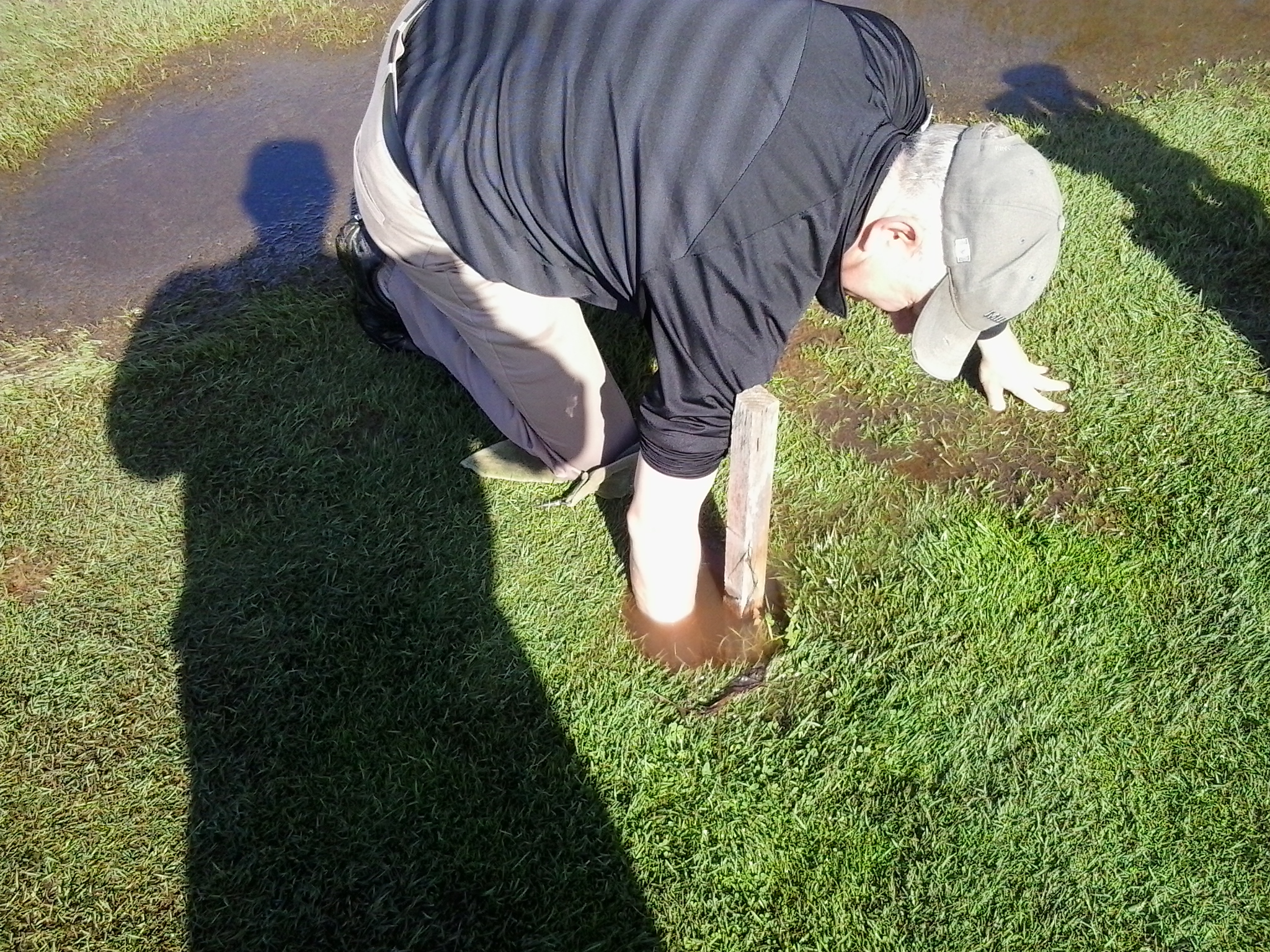
IMG_20140517_085818Another interesting thing about my round happened on the 11th hole. Teeing off, I was quite happy to see the ball head towards the center of the green. Walking up to where my ball landed, I was confused not to see it on the short grass. After about a minute, one of the grounds keepers came over and said that my ball landed about 5 yards short of the post, skipped once, hit the post and fell into the water. Slightly dismayed, I stuck my arm in the hole to retrieve my ball. Thinking it was only a couple of inches deep, I quickly found out something different! I would never have found my ball without the help of the greens keeper.  Thanks Buddy, I appreciate the help!

Rule 25-1 was a major player in today’s round and despite the wet conditions, I had a great time today! The company was awesome; the wet adventure fun; and I learned many things that will help in the future!

I am a grateful golfer! See you on the links!


Failing to Succeed

Failing to succeed is a reoccurring theme in my life recently! Driving to work everyday, I listen to self-help, novels, or how to books on CD. I find that this helps pass my 20 minute journey each morning and evening. The CD I was listening to over the past couple days is from Success Magazine. There were five stories that dealt with failure and how it ultimately leads to success in life. As I listened, it hit me that their message was exactly the same as anyone trying to lower their golf score!

Slide1

How many times has a player practiced the same chip shot from 10 yards off the green; each time, they make a minor adjustment until they are confident in the shot. How often have we gone to the range and hit ball after ball until we felt comfortable? How many rounds of golf have we played only to see slow glacier-like improvement in our scores? Each time we play the failures are actually lessons for success.

This is exactly the message from the speakers on the CD. They stated: “fail often, fail fast, and fail big”! There is truth to their statement, but I would also add – and learn from your failures. It is important that golfers do pay attention to the many aspects of their game. Try to emulate the successes and always be open to learn.

Last night I played my first nine holes of golf for the year! It was very exciting and rule 25-1 was my best friend (casual water). The course was extremely soggy and it was difficult to find dry land on some of the shots. As I continued to play, I quickly realized that taking a divot was a real bad idea! My wedge was more like a shovel and my divots were more like patches of sod. Each swing taught me that I should be picking the ball instead of hitting through it. So after the third hole, I stopped taking a divot and my success rate went up significantly. This small example shows that failure is not necessarily a bad thing as long as we take away a positive lesson.

So as the season unfolds, I hope to fail early, learn, and be successful when it counts! Have you had repeated failures only to conquer a skill? If so, what was it?

Golf season is here and I am a grateful golfer! See you on the links!