Picking a Golf Club to Improve Your Game

Recently, Josh from Golf is Mental commented on my blog called “Golf Technology – Helping or Hurting”; his statement really hit home for me! I have not stopped thinking about it and thought it would be a great topic to talk about.

Josh stated:

If companies started to market equipment that will help them hit “insanely” buttery chips and splashing out “ridiculous” sand shots, if they practice, I bet the average handicap might start to come down.

His point is very profound. The current trend in golf is to add distance to every club. Particularly, the driver and its many variations is catching the most attention in the media. Hitting the ball further is definitely an asset, but clubs that make “buttery chips” would possibly sell more than the driver. Or would it?

DSCF7212I have talked about hitting the ball further off the tee several times in the past, but all the articles were about technique not technology. There is no question that hitting the ball further is a tremendous asset! Watching players like Bubba Watson, Rory McIlroy, and Phil Mickelson smash the ball 270 yards with a three wood and land just off the green is amazing….not because they missed the green, but the confidence in their short game. Most of the time, they coolly walk to their ball and hit a “buttery chip” for the up and down! Is that not worth a few extra dollars if we could buy a club that could do that more often than not?

Or, is there more interest in being able to hit your 5 iron 190 yards for an approach shot? Or, hitting a 9 iron 160 yards as you go pin hunting? Or hitting the 3-hybrid 240 yards to the center of the green? Or…..I think you get my point!

Personally, I would pay extra for a wedge that would guarantee an up and down from 15 yards 6 times out of 10. If a club could be invented that would guarantee 25 yards on my irons…I would buy them! If the golf companies could offer a guarantee such that their irons would never slice….they would be in my bag. Of course we know that it would be impossible for companies to make these claims, however it is good to dream.

So here is my question, if a golf company could create that one club and guarantee its success, which club would you choose and why?

I am a grateful golfer! See you on the links!
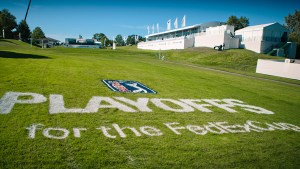
The FedEx Cup

The FedEx Cup - a race for 10 million dollars!

The FedEx Cup – a race for 10 million dollars!

The race for 10 million dollars is on! The final tournament, Wyndham Championship, concluded today and set the stage for the four-tournament playoff  that will crown the FedEx Cup champion. This elimination style competition starts with The Barclay’s on Thursday.

For the first time in 2013-14, the PGA TOUR embarks on a wraparound schedule that bridges two years with a total of 45 events played over 43 weeks. The PGA TOUR season is divided into two segments – the FedExCup Season (41 events) and the FedExCup Playoffs (4 events) – played over 43 weeks.

The FedExCup Playoffs once again features four events, starting with The Barclays (Aug. 21-24) at Ridgewood Country Club in Paramus, N.J., onto the Deutsche Bank Championship (August 29-Sept. 1) at TPC Boston and BMW Championship (Sept. 4-7) at Cherry Hills Country Club outside Denver, before concluding at the TOUR Championship by Coca-Cola at East Lake Golf Club in Atlanta. (FedEx Cup)

The FedEx Cup is an interesting golf competition because of the “play well – move on” format. At the Barclays, all 125 players will start, but only 100 players will move on to the next event at the Deutsche Bank Championship. The third week at the BMW championship will only have 70 players competing; then at the TOUR Championship, 30 players will be left to vie for the 10 million dollar grand prize.

I have talked about the FedEx Cup before and my view still stands. The FedEx Cup needs to create more excitement! I thought I would share my thoughts from before when I compared the FedEx Cup with the World Cup of Soccer:

Limiting the FedEx Cup field through the final four tournaments is definitely a must!  It does provide a level of excitement that peaks the interest of most sports enthusiasts.  However, this is where real excitement for sports fans fades. The current FedEx Cup format does produce a strong field, but unfortunately the format only ensures the big names in golf make it to the finals. There is no real “David and Goliath” excitement; the underdog remains under; and there is no last-minute heroic sand shot remembered for 60 years!  The FedEx Cup playoffs is like watching the same group of players week- in and week-out win large purses without any real excitement.  6 of the top 10 ranked players in the FedEx Cup are also in the top 10 in the world!  It is somewhat exciting for true golfing fans, but the current format does not generate the enthusiasm of a World Cup event.

The FedExCup should take a page from the World Cup.  Have all the qualifying tournaments to set up the 125-man field for the playoffs.  Then, have all the players start with zero points and let the chips fall where they may.  Lose and go home!

Adopt the World Cup way.  Once the playoffs start, everything should be performance based.  If a pro plays well, they make it to the next stage.  If not, better luck next year.  Regardless of their world ranking, it allows the 125th ranked player the opportunity to reach out and rip the title out of the hands of the giant.

This format will make for great golf!  It will elevate the FedEx Cup to the ranks of a must see sporting event! All sport nuts remember the huge upset, but rarely remember the team that should have won. Creating excitement on any playing field is really what fans want!

This sums up my thoughts on the FedEx Cup. It is great to watch some fantastic golf, however I would like to see more excitement in the event.

What do you think? Could the format change to create more excitement for sports fans?

I am a grateful golfer! See you on the links!


Golf Technology – Helping or Hurting

Golfplan International Golf Insurance asks a very interesting question: “What has been the best technology advancement, and what has been the worst in the game in the last 10 years?” They want to know what drives the golf industry and what slows it down. After some considerable thought, discussion, and research, here is what I believe are the best and worst advancements in golf over the past 10 years.

Best Technology Advancement: Distance Finding Devices

Garmin_Approach_G6_M_1

The introduction of GPS distance finding devices to golf are shaping its future!

Not really new to golf, distance finding devices have grown in popularity in the past 10 years. The use of a distance finding device was adopted by the USGA in 2006. Since that time, popularity has grown exponentially. The most popular are the laser range finders because they provide exact line-of-sight measurement. In the past 5 years, the GPS devices such as the GARMIN Approach 6 have started to be “must have” equipment. As technology continues to grow in this area, smart phones, watches, and devices that voice the distance are becoming even more common place. As long as the device does not provide course conditions such as wind and elevation changes, it is legal for use in a tournament.

Distance finding devices are good for golf. They help all golfers, regardless of skill level, with course management, speed of play, and club selection. Of the two categories of devices, the GPS gets my vote as the better of the two. It provides accurate distances on blind shots, significantly helps when playing a course for the first time, and can measure the distance from one point to another. Overall, GPS devices are the way of the future.

Worst Technology Advancement: Innovation

Innovation is an overly used word. It is defined as the act of innovating; introduction of new things or methods. There is no question that golf paradigm shifts have occurred due to innovation. The innovation of steel (then graphite) shafts, metal heads, golf ball design, etc. are innovative changes that have actually shaped the golfing industry. Today, innovation is the most overused word in golf.

When a major manufacturer makes a minor change (which they try to pass off as a technological change) to their club – it is called innovative. New innovative ways to swing a club, lower your score, or fix your golfing woes pop up everyday and disappear just as quick. Even if someone wanted to keep up with all the “so called innovative changes” they could not….unless they were extremely rich and had unlimited time.

It is perfectly understandable that manufacturers continue to try and develop the best equipment for the average golfer, however it is unlikely that new innovative equipment can be developed every six months that will dramatically change the face of golf. The cost of buying new innovative equipment, in my opinion, is hurting the golf industry! There is a point where feeling the need to purchase new equipment will scare off new players, due to the costs involved; the difficulty is determining what that cost is!

What is considered the best and worst advancements in golf in the past 10 years, varies from person to person. It is challenging to pinpoint which are the best and the worst. For me, the best is distance finding devices; the worst is innovation.

What do you think are best and worst golf advancements in the past 10 years?

I am a grateful golfer! See you on the links!

Does Golf Need Saving?

There is much talk about how golf is slowly dying as fewer people take up the sport. Golf is a game that is time-consuming, requires practice, is difficult to master and can be expensive to play. It is difficult to dispute these facts, however, is the golf industry really dying or is it going through an economic adjustment?

CTV News reported that, “a new survey finds the overall number of rounds played has dropped by nearly 15 per cent since 2008 — a tough hit for a multi-billion-dollar industry.” One of the current difficulties is keeping “under 30” players playing! If we match the rising costs of everything from fuel, fertilizer, wages, and equipment to the economic downturn from 2008-2012, there is no wonder that people with very little disposable income are finding something else to do.

Rick Harrow of Fox Sports is suggesting a different story. The golf industry and the PGA are doing fine. The influx of money from the Fox TV deal and the growth of club professionals are macro indicators that things are not as doom and gloom as some might suggest. Have a look below.

Does golf really need to adapt to survive? As a traditionalist, I suggest that some modifications to the game might be required, but not as to change the game dramatically. The “TEE IT FORWARD” initiative is a great example of modifying a round of golf without changing its integrity. However, even the Golden Bear, Jack Nicklaus, thinks it is time to make changes to mainstream golf. See below.

Personally, I am not a fan of bigger golf holes, playing football on the golf course, or changing the basic premise of the game. However, I am already an avid golfer so my opinion is definitely biased!

Earlier I wrote an article for Punditarena.com called “Is Golf Imploding?” The landscape of golf is changing. New faces of golf are emerging everyday. I would suggest that golf is evolving instead of imploding. This multi-billion-dollar industry will make the economic adjustment required to survive and grow….it always does!

Do you think that golf needs saving?

I am a grateful golfer! See you on the links!

Golf Etiquette on the Green

Golf etiquette is one of my core reasons for playing. I like the gentlemanly aspect of interacting with other players at a mature level. It brings civility to the game of kings, unmatched in the sporting world. Name another sport where the playing relationship is rooted in the core values of honesty, integrity and fair play. We monitor our own actions, call our own penalties, and conduct ourselves in such a way as to ensure everyone enjoys their round of golf. Etiquette, especially on the green, is a guiding principle.

Understanding etiquette is not as simple as it sounds. The PGA has outlined some etiquette guidelines that everyone should read. However, for most beginners, etiquette generally falls into the category of “You don’t know what you don’t know”! Etiquette has never been explained to them and as such, they do not understand that they are doing anything wrong. Below are a few pictures to help address this knowledge gap!

Flag in Sight Line

When placing the pin down, be aware of the ball location and do not place the pin in the sight line of a player.

Flag in Sight Line2

The pin was placed away from the player, but is still in the sight line. 

Cart in Sight Line

Avoid placing your clubs in the sight line of a player. 

Person in Sight Line

Avoid standing in the sight line of a player. If you want to watch as their ball rolls to the pin, stand-off to the side and move to a better viewing location after contact.

Shadows in Sight Line

Avoid having your shadow in the player’s sight line. This is a potential problem early in the morning or late in the evening.

Proper Location of Flag

This is a good example of the proper placement of the pin. Behind the player, out of their sight line to the hole.

These are just a few examples of golf etiquette on the green. As the weeks unfold, I will bring you more examples from the cheap seats of the do’s and don’ts that make each round of golf enjoyable!

If you have any etiquette examples or stories to share, please do not hold back!

Thanks to my friend Jean for helping with the photo shoot. I am a grateful golfer! See you on the links!