Lower Scores Less Stress

Osprey Links Golf Course

Is the sun rising or setting?

Every golfer tries to shoot their best score each time out.  Some times they are successful, sometimes not.  I routinely go through streaks of good play and periods of OH MY GOD!  Regardless, it is important to maintain a cool demeanor on the course.

Two weeks ago I shot a smooth 87.  Yup, I can not believe it either.  No matter what I tried, I could not score well.  I was either shooting par or double bogey and nothing in between.

Five days ago, I shot a 1-over 72.  Actually, I can believe this one because I carry about a 5-6 handicap.  I had four birdies and thee bogeys and a double (grrrrr).

So what is the difference between the two rounds that I should build upon to maintain success on the links.  After much introspection, I decided that lower stress about my game was a very important factor to my score of 72.

Early in each round I encountered a point where my short game skills were tested.  During the high round, I had plenty of self-doubt and lack of confidence.  Not sure why, but my attitude was poor.  I made a poor chip and started to get frustrated and my stress started to climb.  Unfortunately, I could not reverse this trend and poof, a score of 87!

During the great round, as I walked to the ball, I told myself that I can make this shot like a hundred times before.  I confidently chose my 52 degree gap wedge and easily chipped the ball within 2 feet and putted in for par.  Feeling very happy about the result, I continued with the positive attitude (even when I shot a double bogey) and it seemed that I just could not miss a shot.  There was no stress at all during the entire round.

I am not sure exactly how to control my stress on the golf course, but I do know that a positive mental attitude definitely helps.  It must be working because I have shot 72, 74 and 74 during my last three games…..and NO STRESS!  And I am confident my good play will continue.

I am a grateful golfer!  See you on the links!

TEE IT FORWARD

With a goal of improving Canadian golfers’ overall enjoyment of the game, the Canadian PGA and Golf Canada support the TEE IT FORWARD initiative.

“TEE IT FORWARD is aimed at helping golfers have the best possible experience on the golf course by playing from a set of tees best suited to their abilities. The initiative encourages all golfers to play the course at a length that is aligned with their average driving distance.” (Golf Canada)

Driver Distance Recommended Yardages to play:

  • 275 yards 6,700 – 6,900 yards
  • 250 yards 6,200 – 6,400 yards
  • 225 yards 5,800 – 6,000 yards
  • 200 yards 5,200 – 5,400 yards
  • 175 yards 4,400 – 4,600 yards
  • 150 yards 3,500 – 3,700 yards
  • 125 yards 2,800 – 3,000 yards
  • 100 yards 2,100 – 2,300 yards

This not just a Canadian initiative, the PGA and USGA are supporting partners as well.  “When you TEE IT FORWARD, you hit more lofted irons into greens, putt for birdies and pars more often and play faster and score better!  Many amateurs are regularly hitting approach shots on a par-4 hole from 185 to 205 yards. The fact is, most bogey golfers only hit approach shots generally with any accuracy from within 170 yards. When you TEE IT FORWARD, you have the potential to hit approach shots from 145 to 165 yards.”

TEE IT FORWARD received great feedback in 2012 from golfers nationwide (USA) who reported:

  • 56 percent of those who used TEE IT FORWARD played faster
  • 56 percent indicated they are more likely to play golf more often
  • 83 percent hit more lofted clubs into greens
  • 85 percent had more fun
  • 93 percent continue to TEE IT FORWARD
Turtle1

Coming Through!

The TEE IT FORWARD program is great for golf and last nights round is a perfect reason.  My friend and I were playing behind a twosome of women, who in turn were playing behind a threesome of men.  The threesome of men were very slow.  So slow that the women played two balls each and were still waited on every hole.  The men in front had several holes open in front of them and would not let the women play through.  The most frustrating aspect of this entire ordeal is that the two of the men rarely hit the ball further than 150 yards!  In stead of playing from the whites, they should have moved up to the golds.  It makes a difference of about 30-50 yards a hole.  It would definitely have sped up play.  For those who may be asking, we did join the women and still had to wait!

TEE IT FORWARD is a great program for golf!  It will definitely improve the pace of play and the enjoyment for those on the course.  I am a grateful golfer!  See you on the links!
The Rules of Golf

The rules of golf are in-depth and attempt to explain some of the crazy situations that may occur on the links.  They are varied and sometimes a little off the wall.  They can be applied after the fact or during a match that could mean the difference of winning or losing.  The rules are applied evenly (we hope) or perceived not to fair.  The rules will undoubtedly make you scratch your head.  Regardless, the rules of golf are important and should not be taken lightly.  Or should they?

In a previous article called Gopher It! I explain how rule 25-1, Immovable Obstructions and Abnormal Ground Conditions, from the 2012 Royal Canadian Golf Association rule book impacted a tournament I participated in several years back.  Needless to say, we discussed this rule for quite some time.

Sergio Garcia took the meaning of “play the ball where it lies” to a whole new level.  The Arnold Palmer Invitational at Bay Hill Golf and Country Club, Garcia climbed a tree to play the ball out into the fairway.  It can be seen at PGATOUR.COM.

The penalty for slow play against the Guan Tianlang, the 14-year-old, grade 8 player from China, who made the cut at the 2013 The Masters caught everyone’s attention.  A statement, in The Guardian, by rules officials stated that his age did not matter.  I would have to agree with that statement.  He obviously has the game to play at the Masters, so he must play by all the rules.  Whether the rules are applied equally is the real topic of conversation of most analysts.

Of course the Tiger Woods rules challenge at this year’s Masters.  In this case, the rules officials were under tremendous pressure to make an appropriate call because a television viewer called in and challenged Tiger Woods drop.  Woods was not disqualified for signing an incorrect score card as many had suggested, but was assessed a two stroke penalty.

The RCGA, USGA, R&A are all governing bodies that routinely examine the rules of golf and make what they deem as appropriate changes.  They focus mainly on the elite players, but do attempt to keep the average duffer in the mix.

The Putting Rule

The Putting Rule

So, what about those unwritten rules used by local players?  No, I am not talking about etiquette, but the fun rules!  Rules like:

  • The 30 Second Rule – If you can pick up your ball and place it back in the spot you just hit from within 30 seconds, the shot does not count.
  • First Tee Do Over Rule – You arrive at the first tee before 7 am and duff your drive – you get a do over because you are not warmed up yet.
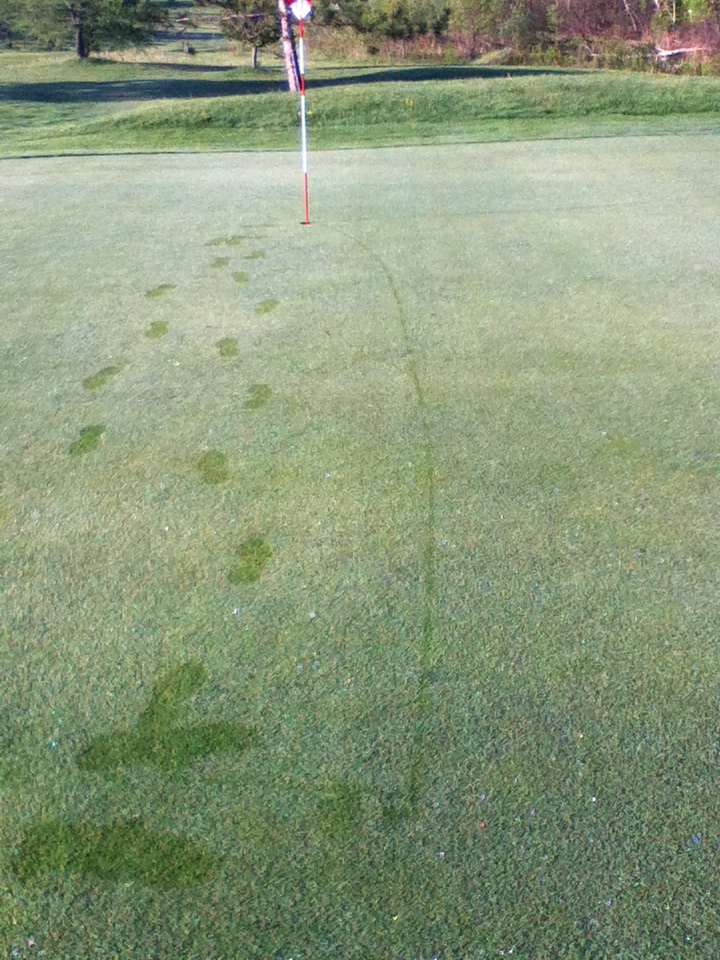
  • The Putting Rule – On the first green, if it has not been cut yet, you are allowed two putts from the same spot to get a feel for the speed.  If the ball drops on either stroke count one!
  • Foot Wedge Rule – it is used regularly and without shame!  It is the – I am here to have fun and do not care about the score – shot!

These unwritten rules are for the fun of the game.  Golf is challenging and the rules were developed over centuries of play, however golf is meant to be fun!  Using your own rules sometimes is just the break we duffers need to have a memorable round. If we were making money at golf, maybe the rules would be more important!  Since we don’t….remember – be a grateful golfer!  See you on the links.

US Open Day 2

logoWell the second day of the US Open proven to be interesting.  It seems everyone took a few steps backward.  This is not surprising given the tough conditions of Merion Golf Club, Ardmore, Pa.  The rough is long and the fairways tight…what a great course!

I was particularly impressed with a couple of amateurs; C. Pan and M. Kim, both shot 2 under.  How is that for playing under pressure.  I hope that the play well for the rest of the weekend.  Would the US Open truly be the US Open if an amateur won!

Phil Mickelson finished strong with a birdie on the 18th hole.  He made a long putt with authority.  Maybe this will be his trigger for success this year.  Mickelson has the game to play Merion only if he continues to hit most of the greens in regulation.

Mike Weir, another of my favorites, has a chance to make the cut.  As a past Masters Champion, he will have to play tomorrow morning because he finished on the 10th hole.  He was a last entry and again, as I love underdogs, it would be great to see Weir do great this year.   Weir also has a chance because he is a relatively short hitter, but is accurate and consistent (most of the time).

Lastly, the big three: Tiger Woods, Rory McIlroy, and Adam Scott finishing +3, +3 and +7 respectively.  They did not play bad or good.  They just stayed alive….especially Scott.  These three cannot be counted out, however my pick is McIlory.  He is ready for a breakout round and tomorrow may be it.

The US Open is a tournament that tests even the most seasoned golfer.  It is treacherous rough and greens slicker than your kitchen floor!  Tomorrow should prove to exciting as the course will dry out and speed up.  I can hardly wait!

I am a grateful golfer!  See you on the links!

Is The US Open Actually Open?

Image courtesy of:  http://www.usopen.com/en_US/news/gallery/2013-06-10/201306101370895624040.html

The Merion Golf Club, Ardmore, Pa, is hosting the 2013 US Open.  For the 113th time, this elite tournament is garnering the attention of the world.  The 156 player event traditionally captures the golf world like most majors.  Unlike other professional tournaments, the United States Golf Association totally controls the US Open.  This arrangement begs someone to ask if their selection process to enter and win this prestigious tournament fair or are the cards stacked in favour of a small elite group of golfers?

The USGA will set the specific rules to their championship, ranging from how the course will be laid out and the course conditions to include the length to the treacherous and famous rough. “The rough should be of sufficient height to provide a significant problem … The USGA believes that the penalty for straying off the fairway should be about one-half stroke.  The desired height of the rough depends on the type of grass involved…  (approximately) 3 and 6 inches, except that there is a strip of rough about 6 feet wide just off the fairways … Less punitive rough would be advisable for most club competitions as it increases the time spent searching for balls and leads to slower play.”  Their exacting standards have caused many a player to self-destruct during the final round.

This year’s entrants include representation from approximately 17 different countries, 76 exempt players, 5 amateurs, and a slew of hopefuls.  This year, the US Open starts on Thursday, 13 June 2013 and ends on Father’s Day, Sunday, 16 June 2013.

“Each year, thousands of competitors enter the U.S. Open. They are professionals and amateurs, teenagers and seniors, All-Americans and walk-ons, teachers and firemen. No matter their background, what they have in common is the dream of teeing it up in the national championship.”

There are some qualifying rules before any golfer can try their hand at winning the US Open.  First, all entrants must have a handicap index of 1.4 or less.  This means that they must shoot 1 shot over the course rating 10 times out of 20 rounds.  This is a very difficult feat except for the best of the best.  This year, qualifying started with an 18-hole local tournament at 111 sites around the United States.  Those excited qualifier winners advanced to sectional competitions around the United States, the United Kingdom, and Japan, to compete with exempt players in a 36-hole marathon. After all is said and done, the field for the US Open is set.

So far, all seems fair for those players wishing to raise one of the most valued trophies in golf.  With all this openness, has anyone actually been successful enough to enter the qualifier and win the tournament?  The short answer is yes: Ken Venturi, 1964 and Orville Moody, 1969.  Other important points include 5 amateur champions who won the US Open eight times.  The oldest winner was Hale Irwin at age 45, the youngest winner was John J. McDermott aged 19, the youngest competitor was Andy Zhang aged 14 and the oldest competitor was Sam Snead at age 61.  Most US Open wins was 4 by four players; one being an amateur…maybe you heard of him, Robert Tyre Jones Jr. Better known as Bobby Jones!

To answer the original question: Is the US Open Actually Open?  The answer is an undeniable yes! The process to qualify is fair, yet challenging.  They allow anyone who has the skill to step up and swing their way to victory!  It is a difficult challenge, but over 9000 golfers felt they had what it takes to win this year’s US Open.

To get ready for the US Open, Major Championships.com has a top twenty moments in US Open history that will put you in the mood for more action.  The Bleacher Report has some odds set out that may help and Major Championships.com has power ratings out for those interested in picking the winner.

Golf is a passion and I am a grateful golfer.  See you on the links!