Golf Season is Here!

After a long seven months golf season officially starts tomorrow.  Only 10 days off of my prediction of 15 April.  The weather is fantastic (interestingly, the forecast is for light rain later in the day but it is the first day of golf so I am ignoring the forecast) and I am prepared to another awesome season on the links.

It is unlikely that I will actually play any holes because of work, but it is best to practice a bit before I try anything crazy. Besides, each year I set a bronze, silver and gold goal for my first round.  If you have not figured it out, bronze = break 100; silver = break 90; gold = break 80. Normally, I achieve my silver goal, but have won the gold goal a couple of times.

Tomorrow at the course, I will gently hit balls on the range, chip for a few minutes and putt for a few minutes. My past experiences tells me to ease into the golf season to prevent early injuries. My plan for this golf season is a crawl, walk, run approach.  By starting of slow and easy, I will build on success, thereby enjoying my golf season longer.

DSCF7364So my car is packed (not to be unpacked until October unless absolutely necessary) and ready to go.  I have my clubs, two pairs of shoes, rain gear, umbrella, balls, a couple of hats and practice sticks. Now all I need to do his finish work and head to the course.  Today is an exciting day and golf season has officially started!

I am a grateful golfer!  See you on the links!


Success Breeds Success

Success Breeds Success is a common theme in all areas of life. The main tenet suggests that positive results are built by a set by step process of small successful actions. Golf is no different. Talk to any professional and they could outline how, from a very early age, an orchestrated plan of baby steps resulted in long-term success. With encouragement and training they were able to live the dream of playing golf for a living!

Talk to an amateur and the story is completely different. Although their desire to play well is as strong as a professional’s, yet the process to success is more challenging. It becomes more difficult because the process of small successful actions is not easy to envision or achieve. Why is it so difficult? How do amateurs determine what is important and what is white noise?
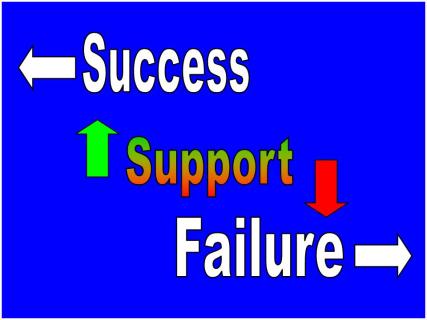
Slide1This is the time when most articles would point out that at the core level, practicing your short game, grooving a swing at the range, and focused putting are extremely important to lowering your golf score. Many would espouse which skill would be the most important or a diatribe on fundamentals; yet really not touch on how success breeds success.

So how does success breed success in golf. Finding out what works and does not work when swinging a club is definitely a great place to start… and that takes time.  Practicing different strokes at the practice green and the driving range would be the next step. Lastly, focusing on course management would help develop great habits. I could go on, but really all I have to say now is – make the madness stop…please make it stop!!!!

Success breeds success is simpler than that; for amateur golfers it breaks down to one important area: support. Amateurs can find support from a friend, support from their local professional, and support from your golfing buddies. These are all great places to start the baby step process to achieving lower scores in golf. Support is very important.

Lastly, there is one other area amateurs seek for support: golfing websites. Before I started The Grateful Golfer, I searched many golf blogs and websites to see what they had to offer. Some of the sites immediately peaked my interest and others turned me off forever. What surprised me the most is the mountain of support, advice, tips and great golfing stories. I believe that my interaction with many of the authors has drastically improved my game and help weed out the white noise.  If you are curious, here are just some of my favorites:

This is not a complete list, but I believe you will get the point once you take a look. To me, one of the most interesting aspects of these sites is that they are around the world.  Each author offers something unique about golf, but the one thing they all have in common is support for fellow golfers!

Success breeds success! The first step towards developing your plan to become a better golfer is to find the support you need to succeed!

I am a grateful golfer! See you on the links….real soon!


Lending a Helping Hand

Easter Sunday is a time for reflection and is quickly coming to an end. For many, it is a time of reflection and happiness for the wonderful things in their lives.  For others, it is a challenge to be grateful for the things in their lives. Yet there are some who need help and understanding as they struggle to achieve even the most minor of things; for those, there are special people who extend a helping hand and a leg up.

The PGA Tour of Canada and The United States support two of many important charities – True Patriot Love Foundation and Birdies for the Brave, respectively. These two particular charities are focused on supporting the brave military men and women who serve both at home and abroad. I am grateful to the PGA for their unwavering support to my brothers in arms!

The PGA also supports many other charities throughout the golfing year. Their motto “Together, anything’s possible” says it all. Virtually every tournament has an associated charity where the giving never seems to stop. Although the Tour receives most of the recognition, it is extremely important to recognize the thousands of volunteers who selflessly give their time and money to all the worthy causes. As a volunteer through the years, I am grateful to volunteers, who without, none of this would be possible!

Charity is not always on a grand scale and does not need to raise money. Sometimes time is far more important and a little help goes a long way to positively impact people’s lives.  If we were to look around our neighbourhood, there are places to help. Whether it be at the local school, church, community centre or sports team – charity of time is extremely important.

10256053_10152393304113552_833345085_nOver the past couple years, my nephew-in-law has coached the local floor hockey team. This team has thrived under his leadership and all the players are devoted to him and the team.  He continually provides them support, understanding and guidance which in turn is transferred into their daily lives. This particular situation is not uncommon, but what does make it unique is that the floor hockey team is part of the Sudbury Special Olympics. My nephew-in-law has explained how these players never cease to surprise him by their efforts and love for the game and each other.  It is truly inspiring. Recently, a local business, KGHM International where my sister-in-law works, stepped up to buy uniforms; their local financial contribution has made a tremendous impact on the community and the local athletes. Recently, a hockey game between Special Olympics Sudbury, now named the KGHMI Miners, and the Cops to Conquer Cancer hockey team was a huge success and great fun was had by all! Their inspiring story shows how a few dedicated people can make a huge difference in the lives of many!

Being grateful for so many things does not stop at Easter.  Whether large organizations, like the PGA, are focused on helping on a grand scale or whether a few volunteers make a tremendous difference in their local community, I for one am grateful for their efforts. Sometimes it does not take much to have a positive impact on someone’s life and Easter is a time for reflection and an opportunity to help.

I am a grateful golfer.  See you on the links!

The US Open – Is it Worth the Wait?

The 114th United States Open Championship is scheduled for June 12–15 at the No. 2 Course of the Pinehurst Resort in Pinehurst, North Carolina.  This is one of eight courses on the resort and is famous for hosting the US Open two other times since 1999.  This majestic course is a Par 72, 7495 yard creation of Donald Ross that has been host to six other major championships through the years.  This course has a rating/slope of 76.4/141 – all I can say is ouch!

Slide1

The US Open Golf Championship is, in my opinion, the third most coveted tournament in the golfing world.  Personally, I prefer The Masters, then British Open, but that discussion is for another day. However, The US Open is by far the most difficult of all the Majors. The course is extremely long and the setup is unfair at best.  When comparing toughness of courses the comment I hear the most “Well at least it is not US Open rough!” Winning scores have ranged from -16 to +5; all due to course setup and weather conditions.  The drier the course the more challenging.

Choosing a course is no easy feat, but the USGA does have certain criteria they use during the selection process. “The following list of 14 factors impact overall U.S. Open course set up. The mix of these factors varies from course to course, year to year. Evaluation of course set up should not focus on any single element but consider the composite result.

  1. Length, variation and playing characteristics of individual holes;
  2. Length of overall golf course relative to total par;
  3. Teeing ground locations (i.e., angles of play, variation of distance day to day);
  4. Fairway width and contours;
  5. Fairway firmness and speed;
  6. Green speed relative to percentage slopes and contours of the putting greens;
  7. Putting green firmness;
  8. Rough height, density and stages of severity;
  9. Bunker preparation (i.e., create challenge of recovery);
  10. Green surrounds (e.g. closely mown areas -vs.- primary rough);
  11. Hole locations (relative difficulty, balance in location of left-vs.-right, front-vs.-back, anticipated wind, anticipated length of approach shot);
  12. Risk and reward options;
  13. Anticipated weather conditions; and
  14. Pace of play.

There is no USGA target score for a U.S. Open. While the final score at some U.S. Open sites will be at or near par, the USGA does not try to formulate a course set up that will only produce a winning score of at or near even par.”

So the course is extremely tough, the best players in the world will be ready to play, and the media hype is starting to going crazy! The second Major of the year is more often than not a war of attrition verses skill! In one round, a player can be out of the tournament. Does this really seem fair? With Tiger Woods likely not able to play with the tournament hold the same meaning?

Through all of this, my question remains – Is the US Open Worth the Wait?

I am a grateful golfer! See you on the links…..soon!

See What I See

Before the Masters took over the golfing world, we were discussing what to look for when approaching your golf ball. This topic is much debated, but often overlooked by higher handicap players. It is important to aware of your surroundings when playing golf because it is a big part of course management.

As discussed in Seeing Whats Important and See to Believing there are many factors to consider before making any golf shot.  As a recap, this is what we identified so far:

  1. What is your yardage?
  2. What is the wind doing?
  3. How does the ground feel?
  4. Is there an elevation change between your ball and the green?
  5. What is the temperature like? Is it humid?
  6. Do you believe what you see and visualize what you want?

So far these points only account for about half of the things I look for when approaching my ball. Adjusting for these above points will help lower your score. Yet, there are still more!

Is the ball above or below your feet? After watching the Masters, it becomes very clear that a flat lie is rare in golf. It is important to understand the adjustments required when hitting from an uneven lie. If the ball is above your feet, grip down on the club a little and lean forward so your weight is in your toes.  With the ball above your feet, players have a tendency to hit left or draw the ball (for right-handed players). If the ball is below your feet, flex you knees a bit more and put your weight in your heels. Have a quieter lower body when you swing to prevent lifting up on the shot. Balls below your feet have a tendency to go right (for right-handed players)

Are you hitting uphill or downhill? When hitting the ball uphill the general rule is to take one more club to adjust for the changes in the loft of the club caused by the angle of the hill. Play the ball slightly forward in our stance. Shot it uphill have a tendency to go left or draw (for right-handed players). When hitting the downhill, the general rule is to take one less club for the same reasons and an uphill lie. Place the ball back in your stance and do not over-swing. Downhill shots have a tendency to go right or slice (for a right-handed player). Regardless if your swing is uphill or downhill, try to swing the club parallel to the slope of the hill. This will help ensure crisp contact.

This video by Ben Austin is about 7 minutes long, but worth watching to understand the challenges when hitting a ball from an uneven lie.

Did you hit the fairway or the first cut?  If you are on the fairway, congratulations! Remember the other points we discussed. If your ball is in the first cut; pay attention. Most of the time, when the ball is in the first cut it has an increased chance to be a flyer. The first cut of grass acts like a natural tee and enables most players to get a cleaner hit on the ball. As a result, the ball travels 10-15 yards further than expected. If the ball is lying in the first cut, consider going down a club to adjust for the flyer lie.

There are so many things to consider when approaching a golf ball. Many experienced players go through a checklist of things that could influence their shot. After watching Bubba Watson and Jordan Spieth approach each shot with precision, a check list of variables may be just what is needed to lower your score!

I am a grateful golfer!  See you on the links!