Giving Bad Advice on the Golf Course

Offering advice on any subject is tricky. Offering advice on a subject that you are not really familiar with does not make good sense. Offering advice while playing golf could be fatal! I have played thousands of rounds of golf and through the years I have offered unsolicited advice, solicited advice, and refused to give advice; but the one constant in everything was that it was always the wrong time!

Before anyone pulls out their Golf Canada rule book and starts quoting rule 8-1, and proceeds to tell me that “Advice’’ is any counsel or suggestion that could influence a player in determining his play, the choice of a club or the method of making a stroke; I never give advice during a competition. If you are wondering, here is what others have to say: Continue reading

Golf Canada Handicap Changes for 2016-2017

Golf Canada put out is annual changes to how it plans to govern in 2016 – 2017. If you have not read the details, let me save you some time.

Blah, Blah, Blah, we change our mind on solo rounds – Blah, Blah, Blah!

Okay, that was a little harsh, but like many other amateurs, Golf Canada’s decision in November of 2015 not to follow the USGA’s crazy idea of disallowing solo rounds for a handicap was applauded by the Canadian golfing masses! So what changed?

Continue reading

Slow Play Costs Jordan Spieth

Loyalist Country Club (12)

Slow Play! No Way!

As one of my must read golf blogs, White Dragon Golf, by Pete Robbins, hammered home a misunderstood point about a contentious topic: Slow Play! This what Pete wrote:

World #1 Jordan Spieth received a slow play penalty at the Abu Dhabi HSBC Golf Championships.

Jordan reported that he had no idea why he got the penalty in the first place, he said it was a surprise to his playing partners Rory McIlroy and Rickie Fowler as well. The official ruling was that he took too long over a putt, while already being on the clock.;

“It didn’t make any sense to me”

“It didn’t affect the round, but Rory and Rickie were surprised as well.”

Under the European Tours slow play policy, two monitoring penalties will result in a fine, of about $2,800.

Rory commented;

“It was a bit of a weird one.”

“Sometimes the refs have to use common sense. With the time we’re allowed if you take an extra look at a putt you’re over the time.”

“But if we’re in position relative to the group ahead there’s no reason to time us.”

So I guess walking around to check all angles of a putt is verboten on the Euro Tour, you just have to stand up and hit it. Officialdom gone mad, if you want to watch the best golf in the world, let the players take some time over a putt. There are too many rules already.

Turtle1

Everyone plays to quick!

As you can see, Spieth’s playing partners were flabbergasted by the call and wondered why the penalty was assessed. The apparently were keeping pace with the group in front of them, and they were not holding anyone up! Thus, is this really slow play.

According to Pete, Spieth took too long over his putt. He had already been warned, thus the reason for the penalty. However, does this really constitute slow play when you are keeping pace with the group in front?

Personally, if a group is keeping pace, it is impossible to call someone for slow play! A player might take a bit longer putting or aligning a shot, but as long as it does not jamb you for time on your shots or cause the group to fall behind, slow play cannot be called. I am not sure what the referees were thinking, but I am sure more of the story will unfold over the next few days!

What do you think? Should Jordan Spieth have been called for slow play?

I am a grateful golfer! See you on the links!
Video of New Rules for 2016

In a previous article, I talked about the upcoming 2016 rule changes to golf. They were pretty clear, but I wanted to follow that article up with a video. I find that it is sometimes easier to understand the changes when explained and demonstrated by someone.

If you want more information, check out the USGA website here or go to the Golf Canada website here.

I am a grateful golfer! See you on the links!

Golf Rules: Nearest Point of Relief

I cannot count the number of times I am asked about the rules of golf. What is really surprising is that most of those times, the requests happen during a tournament. Normally, I am not fussed about citing the rules, but when it comes to the “nearest point of relief”, I generally have to referee as well.

Most players do not mind taking relief, but they generally try to interpret the rule to gain an unfair advantage. I will always assume they are honestly misinterpreting the rule, but sometimes I am just not sure. So for those who are unsure, I thought it would be great to review this rule.

The “nearest point of relief” is the reference point for taking relief without penalty from interference by an immovable obstruction (Rule 24-2), an abnormal ground condition (Rule 25-1) or a wrong putting green (Rule 25-3).(Golf Canada)

It is the point on the course nearest to where the ball lies:

(i) that is not nearer the hole, and
(ii) where, if the ball were so positioned, no interference by the condition from which relief is sought would exist for the stroke the player would have made from the original position if the condition were not there.

Note: In order to determine the nearest point of relief accurately, the player should use the club with which he would have made his next stroke if the condition were not there to simulate the address position, direction of play and swing for such a stroke.

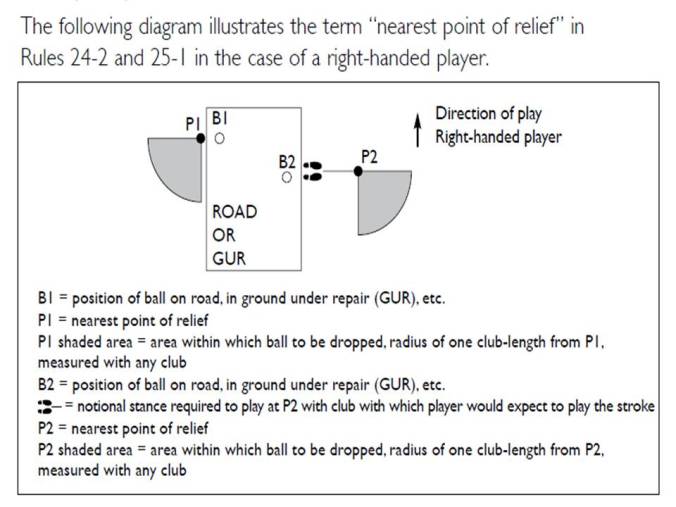
If you are still not sure, here is that diagram that might help.

Nearest Point of Relief

At last, I found a video that perfectly explains how to take relief:

The “nearest point of relief” is the most misunderstood rule in golf. This and all rules of golf can help or hurt your game. Understanding how to interpret rules properly will help your game and lower your scores!

I am a grateful golfer! See you on the links!