To Tee or Not to Tee

Every year I receive golf tees as a stocking stuffer.  It is one of those gifts that I love because I always need them.  As I continue to get my equipment ready for summer, I realized that I have three different lengths of tees.  Not that really bothers me, but I actually wondered if it really makes a difference.

At ehow.com, they explain how to pick a length of tee.  They focus on the size of the club being used and the size of the club.  They suggest:

  • 2 1/8″ tees are used for your irons, hybrid clubs, and low profile woods.
  • 2 3/4″ tees are used for drivers under 360cc.
  • 3 1/4″ tees are used for drivers over 360cc.
  • 4″ tees are the longest tees allowed in play, they will give you the maximum impact angle while driving.

Sandtrap.com conducted a poll on the length of tee used by golfers.  2 3/4 inch was first with 44% of the vote and 3 1/4 inch was second with 34% of the vote.  I would suggest that the longer tees are used more because of the increase in driver size over the past 10 years.
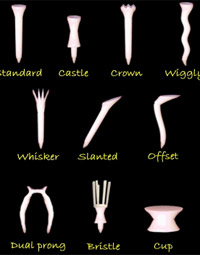
Image from:  http://blankmetees.com/innovations.htmlThis is all very interesting.  The length of tee is important, but there are no real rules.  I believe that the 4 inch tee may not be the length of choice because of how high the ball would sit, but again I have never tried it.

For my driver, I use a 2 3/4 inch tee.  For my irons, hybrids or 3 wood, I use broken tees.  I collect them around the course and use them all the time.  Rarely will I use a new tee.   I have tried just about every design and style of tee.  I always go back the standard old fashion tee.  Seems to work best for me.

Overall, it really does not matter.  What does matter is that the length of tee is right for you.  Experiment and try different lengths.  Let me know how you made out.

I am a grateful golfer.  See you on the links!

Buying a New Sand Wedge

Image from:  http://www.vokey.com/wedges/pages/wedge-selection-guide.aspxToday is the day!  I have waited, researched, and mulled over the purchase of a new sand wedge.  Currently, I use a 30-year-old Ping Eye 2 Black Dot that has been golden for many years.  But, I rarely use it in the fairway because the bounce is too high….so it is time to retire one of my favorite clubs.

On an earlier post, “Choosing a New Wedge” I went through all the aspects to consider and linked you to Goldsmith.com for a more in-depth discussion.  I used these two sites extensively.  They were very helpful and greatly aided in my decision.

Next, I look at reviews.  Reviews are very important to cut through the hype of advertisement.  Virtually every site I went too rated the Titleist Vokey Wedge as the top wedge to buy.  Additionally, I looked at customer reviews because the average golfer has plenty to say and generally are more honest.  The Titleist Vokey Wedge still came out on top.  Next, I went to the Titleist website and found a very good guide to Vokey Wedges with information that could be applied when choosing any wedge.

After all of this, I have chosen to by the Titleist Vokey 56 degree wedge with an 8 degree bounce.  When I hit the links, I will let you know how my decision made out.  \Well, I am off to Golf Town….any thoughts?

Lowering Your Score…..or Not

I decided to do some research on how to lower my golf score.  Everyone, even single digit handicappers, looks for ways to lower their score.  I have to say I was a little disappointed at the number of websites that were more interested in selling stuff than helping people improve their game.  I guess that is why I am the grateful golfer for all those people who give free advice without wanting anything in return…but that is a completely different conversation.

I have my own views on lower your score, but during my search I did find a 2005 article from GOLFTIPS that struck a chord.  It outlines five tips that would be helpful to lower ones score.  The are

  • Hit To The Fat Part Of The Green
  • Play Golf, Not Golf Swing
  • Monitor Your Tempo And Rhythm
  • Be Positive
  • Know When To Leave The Driver In The Bag, Baby

I have talked about these tips in one form or another, but what I like best is the simplicity of the points.  Basically, play within yourself.  Pretty simple.  Unfortunately, the ego has a tendency to sabotage that plan.  I guess that is why we are not Pros!

Lowering your score in golf is one of the most difficult goals to accomplish.  It takes disciple, desire and sometimes laughing at yourself.  Regardless of your handicap, lowering your golf score can be achieved….it really depends on how important it is to enjoying the game!

See you on the links!


When You Have Been Away

I have been asked as the first thing I would recommend as a place to start when away from the game of golf for a time.  I have pondered this question a fair bit and always come back to the same question:  What is it you want to accomplish – short or long-term success?

I know answering a question with a question seems like I am avoiding the question, but it really is important to my answer.  So for those just starting again or have had 5 months of winter, this is what I came up with as a way ahead.

Short term – go to the range and practice hitting the ball.  Try and reproduce muscle memory that will ensure a consistent swing.  Make sure you use every club in your bag and mix it up.  Hitting driver most of the time is not the answer.  Once you have determined how far you ball will travel on a consistent basis, head to the chipping and putting green.  Practice chipping with your 7/8 iron, PW and 60 degree wedge.  Hit from different distances.  Then putt!  Putt for as long as you have chipped.  Realistically, this whole process should take about 1 hour.  20 minutes on the range, 20 minutes chipping and 20 minutes putting.  This approach is generally more fun for the player and they feel they will have immediate success.  Of course that varies depending on the skill of the player.

Long term – head to putting green first!  Practice putting for 20 minutes and chipping for 20 minutes, the sand trap for 10 minutes and pitching from 25-35 yards for 10 minutes.  Once you have established your short game, then start working on our long game.  Practice your short game for the first two weeks, then head to the range alternate times for 30 minutes.  I have found that muscle memory in your short game is harder to achieve, but has greater long-lasting results.

Well I can hardly wait to start golfing, I guess you figured which approach I am going to use….the long-term.  I am well into my workout routine to prepare for golf season in 48 days.  Hope this helps.  I am a grateful golfer.  See you on the links!
Conceive – Believe – Achieve

Image from:  http://www.cafepress.com/+conceivebelieveachieve_poster,574312749The phrase ‘Conceive, Believe, Achieve’, finds it roots from the mentor Napoleon Hill – It was later adopted and given an addition by another highly successful man – W. Clement Stone.  No truer words have been spoken!  But really, what do this have to do with golf.

Do you think that Phil Mickelson, who was 1 centimeter from shooting the ever elusive 59, has ever sat on his couch and thought of what it would feel like to break 60.  I say – absolutely!  Hasn’t everyone.  Do we not think of shooting a hole-in-one, chipping in from 150 yards, making a 60 foot put for eagle or winning the club championship on the 18th hole with everyone watching?  If you said yes to any of these statements, then you are half way to setting yourself up for success on the golf course.

Manage your internal expectations and reality will tend to meet them.  Although this is not just for golf, it can easily be applied to our favorite game.  The use of positive mental imagery is nothing new.  It is all around us.  At Clear Mind Meditation Techniques, they describe how to use this powerful technique.  It is very simple, yet can change even the greatest obstacles.  Norman Vincent Peale said that “we tend to get what we expect.”  So why not expect great things on and off the golf course!

At GolfMindShop.com, they talk about four benefits of positive mental imagery:  emotional control, perfect result imagery, physical bio mechanics imagery and self-image “Engineering” imagery.  These benefits are very important to success on the golf course.  It is not just about swing mechanics, but developing a strong mental attitude in all areas of the game.

At Golf Mental Game Coaching also outlines the benefit of using mental imagery to change your game.  They go into more detail of what areas can be affected, but the process is basically the same.  Ultimately, each player will decide the area they what to improve – keeping it all positive will definitely help.

In an earlier post “When Life Gets In the Way“, I suggested a 5-minute mental exercise to calm your mind and to focus your efforts while running to the first tee.  The techniques suggested today are an extension of that exercise.  It allows for a total examination of your game and will help improve your mental toughness.  There is no specific length of time one should perform mental imagery….it really is up to the individual.

Golf is not just about swing a club.  A positive mental attitude through imagery is a fantastic technique to improve your game.  What other tips would you suggest to help with your golf game?