Jumping to Confusion

Lost and Confused SignpostHave you ever walked up to your ball with a club already in your hand before you actually looked at what was going on around you? This usually happens when a player is familiar with the course and draws conclusion before their next shot. We are all guilty of it, but is it really a case of familiarity or confusion?

One of the major challenges to members of a golf course is familiarity. Many players use the same club off the same tee all the time. Next they walk to their ball with the exact distance in mind; then select their club because it is the one they always use! After shooting the same score over and over, they question what is wrong!

Complacency on the golf course is a real challenge for most players. It causes them to stop thinking and to play golf on autopilot. Playing without thinking is the root of many challenges for amateurs. Having a preset plan on each hole stagnates the development of the famous Jack Nicklaus course management, degrades the Seve Ballesteros shot ingenuity, and limits their Lee Trevino’s love of the game!

Ultimately, by jumping to confusion players limit their ability to lower their score. Fortunately, there is a fix to this quagmire – change your approach to playing your favorite course. Instead of using your driver, use your three wood off the tee. Instead of bashing the ball each time, play to your favorite distance to the green. Instead of pin hunting, shoot for the middle of the green. There are many fixes, the real approach is just deciding to make a change.

As Jack Nicklaus says: Success depends almost entirely on how effectively you learn to manage the game’s two ultimate adversaries: the course and yourself. The only thing that a player can control is themselves; so instead of jumping to confusion, try something different. Only you can decide what changes are required, but changes are required if you want to lower your score!

I am a grateful golfer! See you on the links!

Conquering Your Ego

ego2-drhannanA follow-up to my last post about ego, the email below is from my best buddy in the UK. Among other things, he and I have share the passion for golf. He moved to the UK a couple of years ago and has focused on his game. Only recently has he noticed the improvements in all areas of his game.  He is his story:

“This is an interesting dilemma for sure.  I know that I would NOT be willing to have higher scores, shorter drives etc over the short term for longer term gain.

However….

Because the course is open all year here, I made the decision in Dec to do exactly what you are talking about in the blog.  I changed grip (very difficult at first); I changed my position at address to be 3 inches off front foot for all clubs except driver (this was also difficult, however now is great); and I changed my attitude towards course management by hitting driver on all holes that were 380 plus (this proved to be the hardest thing as I hit lots of balls in unplayable areas and was forced to play 3 off the tee). Lastly, I changed my ball position while putting (this proved to improve putting numbers immediately)

Now…..

Things are great as I had the extra few months of practice to try all of these things.  It was frustrating for sure, however most of these months I was playing alone and had lots of opportunities to hit many shots without holding up others.  

Grip change has been the greatest change for me as it ensured that my hands (therefore club face) are square at impact.  I have learned that the back of my front hand is simply the club gave – where this hand points so does the club face at impact. Not many draws or hooks any more and certainly there are no slices.  Sometimes I find myself aligned incorrectly when playing other courses, however normally the ball flies on a straight path right or left and not due to hook or slice – I can accept this, however it is rare at my home course as I know where every tee box location fits my address position.

Having the few extra months has been like a 4 month practice session, however if I had the Canadian golf season, I would be reluctant to change anything – perhaps one thing of this magnitude each year.

I was scoring well at the end of the 2013 competition season and I hope the practice pays off for 2014.  First stable ford was 40 points, which grabbed me second place (31 competitors with full handicap allowance)

Looking forward to my six strokes aside so I can be competitive with you.”

What a great story! His tale is not uncommon for all golfers wanting to play better. He actually took steps, endured the frustration, and as a result is playing better. I am not sure I want to give him any strokes next time we play, but that will be negotiated at the time. I think the word sandbag may be floated around regardless of what we decide.

Interestingly, my friend said that if it was not for playing year round, he would not likely have made as many changes to be a better player. I can appreciate his point, but would counter that the process would be slower and possibly less painful. A big thank you to my buddy for sharing his story!

Conquering your ego always starts the same way….make the decision to change! The rest is just details.

I am a grateful golfer! See you on the links!

Setting Goals for 2014

Roundel Glen Logo (1)As in previous years, I set goals at the beginning of my golf season. I find that by setting goals, it keeps me focused throughout the entire season. Sometimes, I achieved all may goals and more, others….not so much!  I am always excited about each new season because of the fantastic opportunities improves my game it offers.

Today, I hit the range and putting green. I had no expectations and no real plan. It felt fantastic to be be playing again. Normally, I have a plan on the range, but being the first time this year I just wanted to hit balls. I was quite surprise at how well I struck the ball, but I am sure it was beginners luck! A quick note to my buddy in the UK, I still want two strokes aside!

2014 golf season is upon us and it is time to make goals. Experience tells me that reaching for the stars is great for my ego, but not necessarily for my game. So as I progress, I need to build a plan and set goals to achieve my dream of being a scratch golfer. Setting goals in golf is important for players serious about lowering their score.

Previously, I came up with following to prepare me for the season:

  • get fit – focus on exercises designed to improve my golf game;
  • research – the drills and techniques required to improve my game;
  • practice – dedicate time to practice to improve my game; and
  • compete – either formally or informally compete every time I hit the links.

It is fair to say that I have successfully accomplished the first two goals.  I have remained fit and completed my research on different drills to help improve my game.  So now it is on to phase three – practice.

My practice focus will start from the green out. Putting is critical to lower scores. Grooving my putting stroke early will help save strokes in the long run. Next, will be chipping from the fringe and moving further from the green.  I will be using the 3-6-9 drill to simulate playing on the course because it will help hone my short game.

I am not ready to compete. Having swung the club for the firs time today, competing would be stretching even my expectations.

Setting goals is a helpful way to improve anyone’s golf game. This year will be a special year because of my goal to be a scratch golfer.  The plan is in place and my desire is strong…I am ready to succeed!

I am a grateful golfer! See you on the links!


Seeing and Believing

Welcome to the second installment of “Seeing What is Important” when playing golf. As we prepare to watch The Masters, it would be in our best interest to pay attention to what the players and caddies are saying and where they are looking while preparing to make a shot. Value is gained by focusing on their conversations and the language they use to discuss influences on their game.  The last post dealt with knowing your yardage, what the wind was doing and how the ground felt.  I wonder if the pros at the Shell Huston Open are talking about how these variables affect their score!

Learning the finer points of golf can occur anywhere; watching the pros, your buddies or complete strangers navigate around the links. Rarely is a golf course hazard free. Every hole as something that will catch your eye; something the makes your hair on your neck stand up; or something that makes the voices in your head start to speak!

Uphill shot

Landing area is higher than tee. Expect to hit shorter off the tee.

down hill shot

The green is below the ball. Time to throttle back!

Unlike a mirage, most changes in elevation on the course are real. Elevation changes are the most misunderstood challenge on any golf hole.  Modest changes to the elevation will create a 1/2 to 1 club difference regardless of the yardage.  The challenge for most players is to determine if the modest changes in elevation are real or not.  Here is my guideline – if I can see the entire fairway leading to the green without it looking smaller – throttle back and think about hitting one less club.  If the fairway looks like a railroad track going away, the yardage is as paced.  If the fairway disappears quicker; add one club to your approach shot.  This rule of thumb works for me.  Thanks to the Dave at One Bearded Golfer for this topic!

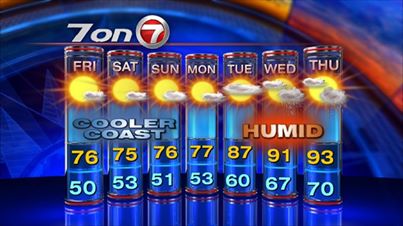
Cooler and Humid

Your ball will travel further on Tuesday, Wednesday, and Thursday!

The second point for today deals with the temperature! Most experienced golfers are saying that the colder the temperature the shorter the shot; but wait, there is more. Temperature is really broken down into three categories: Temperature, Barometric Pressure and Humidity.  As an overview, the ball travels further if it is hot, your golfing at a higher elevation like my buddy Craig in Denver, and the greater the humidity. For amateurs, this is hard to believe, but it is true.  For a more detailed explanation, check out Golf Digest.

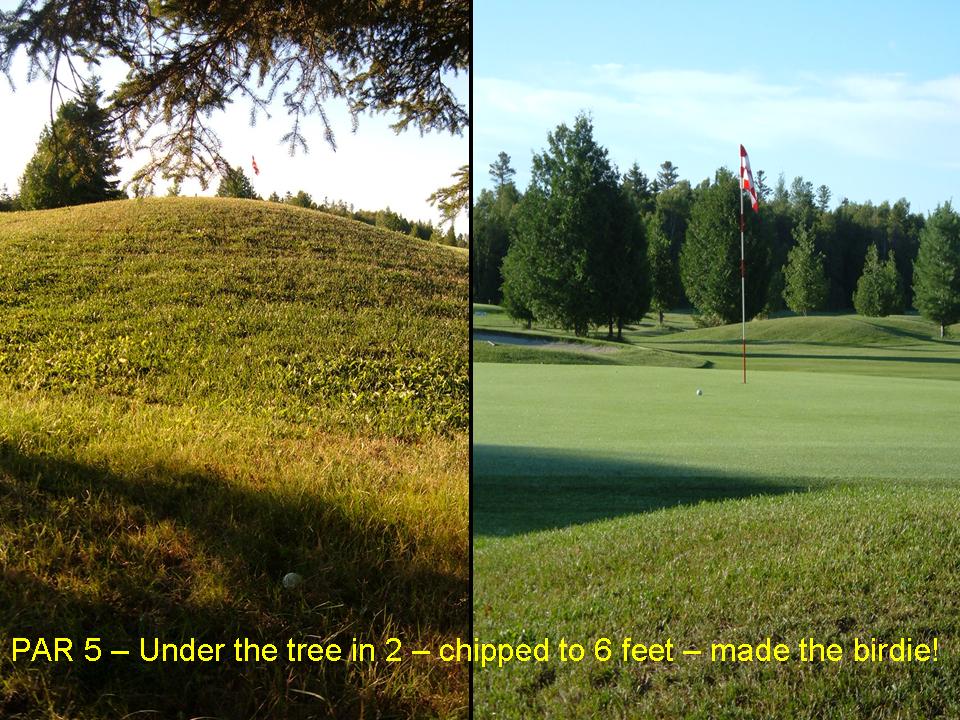
Last tip is to believe is what you see and visualize what you want.  How many times have I heard the saying, “come on, this is ridiculous!”  There will be many times over a round when a player thinks they hit the perfect shot; only to walk up to the green and wonder what happened.  After shaking their head in disbelieve, they walk to their ball and hit a poor shot and blame it on their lie.  As an experienced golfer, I would have to tell that player that the lie did not cause the problem – it was caused by disbelief; then frustration.  Acceptance to the situation is extremely important to lower scores.  Everyone hits poor shots, it is the next shot the will determine if you score a par or double bogey – you get to choose.

Slide1

There are many optical illusions in golf and it takes an experienced eye to identify them and adjust their shot accordingly.  Understanding and recognizing the potential hazards is one of the first steps to lowering your score.  Anyone can do it, it is a matter of “Seeing and Believing!”

I am a grateful golfer!  See you on the links!

Are Long Irons Important?

Long Irons are the most misunderstood clubs in a golfer’s bag.  In some cases, these tools are dusty and look like brand new.  Most beginners look at their long irons with fear and contempt because they find them difficult to hit and very unforgiving.  Regardless of what your fears are associated with your long game; there are no secrets to success from 200 yards out.

There are many pundits who have the answers on long irons.  Some will tell you to move your hands forward, others move them back.  Experts talk about where to place the ball; forward, backward, or centre.  Even your buddies talk about swing plane, releasing your hands early, weight shift, and on and on.  Talk about white noise….please make it stop!

The basic mechanics of a golf swing are not supposed to change regardless of which club is in your hands.  Most players take that to mean that exactly everything remains exactly the same. Unfortunately, that is not true.  Using long irons is a perfect example.  Below are two short videos that focus on a couple of aspects when hitting long irons.  They advice is simple and easy to follow.

The discussion about posture and maintaining balance is very important when hitting long irons.  It is important not to over swing, but maintain your normal rhythm.

Hand placement is very important with long irons.  Most players reach when trying to hit long irons and that is a result of improper hand position.

If you are still having difficulty hitting your long irons, take the fear out of your came and consider switching to hybrids.  There are some unique advantages to hybrids over irons especially for a higher handicap player. Although I was not trying to break 100, I switched to hybrids two years ago.  This switch increased my confidence from 200 yards out and help lower my score.

I am a grateful golfer!  See you on the links!