Chipping to Lower Your Golf Score

Chipping to lower your golf score is the goal of all golfers! For most amateurs chipping the ball during a round of golf, having a tap in putt helps lower their score very quickly. Recently, one of my normal playing partners shot 78 by getting up and down 6 times out of 7 during his round of golf. Although capable of shooting in the 70s most of the time, he has been plagued with challenging putts as a result of not chipping the ball close to the hole when given the opportunity. His challenge is one that most amateurs face every time they hit the links!

Previously, posts on club selection, chipping drills, and course management have outlined some of the concepts of chipping the ball close to lower your golf score. These are great points, but do not really discuss the mechanics of chipping. The “how to” chip is fundamental to beginner and intermediate players because saving strokes around the green is important to breaking 100, 90, or 80.

Derek Hooper has a fantastic video on chipping. Additionally, he is a great resource for other golfing techniques because he explains the golfing process in a manner that is clear and easy to follow.

The video discusses how to consistently chip close. However, three points during the video need to emphasized.  For consistent, successful chipping, pay attention too:

Keeping Your Head Still – Most miss hits are caused by extra movement in the upper body. As amateurs, we have the tendency to try and help the ball to the hole. The extra movement in the upper body will change the contact position of the club on the ball (resulting in topping or sculling the ball), hitting the ball fat (club hits the ground before the ball) or scooping the ball (sometimes known as a chilli dip). Keeping your head still will prevent additional upper body movement, thereby increasing the effectiveness of your chipping.

Weight Distributed on the Lead Foot – Having 80% of your weight on your lead foot is critical to solid chipping. The important aspect of this weight distribution is to keep your knees bent slightly and to have your weight distributed over the whole lead foot. Sometimes, amateurs will lean so the weight is on either the inside or outside of their foot. To build a strong foundation, keep the weight evenly distributed on the lead foot.

Keeping your Hands Ahead of the Ball – On contact, the hands need to be ahead of the ball slightly. Also, while following through, avoid breaking your wrists! It is important to let the hands lead the chip because it promotes crisp, solid and repeatable contact. Locked wrists also ensure that the ball is contacted first before the follow through, which allows for spin to be placed on the ball.

It is important to practice chipping. It is more important to practice focused chipping. By following these chipping tips, strokes will be saved during your round. Chipping the ball effectively is a great way to lower your score and have more fun while playing golf!

I am a grateful golfer! See you on the links!


Finding Weaknesses In Your Game

Golf is a simply complicated sport.  Everytime a player hits the links, they have the opportunity to score really low or really high relative to their skill level.  Most think that is the best time to pinpoint what is going right or wrong.  Or is it?

Finding Weaknesses

Keep head Down; Left Arm Straight; Slow Tempo; What did the Grateful Golfer Say…..Oh never mind, just Grip It and Rip It!

If a player consistently shoots in the low 100, 90, 80 or 70, identifying positive and challenging aspects of their game is important.  This process, if the player really wants to improve, is continuous and unrelenting.  However, identifying areas to improvement is specific to each player and it is impossible to use generalities to guarantee a better golf swing. Therefore, which is the best method?  Who can help?  Are there methods?

The short answer is yes, there are methods.  Which is the best…..depends on the player. Who can help….basically it is up to the person to seek and conquer the challenges of improving their golf game.  Having said that, the following are my suggestions on how to improve your game:

BroNet. Sometimes referred to as the buddy system.  While out on the course your friend will notice something in your swing that they believe you should correct.  Generally, it varies on a shot by shot basis.  It has a tendency to cause more confusion that success, but sometimes it is helpful.  The quality of the advice depends on the skill level of the player giving it.

Self-Taught.  This is where a player will research various skills, look for tips, watch others and try to duplicate.  This method can be very good, especially if you use websites like Hit It Solid, Slice of Golf, Gorilla Golf, All About Golf or Mind Body Golf.  And of course The Grateful Golfer site!  (Sorry for the shameless plug….just could not help myself) They offer tips on golf, the challenging aspects of the mental game of golf, course reviews and will allow for interaction via comments/questions to help improve your game.  This method is generally how most players start.

PGA.  Having your local professional, like Dan Garagan at Pinewood Park Golf Course, North Bay, Ontario, Canada, analyse your swing and provide helpful tips on how to improve is definitely a winner.  They have the skill and expertise to help.  The only draw back on this method is that you must be willing to learn from their sage advice.  It is difficult and sometimes causes a player to initially score higher, but in the long run it is probably the best way to learn golf.

Wing It!  The last method is the most fun!  Basically, you have no plan nor want one. Each day is an adventure and you real goal is enjoy the experience.  The million dollar shot you can brag about is what you seek.  There is nothing wrong with this method, however your game will develop slowly if at all.  This is not a problem because you play for the fun of the game.

Finding weaknesses in your game is relatively easy.  Fixing them is usually the problem. For me, the best method to use in order of effectiveness is local professional, self-taught, Bronet, and finally, Wing It!  Ultimately, chose the method that best fits your goals and desires.  I am a grateful golfer!  See you on the links!

Canadian Open – More Than Just a Game!

Brant Snedeker

Brandt Snedeker of the United States poses with the championship trophy after winning the Canadian Open in Oakville, Ont., on Sunday, July 28, 2013. (Nathan Denette /The Canadian Press)

The RBC Canadian Open did not disappoint this year. The Glen Abbey Golf Club is one of the great venues in Canada for golf enthusiasts. This 7200+ yard course was challenging and yet playable for the pros.  Finishing with 16 under and a 3 stroke lead, Brandt Snedeker was smooth down the stretch and did not crumble when the pressure increased during the 16th and 17th hole. Famous for his putting, Snedeker demonstrated that playing fast and staying focused can a benefit for any player.

Adam SarsonWhite Dragon Golf, and TSN provide great synopsis of the tournament including some of the highs and lows.  Regardless of who you were rooting for, the RBC Canadian Open provide all the excitement of any PGA tournament.

As per The Open, the pros demonstrated many aspects of golf that can show amateurs how to lower their scores and be successful on the course. The pros were very accommodating by their play and the following is how I would recommend lowering your score.

Breaking 100

To break 100, putting was the key. Watching Brant Snedeker use his putter like a surgeon wields a scalpel!  “I hung in there really well and made the key putts I needed to and I was able to survive,” said Snedeker, the reigning FedExCup champion who, with the win, moves up one spot to No. 3 in the 2013 FedExCup standings. “That’s what today was all about.” (PGATOUR.com)  Snedeker demonstrated that the flat stick saves strokes and lowers scores.  In his case, putting propelled him to victory!

Breaking 90

Eliminating costly mistakes is key to keeping your scores low.  How many times have we been playing fantastic and decided to take a chance that we know had a low percentage of success.  Then, oh noooo, a triple brings our hopes of your best round ever crashing to the ground.  Unfortunately, Dustin Johnson experienced the same feelings of despair.  Following Johnson’s career, it is easy to see a repeat of costly mistakes.  An article from the Bleacher Report outlines his many disappointments, but does provide a lesson for amateurs.  Play within yourself, and manage the course to eliminate costly mistakes. There are many ways to achieve this difficult task and staying focused down the stretch is the best way.

Breaking 80

Practice difficult shots around the green.  Then know how and when to press a difficult position. Place your ball in deep grass, plugged in the sand trap or chipping over a hazard. Watching the pros navigate the difficult shots makes it clear why they save strokes during difficult times.  Take the 12th hole, Snedeker shot bogey and David Lingmerth tripled from the woods just off the green.  Snedeker’s ball was partly open and Lingmerth’s was buried deep in the cabbage.  The result speaks for itself. Knowing when to press a difficult position and when to take your punishment is extremely important to breaking 80. On a side note, Jim Furyk provides a great article on how to play 20 difficult shots at Golf.com.

The RBC Canadian Open was very entertaining.  Brant Snedeker is a great champion and deserved to win.  Of all the events that occurred during the Canadian Championship, Hunter Mahan provided the best headline.  He left the tournament as the leader after the second round to jet home to Dallas for the birth of his first child. I am grateful that he provided an awesome example what is really important in life.

I am a grateful golfer!  See you on the links!
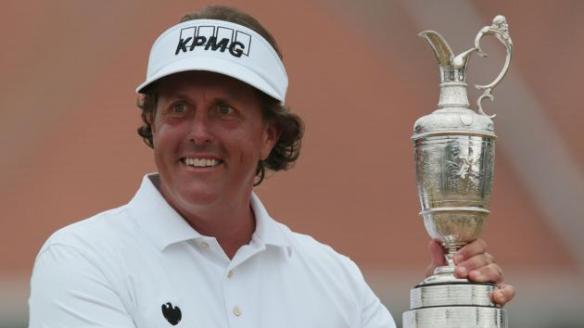
The Open Champion – Phil Mickelson

Phil-Mickelson-surges-to-first-British-Open-title-with-5-under-66

USA’s Phil Mickelson holds the Claret Jug after winning the Open Championship at Muirfield on the fourth day of the 2013 Open Championship in Muirfield, Scotland on July 21 , 2013.Mickelson won with a score of three under par. UPI/Hugo Philpott

Congratulations to Phil Mickelson for winning the 2013 Open Championship.  It is the first time he has won this prestigious tournament and he did it with style.  Mickelson is one of the top players in the world and was inducted into the World Golf Hall of Fame….and rightly so!

It is no secret that Phil Mickelson is my favorite golfers.  He embodies all the positive aspects of golf and yet is not afraid to speak his mind on issues of importance. His performance at The Open was solid and consistent.  He really did not do anything spectacular until the last six holes of the final day.  And what an awesome last sic holes! He hung around and hung around; pressing where required and playing safe when needed. There is a lesson in his win for all golfers.

Breaking 100

Practice your short game.  Mickelson practices 25 yards and closer all the time.  That is where real strokes are saved.  He is considered one of the best wedge players of all time; so to break 100 work on your short game!

Breaking 90

After practicing your short game, practice your putting!  Mickelson is a great putter.  He is no Steve Stricker, but Mickelson seems to sink the important putts when required; much like his putt on the final hole at Muirfield….simple spectacular!

Breaking 80

After conquering your wedges and putting, the next step is the range from 150 to 75 yards. This distance will determine your greens in regulation stat.  I believe this is the most important stat in golf.  If a player can be putting for birdie eight times out of ten….their scores drop considerably.

Phil Mickelson played great during the Open this year.  His steady approach shots, chipping and putting clearly demonstrated where most players should focus their practice time to lower their score.

Phil Mickelson’s quote “A great shot is one that you pull off and a smart shot is the one you hit when you don’t have the guts try it!”  I love this quote!

However, as amateurs to break 100 or 90 or 80, it is better to play more smart shots than great shots!

I am a grateful golfer! See you on the links!