Course Management – Crazy Man Style

Grip it and rip it!

The only way to play golf is to hit the ball as hard as I can and as far as I can every time! The initial logic of this style of course management may have you shaking your head, but let me lay out my reasoning.

  • By hitting the ball as far as we can off the tee, a shorter second shot awaits the daring;
  • A shorter second shot, means a even shorter iron and a greater chance to improve our GIR stat;
  • Attacking the pin on every shot results in shorter putts;
  • Hitting long irons and fairway woods when possible improves our changes at eagle; and
  • Putting the ball with enough speed to roll past the hole ensures the ball always has a chance to drop in.

Continue reading

Giving Bad Advice on the Golf Course

Offering advice on any subject is tricky. Offering advice on a subject that you are not really familiar with does not make good sense. Offering advice while playing golf could be fatal! I have played thousands of rounds of golf and through the years I have offered unsolicited advice, solicited advice, and refused to give advice; but the one constant in everything was that it was always the wrong time!

Before anyone pulls out their Golf Canada rule book and starts quoting rule 8-1, and proceeds to tell me that “Advice’’ is any counsel or suggestion that could influence a player in determining his play, the choice of a club or the method of making a stroke; I never give advice during a competition. If you are wondering, here is what others have to say: Continue reading

The Biggest Dilemma in Golf

There is an age-old dilemma in golf! It is on every players mind every time the stand next to their ball wondering which club to hit next. They are at 175 yards, hitting over water, with a wide open, yet tricky green to land on. The dilemma has arrived; play safe or go for it!

I asked this very question a short time ago, and was surprised by the response.

81% of the respondents had enough confidence in their game that they felt going for it was the answer! Personally, I would go for it as well, but I would have to admit, I would not go for it every time. @cencalhack added a qualifier to his comments below and most golfers would agree that “going for it” depends on many factors.

Hitting a long shot over water is difficult at best. There are so many factors that must be considered, that I am not sure we amateurs actually consider them all! So, I thought I would make my list and see if I am forgetting something. If I am forgetting something, please let me know! Here is what I look at when hitting the ball 175 yards, over water, to an open, tricky green:

  1. Lie. My lie will have to be relatively flat and in the first cut or fairway for my next shot to be an automatic go shot.
  2. Wind. Which way is the wind blowing and how strong is the wind are definitely.
  3. Hazards. The water hazard is the most obvious hazard, but what about the hazards by the green. What happens if I hit long, left or right? Are there out-of-bounds markers near the green?
  4. Feel. How am I playing to this point? If I am playing poorly, well a lay up shot might be the best course management approach. If I am playing well, then pin hunting might be the solution.

My list is fairly generic, but covers most situations. Again, if you have any suggestions, I am all ears!

One final note, ego does play a part of golf. Some players (myself included sometimes) automatically reach for a club when we get to a specific distance or think “that difficult shot” is in our bag. Playing automatically is not good course management and will cost us strokes over 18 holes. So beware of that dreaded ego!

It is important to remember that risk – reward is part of every golf shot!

Regardless of your decision, commit to the shot because anything can happen on the golf course!

I am a grateful golfer! See you on the links!

Golf Tip: Eliminating Trouble off the Tee

Roundel Glen 06 Jul 14 (4)In my earlier golfing career, my biggest challenge in my game was staying in play off the tee. I have always hit the ball straight, yet my game continued to be hindered by poor tee shots. This frustrating challenge actually prevented me from maintaining a single digit handicap. Not knowing what to do, I ask the Club Pro, Gary Corriveau at Circle Pines Golf Course in Borden, Ontario.
Gary was always a great resource of information. He was approachable and always had time for players who had questions about improving their golf game. I remember talking to him about a particular hole at Circle Pine and explained my challenges off the tee. After listening to my diatribe, he patiently explained about teeing up on the side of the potential hazard; to avoid the potential hazard.

Gary explained how I would naturally adjust my alignment to avoid the hazard. He took 5 minutes to show me how my set up changed without me thinking about the potential challenges that faced me off the tee.

I have used and expanded this lesson over the years. I expanded this tip to include how I am hitting the ball on any given day. If I am pushing the ball (for some unknown reason) I tee it up on the right side of the tee box. This, without thinking too much, forces me to aim left to allow for my swing flaw. It opposite applies if I am pulling the ball.

Here is what Hank Haney has to say:

Adjusting where you stand on the tee box to avoid potential hazards is one of fundamental steps to great course management. Taking the time to understand your natural swing and using the above tip will also help. Course management is not just about club selection; it also deals with how to avoid trouble before you start. Standing on the right side of the tee box to avoid the potential hazards on the course will help lower your scores and reduce your frustration while looping the links.

I am a grateful golfer! See you on the links!

What a Return to Golf

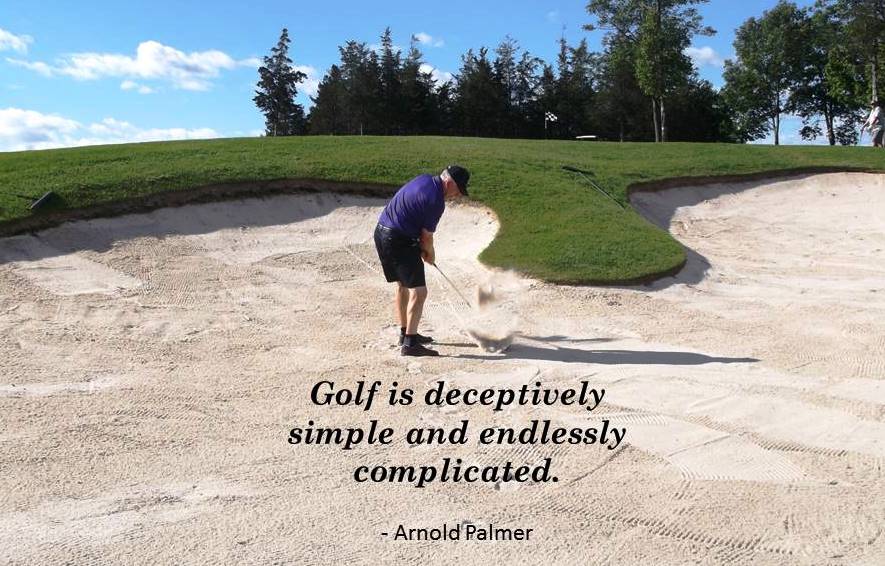
simple and complicatedAfter about 1 month off, I finally was able to hit the links. On Thursday past, I was able to get out after a charity tournament and had the course to myself. Arriving early, I hit a large bucket of balls, then chipped and putted for about 30 minutes. I had thought about how I would play this round trying to manage my expectations! You know exactly what I mean, knowing that your game is a bit rusty, you down play the end result as not to be frustrated while enjoying your time on the links!

As I walked to the first tee, a 150 yard par 3, a friend of mine was getting ready to play. Steve asked if I wanted to join them for their last hole. Of course, I said yes and waited my turn. Pulling my 7-iron, all I kept saying to myself was to keep my head down and swing easy. Well, to my surprise the ball ended up in the middle of the green. After an easy two-putt, I started with a par.

On par 5 second hole, I hit my third shot to 1 foot from 100 yards. A quick tap in and I was 1 under! Well, no one was more surprised than me! The par 3, third hole, par, and so on and so on! This was  one of my best front nines of the year. If I missed the green, I chipped to within 2 feet. If I hit a tree (which I did twice) the ball bounced into the middle of the fairway. I even hit a bunker once and the ball bounce out onto the green! It seemed that I could do nothing wrong. I finished the front nine with a 1 under 35!

As I walked to the 10th hole, I started to think. Yup, I know, that was a big mistake! The last thing I should have done was to start thinking. I was starting to play out the back nine in my mind and I envisioned shooting under par for the second time this year!

Opening with two bogies, I started to worry about my swing. Instead of swinging slow and controlled like the front nine, I tried to hit the ball a bit farther and to shape the ball. This strategic error was the start of a different outcome.

As the back nine unfolded, I tried several times to regroup and was successful for the most part. The one technique I relied on the most was my pre-shot routine. During the front nine, I relied on my pre-shot routine to keep focused and steady. The first two holes of the back-nine I change what worked and it cost me immediately. So, back to what works and presto – I was back on track.

As the back nine continued, I struggled with my swing more and more. Mostly, I was getting tired and as you know, your swing starts to breakdown when you are tired. Trying to stay focused, I started to really work at my game. The last 6 holes was all about course management. Instead of trying to crush the ball, I started to play to distances. This approached worked well and I played the last 6 holes 1 over (2 bogies and a birdie)!

At the end of the round, I shot a 74 from the tips! It was one of my best rounds of golf of the year. After a month off, my round exceeded all of my expectations! Now I have a dilemma, trying to remember how I played on the front nine and duplicate it the next time I play! The biggest test will be to keep my brain out-of-the-way and let my body naturally play as it knows how!

I have never taken this long of a break during golf season and been so successful upon my return. I am a bit out of my league, grateful golfers, I need some help. How do you propose I keep focused on the positives from my last round of golf and incorporated them in my next round? Any suggestions would be gratefully appreciated!

I am a grateful golfer! See you on the links!