On A Train Bound for Nowhere!

kenny-rogers-gambler

Are you a gambler?

The Gambler by Kenny Rogers is stuck in my head. For some reason I keep saying the words and humming the tune. After a short while, I realize that there is a lesson to be learned if I decide listen to what Rogers has to say. The chorus particularly applies to golf. Take a look:

You’ve got to know when to hold ’em
Know when to fold ’em
Know when to walk away
And know when to run
You never count your money
When you’re sittin’ at the table
There’ll be time enough for countin’
When the dealin’s done

How many times are we faced with a risk/reward shot? We walk up to our ball and weigh all the possibilities for success. Then a small voices starts to point out a small percentage shot that would advance the ball towards the green. Suddenly, we are more focused on a ‘losing hand’ then making the smart shot. Tunnel vision sets in and now the only option available is to make the impossible shot.

Enter stage right – The Gambler! Instead knowing when to make the safe shot and invoking proper course management, we attempt the impossible. Most of the time, it does not work. We attempt another crazy shot, then the score counting starts. The pressure mounts and low and behold, a bogey turns into a triple! Ouch! We walk to the next hole mumbling to ourselves how foolish we played the last hole!

Course management is critical in golf! It helps players navigate around the links in the most efficient way possible. It helps players decide when to ‘take their medicine’ or to press a difficult situation. Course management is extremely important if a player wants to lower their golf score. Want to learn more, check out one of my previous articles on course management.

Next time, before you hit the links, think about the chorus from The Gambler! I bet it will change your mental approach to your game and positive things will happen!

I am a grateful golfer! See you on the links!


UK Golfing Adventure – Part 2


Norwood Golf Course 3 Nov 14 (12)

On the bridge at Northwood Golf Club

My golfing adventure in the UK was very exciting. As stated earlier, I had a fantastic time and was treated like royalty by my best friend. While my stay was short, we did pack plenty of golf in the four days. We spent three days trying to conquer the Northwood Golf Club, my friend’s home course.

I thoroughly enjoyed playing the Northwood Course! Besides the historic aspect of this fun track, the course itself was in fantastic shape. Despite the torrent of rain it received leading up to my arrival, the course was extremely well maintained, the greens were in great shape, and the staff were first-rate. Overall, I would rate my experience as a 4.5 out of 5!

Northwood Golf Course does not play extremely long (6473 yds). Most of the par 4s were easily reachable and the par 5s on a dry day were in play as well. But, do not let the aspect of being a shorter course lull you into a false sense of confidence. The fairway bunkers were strategically placed, the green side bunkers were deep, and the elevation change between holes ensured that course management was vital to scoring low.

Norwood Golf Course 3 Nov 14 (9)

Approach shot to a Par 3.

Most of the greens were elevated, protected by bunkers, or the has a patch of rough to play over. Most of the hazards were fair and provided that touch of excitement to every shot. More importantly, choosing the correct club off the tee cannot be overstressed. Choose poorly and the complexity of the approach shot increased.

As you can see, there is nothing easy about the approach shots. The Par 3 was a 7 or 8 iron depending on the day and the pin was always up front. The slope of the green was from back to front making all putts from the back of the green very difficult. Also, the elevation change of 50 feet added to the difficulty of the tee shot.

Norwood Golf Course 3 Nov 14 (17)

Approach shot on Number 10.

The number ten green was the most challenging. What you cannot see is the green. It is kidney-shaped and that bends from right to left. The green narrows towards the back and the 15 feet of elevation on the approach shot was just enough to affect your club selection. Of course, we cannot forget the two deep bunkers on the left side. Anything short and left easily added an extra stroke to your score. The bail out area appears to be to the right, which was the correct play, but the rough was deep and wet. Overall, this was one of the most difficult approach shots on the course!

My Northwood Golf Club experience was excellent. I could go on describing the intricate aspects of the course, but I think you have gained an understanding of just how fun this course is to play. I looking forward to the opportunity to play Northwood once or twice more! If you want to see more pictures, I loaded them on my Facebook page: The Grateful Golfer.

I am a grateful golfer. See you on the links!

Golfing at a New Course

Golfing at a new golf course can be daunting. The unknown is always challenging and can have detrimental effects on the mental aspects of golf. Most amateurs will fill their minds with self-doubt once the excitement of a new adventure on the links runs it course. Personally, I love playing new golf courses because of the challenge it provides my overall golf game.

In a couple of weeks, I will be playing golf in the United Kingdom with my best friend. We plan on playing at his home course at the Northwood Golf Course in Middlesex, UK. I am excited to play there and I am mentally preparing myself for an awesome time on the links!

To prepare to play at a new golf course, I use visualization, positive thinking, and research to help shoot the best score I can. Since my golf season is over in Canada, I will need to focus more on the mental side of my game to ensure the rust of inactivity does last very long.

There are a few aspects I like to focus on before playing a new course. These things help me score low and enjoy my time on the course.

First, I play a bit more conservatively than normal. I focus more on course management, try to leave my approach shots at around 100 yards, and do not challenge hazards. By playing more focused golf, I tend to score better.

I spend a bit more time on the putting green. Most of the time, the most strokes are lost on the greens. By learning the roll of the green, the length of the grass, and some subtile aspects of the breaks of the greens, my scores stay relatively consistent.

Lastly, I focus on hitting off the tee. Using my driver is not always the smartest play when faced with unknown shots. However, I try keeping the ball in play more than normal and sometimes that means using a different club than driver off the tee. It is important to park my ego at the clubhouse.

Playing a new course can be both challenging and fun. Personally, I like both aspects when playing a course for the first time. I will have that chance soon and I will let you know how it went! Do you like playing new courses?

I am a grateful golfer! See you on the links!

Course Management in Golf

Play the shot that makes the next shot easy.

Tommy Armour

Course management is a familiar topic in golf. To manage your golf game is challenging, depressing and rewarding all at the same time. We have all played rounds of golf where nothing seemed to go well and others where mistakes could not be made! Most of the time, the difference between a final score of 75 or a 78 is course management. Like chess, playing golf requires a player to think at least two shots ahead before taking a swing.

Hitting the best club to set up his next shot.

Hitting the best club to set up his next shot.

Focusing on your shot at hand is obviously the first step to course management. Proper execution of this shot is critical to low scores. When I talk about execution, I do not mean contact of the ball (although this is very important also). What I mean is executing the shot that best sets you up for the next shot. Sometimes that means hitting your 3-wood as close to the green as possible on a par 5 or laying up to 100 yards to have a full shot over a hazard. The most interesting aspect of course management is that it is different for every player! The reason for the differences are that each player shapes the ball differently and hits each club different distances. Therefore, their course management has to be different.

Trying to advance the ball too far usually spells trouble!

Trying to advance the ball too far usually spells trouble!

However, before hitting the first shot, determining what the next shot should be will help with club selection, how to play the shot, whether to punch the ball out of the woods, or try to hit the ball 75 yards down the fairway around a tree. Every shot has infinite variables that are hard to list. The most important thing to consider is what you are planning for the next shot. This part of course management is really what sets up how a round of golf is played. Not staying focused on the next shot is where most amateurs run into trouble!

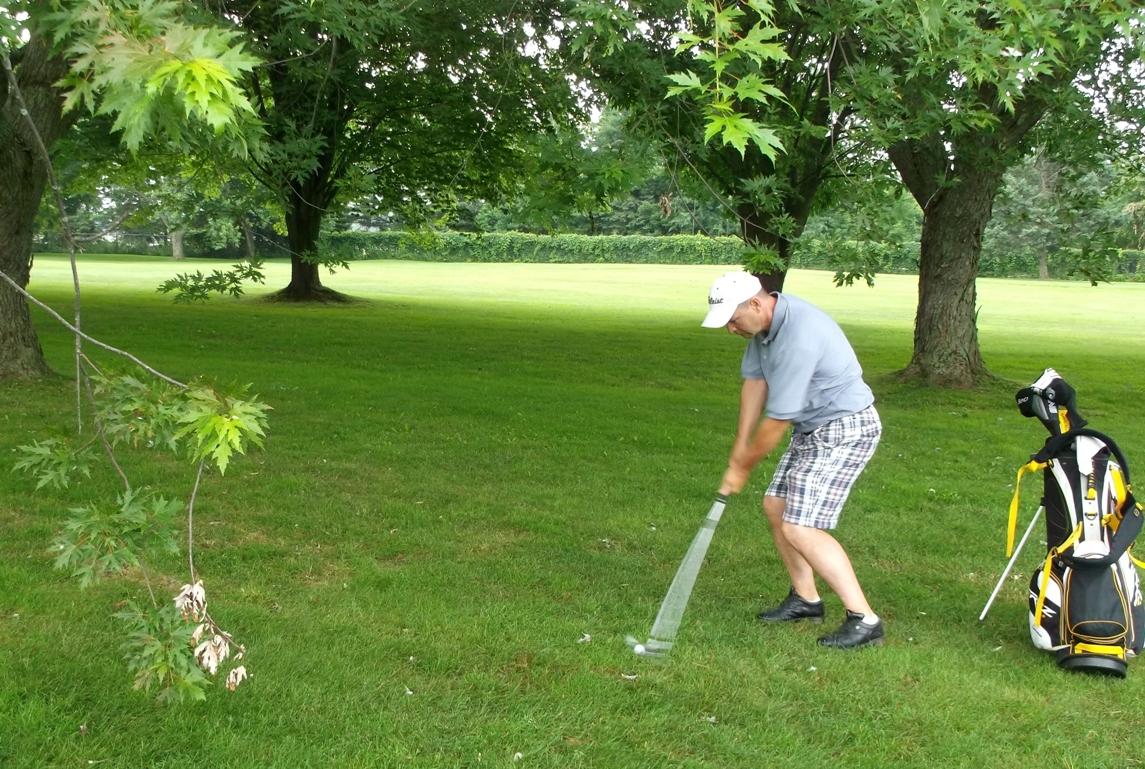
Under a tree

Under a Tree on the 15th Hole. Managing this shot properly will be the difference between par and double bogey!

There are three simple rules I follow to make my next shot easy. I use these rules as the basis to scoring well or at least trying to score well.

  • When in the fairway, always go for the green if in range! Greens In Regulation or GIR is the most important statistic in golf. Personally, I would rather play a short chip or out of the sand then to have a 30 or 40 yard chip to the green.
  • When hitting from the rough, I use my hybrids. I cases where players are not using hybrids, then use an iron. I know many players will suggest that if the lie is good then hit a wood, but the higher percentage shot is to hit a hybrid or iron.
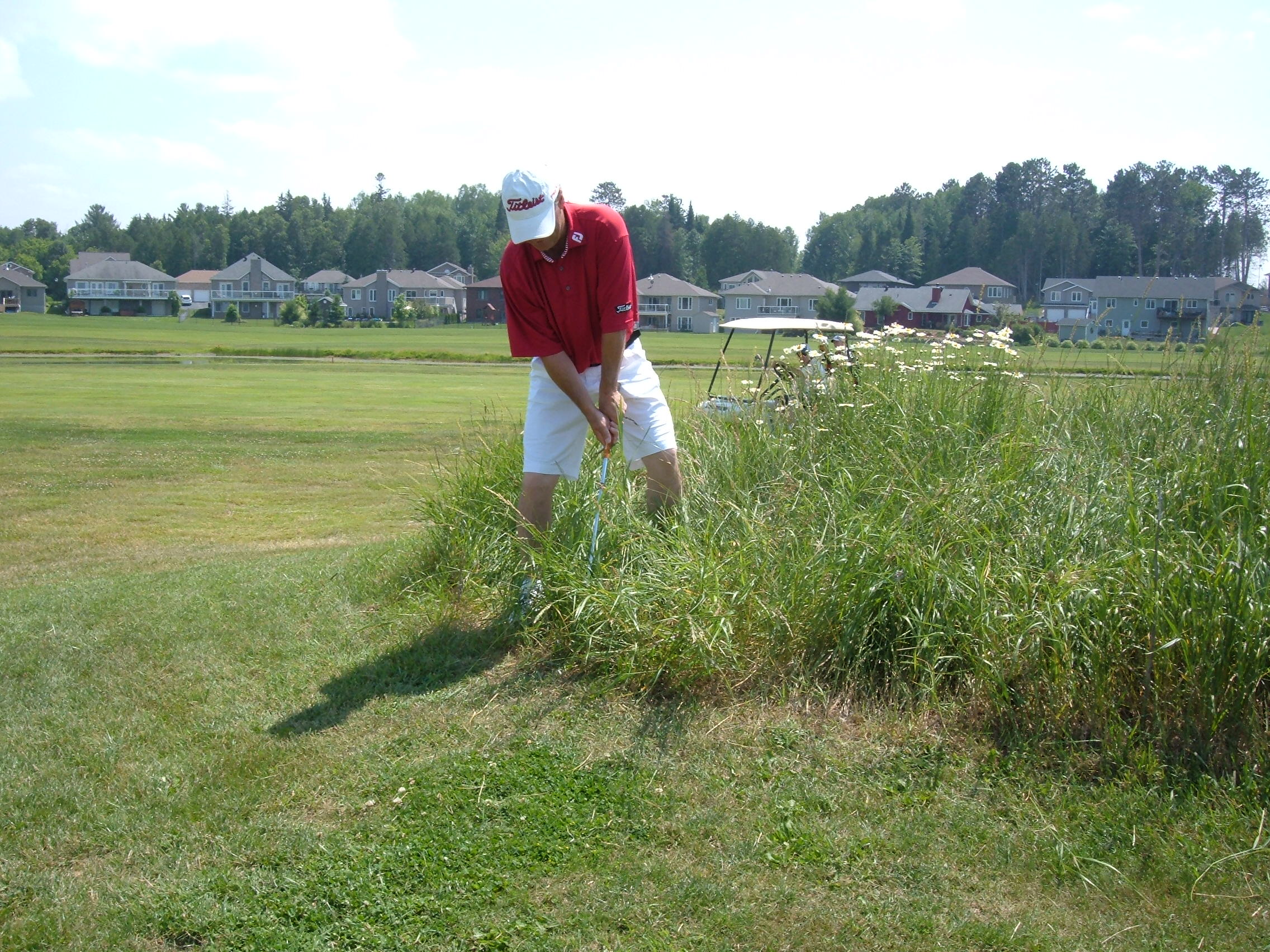
  • When playing out of the woods, do not get greedy! The moment I try to squeeze an extra 10 or 15 yards out of a difficult shot, disaster strikes! Taking my medicine is the safe play! This does not mean that I do not try and find the most advantageous exit from the woods, it means that I have to be smart about setting up my next shot!

I am sure there are many other rules that players use to keep their score low. Depending on the competition, others rules will come into play, but for most amateurs trying to break 100, these three rules are plenty.

This is my approach to course management. Do you have anything to add?

I am a grateful golfer! See you on the links!

Playing It Different In Golf

Hitting to the second green from 150 yards out!

Hitting to the second green from 150 yards out!

Playing to win at golf is no-brainer. It is not a profound statement, but carries many “ah-ha” moments. Avid golf pundits suggest that course management, playing the ‘smart’ shot, or avoiding a hazard at all costs will lower your golf score. In some cases, the logic of playing it safe is a solid approach to golf, however it cannot be the default approach to play winning golf.

As always, when my friend and I get together we talk about our golf game. We talk about the recent changes to our swing, new techniques we discovered and how we play certain holes on our home course. We both find the conversation very interesting and sometimes very enlightening. Last night was one of those conversations where I experienced an “ah-ha” moment.

He described his double bogey on a short hole, just over 300 yards, at the Northwood Golf Club, Middlesex, UK. His shot off the tee only has to carry about 190 yards to clear a sand trap. He suggested that it is narrow past the trap and playing for position was the ‘smart play’. Never seeing the hole, I agreed that it seemed like a logical approach. He says that hitting a 5-iron off the tee puts him into  a safe position and clears the traps without any real problem. Recently during a career round, he approached the 17th tee and started to think. After a ‘angel verses devil’ conversation in his head he took out his 6-iron. He wanted to flop the ball just over the traps to play it safe and to protect his score! Well as expected, the ball did not carry far enough and lodged itself just below the front lip of the sand trap! Five-strokes later he recorded a double-bogey!

This situation has happened to us all! Instead of riding the wave of success, we try to protect our score. This phenomenon is common in golf because most players count their score when playing well. As a result, our decision-making is impaired and more times than not the results are not what we expect. In my friend’s case, playing it different did not work to his advantage.

Another situation of interest during our conversation focused on greens in regulation or GIR. As stated before, I believe GIR is the most important statistic in golf. If a player has a high GIR percentage, they are likely to score very well.

Our discussion turned to playing a shot from 180 yards from the green. He said that often he will play a shot 160-170 yards up the middle of the fairway to make sure that he is in play. He would then rely on his short game to get up and down. Further inquiry gleaned that he uses this approach for two reasons: he is confident with the shorter iron and to protect from pushing his ball left or pulling right into trouble. He stated that this approach works for him and has helped lower his score in the long run.

Well his approach is definitely playing it different to what I would play. At 180 yards I would still recommend going for the center of the green if you can carry the ball that far. My friend unquestionably has the skill to do so and I would recommend that he start being more aggressive. It is possible that this change in tactic may not positively affect his score, but in the long run I believe it would be better for his game. A by-product to my approach is an improved GIR stat and given how well he putts, a lower score.

The interesting point about our conversation was that there are no right or wrong answers. Each golf shot should be played at the moment after taking in all the prevailing factors. There is little question that my friend’s approach works for him and has produced the results he looks for, however it is not the approach I would take. No matter how we look at golf, everyone has an opinion that suits their game and playing it different in golf is whats makes it fun!

I am a grateful golfer! See you on the links!