Which Golf Ball is Best for You? – Pt3

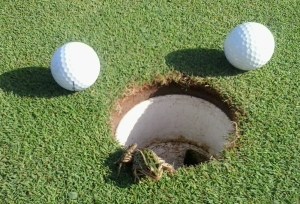
Frog 2 golf balls

Choosing the right golf ball may lower your score!

The feed back so far on my “Which golf ball is best for you” series has been inconclusive. Many players have selected their golf ball in the same way as me – feel, availability, and cost. The previous two posts, Part 1 and Part 2, have covered topics of construction and the number of pieces of a golf ball. To this point, this information provided a valuable insight into selecting a golf ball, but nothing conclusive.

This installment will include cover type, compression, and dimples. These three topics are important because they offer a greater selection for players who are looking for the right golf ball!

Golf Balls have two basic cover types: surlyn or urethane. Surlyn is a harder surface that is considered more durable and enhances distance. Urethane, which has replaced the balata cover, is softer and offers better feel and control; however urethane marks easier and is not as resilient.

“Golf compression rates determine what balls are used by different levels of golfers. Compression creates density in the golf ball, which may affect distance and loft. The golf ball is compressed and flattened by the force of the impact. The lower compression of the ball results in the ball ;travelling farther as the club’s energy creates energy, transferring it to the ball. The ball’s compression handles the high-speed and impact of the club, and allows flexibility so that the ball can recoil and not break apart.” (Golfsmith.com)

“Dimples on a golf ball create a thin turbulent boundary layer of air that clings to the ball’s surface. This allows the smoothly flowing air to follow the ball’s surface a little farther around the back side of the ball, thereby decreasing the size of the wake.” (Scientific America)

The type of cover, compression and dimples all effect a golf ball’s performance. There are many thoughts and reasons to select a golf ball based on its construction. Yet, the increasing information about golf balls seems to confound my decision on which ball to choose.

As I learn more about golf balls, the more my choice becomes clearer and yet, more confusing. How about you?

I am a grateful golfer! See you on the links!

Which Golf Ball is Best for You? – Pt2

The second installment of which golf ball that is best for you will focus on the construction materials of the golf ball. Originally, I was going to talk about the different internal compounds and external covers, however it was turning into a science lesson; definitely not the intent of this post!

I did however, find a video from Wired that quickly sums up the science portion of golf ball construction. Continue reading

Which Golf Ball is Best for You?

Of all the different areas of golf that influence our game, which golf ball is best for us is the most confusing for me. When choosing a golf ball, the options are endless. I have played around with different golf ball to use over the years, but I have never focused on anything specific or the reasons for choosing any specific ball.

This is an interesting video on what is inside a golf balls.

Continue reading

Golf Balls and Cold Temperatures

DSCF7212

Playing Golf in Cold Temperatures!

As winter continues to pound most of Canada, the discussions of the weather is never far away. During previous posts, I offered suggestion on how to play in cold weather to help improve your game. One area that I have overlooked is the effect of cold weather on your golf equipment. Specifically, your golf ball; after some research, I realized that this oversight might very well be robbing me of chance to score low in cooler weather!

There are three aspects of cold weather that affect your golf ball that every player should understand. They are not difficult concepts and they are easily rectified. Understanding how cold weather effects compression, ball flight, and feel on the club will ensure you are always ready to shoot your lowest score.

The optimum temperature for a golf ball is 80 degrees. As a ball’s temperature drops, it won’t compress as much off the clubface. For maximum playability, store the balls at room temperature.

Compression of the golf ball is a key fundamental to hitting the long ball.

“The golf ball is compressed and flattened by the force of the impact. The lower compression of the ball results in the ball; travelling farther as the club’s energy creates energy, transferring it to the ball. The ball’s compression handles the high-speed and impact of the club, and allows flexibility so that the ball can recoil and not break apart.”

6215.WA_Titleist-zone-5-Golf-ball-philosophyUS_09During cold weather, high-compression golf balls are not as effect or efficient because they are more difficult to compress. If you are playing golf in temperatures below 60 degrees F or 15 degrees C, I recommend a lower compression ball or a high-compression ball designed for colder temperatures.

Ball flight is a challenge in cold temperatures. As an ex-aircraft technician, I understand the theory of flight. Although cold temperature helps an aircraft take-off sooner; the same cold temperature shortens the your ball flight. Without going through the science of cold temperatures, it is enough to say that the air is more dense due to the slower movement of molecules. As golfers, we say the air is thicker. This thicker are makes it harder for the ball to travel in the air because it has to push its way through more resistance. The more resistance, the more energy required for your ball to travel the same distance in cold temperatures vs warm temperatures.

The last challenge of cold temperatures is feel. Everyone one of us has hit a golf ball at one time or another and felt a stinging pain in our hands. Immediately, we exclaim “that felt like hitting a rock!” Well, we should not be surprised because the materials that make up a ball are basically plastic and rubber (simplified version). As we all know, both harden when exposed to cold temperatures. Therefore, as we hit the ball and more importantly miss hit a ball in colder temperatures, the feel of hitting a ‘rock’ is amplified. My advice is to swing slightly less aggressively and club up! It will help save your hands and improve your feel!

I found the following at TheSandTrap.com where they quoted the PGA Teaching Manual as a source. As you can see, cold temperatures make club selection more challenging:

The temperature of a golf ball affects its ability to rebound from the clubface. The following chart is the approximate influence of temperature on the ball for a shot that would normally carry 220 yards at 75 degree temperature.

  • Yards — Temp
  • 226 ——- 105
  • 224 ——- 95
  • 222 ——- 85
  • 220 ——- 75
  • 216 ——- 65
  • 214 ——- 55
  • 205 ——- 45
  • 196 ——- 35

It gives the reasoning of rubber being a poor conductor of heat.

I also asked golfers what temperature they would most like to play in and this is what they said:

It is not surprising that just about half the respondents like to play in 80 degree weather. I am sure it has as much to do with the playing temperature as well as the performance of their golf ball.

Golfing in cooler temperatures does pose challenges from most golfers. Understanding the effects temperature plays on your equipment can help mitigate mistakes before you tee up. Selecting the proper golf ball is the first step to shooting your lowest score regardless of the temperature.

Do you change golf balls depending on the temperature?

I am a grateful golfer. See you on the links!

In or Out?

How many times have you watched the ball edge towards the hole. The world slows down, the wind stops blowing and the only sound you hear is heart! This exciting time compounds during a tournament or a match with your golfing buddies.

In or Out

Holding His Breath! Did the ball go IN or OUT?

Last week, Mike was putting to win the hole. As you can see, he had time to stand straight as his ball eked towards the hole! the real question is: Did the ball go IN or stay OUT? You make the call!

I am a grateful golfer! See you on the links!