Unplayable Lie in Golf!

Of the many questions I answer relating to the rules of golf, the unplayable lie is one of the most popular. Rule 28 of the RGCA outlines all the details about what constitute an unplayable lie and your options regarding your decision. Additionally, the video below from Golf Canada also explains your options.

Before viewing the video, and I recommend that you do, there is one aspect of Rule 28 – Ball Unplayable that most amateurs do not fully understand. A ball unplayable can only be called by the player who hit the ball. Their playing partners cannot make the call for them. Additionally, an unplayable ball can be called everywhere except in a water hazard. Yup, that means that if you are in the middle of the fairway and for some strange reason you want to call your ball unplayable, you can.

This rule is very important. In my experience, it is a stroke saver and is one of the basic rules all amateurs should know! Now, enjoy the video!

I am a grateful golfer! See you on the links!

Golf Rules – Play the Ball Where It Lies

‘Play the ball where it lies’ is a fundamental rule in golf. It prevents players from using a foot wedge or other ingenious methods to improve their playing position. During competition, I completely agree with this rule; however when playing of fun, I have to admit that I am a bit more lenient.

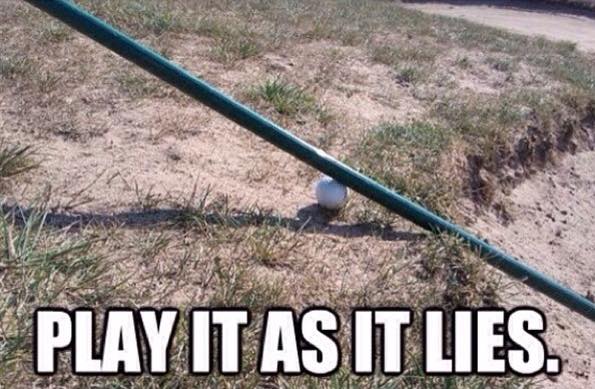
Back to being in competition. Recently, I received a picture from Golf Meme that I thought was pretty funny. I placed it on my Facebook page so others could share in my amusement. After a short while, I began to think about the rule that governed this situation. Unless you have read the rule book, the solution might not be all that simple.

Here is the situation:

Play it Where it Lies - Rule 24.1

There are many questions to pose for this picture. If you are asking yourself what to do, some of the questions might sound something like:

  1. Do I have to play the ball where it lies?
  2. Can I move the rake?
  3. Can I move the rake without penalty?
  4. What happens if my ball moves?
  5. Is anyone looking? A foot wedge would do the trick!

It is not unusual for golfers to find themselves next too, behind, on, in or touching objects on the golf course. The trick is to know which objects can be moved and which cannot. For this answer we must read:

Movable Obstructions (Rule 24-1)
Movable obstructions (i.e., artificial movable objects such as rakes, bottles, etc.) located anywhere may be moved without penalty. If the ball moves as a result, it must be replaced without penalty.

If a ball is in or on a movable obstruction, the ball may be lifted, the obstruction removed and the ball dropped, without penalty, on the spot directly under where the ball lay on the obstruction, except that on the putting green, the ball is placed on that spot. Rules of Golf – Golf Canada

According to the above rule, any player can move the rake without fear of receiving a stroke penalty. In a tournament, knowing this rule could be the difference between winning or losing your flight. If the ball moves, just place it back and keep playing.

A word of advice, always tell your playing partner what you’re doing to prevent any confusion or possible perception you are doing something wrong!

Reading and understanding the rules of golf are important. I carry a copy with me when ever I play. If you do not have a copy, maybe Santa can bring you one for Christmas.

I am a grateful golfer! See you on the links!

The RBC Canadian Open Golf Championship

The RBC Canadian Open Trophy!

The RBC Canadian Open Trophy!

The RBC Canadian Open Golf Championship starts tomorrow at the Royal Montreal Golf Club. Founded in 1873, it is one of only 66 golf courses in the world that hold the official “Royal” designation. The course will play as a par 70 at 7135 yards with six holes snaking around the large picturesque ponds. A Canadian has won this championship seven times since its inception in 1904; however, no Canadian has raised the trophy in 60 years! This is the year it will change.

Throughout its history, the RBC Canadian Open has shaped the face of professional golf in Canada.  Many of golf’s greatest names have claimed the Canadian Open Championship title including Byron Nelson, Arnold Palmer, Sam Snead, Greg Norman, Nick Price, Tiger Woods, Vijay Singh and Jim Furyk.

As the National Sports Organization (NSO) and governing body for golf in this country, Golf Canada’s mission is to promote participation in and a passion for the game while protecting its traditions and integrity.  We hope you enjoy this great championship and leave with an increased affection for the unique spirit of integrity, sportsmanship and fellowship that make golf the greatest game on earth. (RBC Canadian Open)

The defending champion Brandt Snedeker will be teeing it up with Dustin Johnson and Hunter Mahan at 8 am. There are many notables playing this year who are vying for the win. Of note, Matt Kuchar, Graeme McDowell, Ernie Els, Luke Donald and Jim Furyk. More importantly, there are 18 Canadians in the field with Grahame DeLaet, David Hearn, and Mike Weir leading the way. This is a strong field and the winner will have to stay focused for 72 holes to claim the RBC Canadian Open Trophy!

The pressure is on all the Canadians to perform. After 60 years, Canadian golfers are anxious to crown a locally grown hero and claim the title – “king of golf” – in Canada. This year, unlike years past, there are some players in the field that could bring the trophy back home. Grahame DeLaet and David Hearn are having great seasons. They are young, eager and skilled! Both are having great careers and this year they have jumped out to a strong start.

Normally, I would analyse more data before making a prediction, but this weekend I am going with my heart. Grahame DeLaet is the man who will be standing on the podium on Sunday! My dark horse favorite is Mike Weir! Having walked way out on a limb, any Canadian will do! It is time the Canadian Open Trophy is brought home!

I am a grateful golfer! See you on the links!

What’s Your Handicap?

Before you say your driver or 60 degree wedge, this is a valid question that most golfers overlook. This question popped up at work today and I thought it would make for an interesting topic.
2012 CN Future Links Western - Golf CanadaHere is what Golf Canada has to say:

The purpose of the Golf Canada Handicap System is to make the game of golf more enjoyable for golfers by providing a means of measuring one’s performance and progress and to enable golfers of differing abilities to compete on an equitable basis.

Through this system, each golfer establishes an “Golf Canada Handicap Factor” which is a numerical measurement of a player’s potential (not actual) scoring ability on a course of standard difficulty.

The Handicap Factor is calculated using the best 10 of the player’s last 20 rounds and updated with each new round played. The Handicap Factor travels with the golfer from course to course and is adjusted up or down depending on the length and difficulty of the course played, resulting in a “Course Handicap”. The Course Handicap is the number of strokes a golfer receives from a specific set of tees at the course played and represents the number of strokes he would require to play equitably against a “scratch” golfer (a golfer with a Handicap Factor of “0.0′). The more difficult the golf course, the more strokes the golfer receives and vice versa.

The real question dealt with what we considered to be a low, medium and high handicap. My friend suggested anyone with a 20+ score and I said 10+. Immediately we looked at each other and realized that something was amiss.

At SandTrap.com they suggest:

  • Low: Handicaps 8 and under (typically shooting in 70’s)
  • Mid: Handicaps 9-24 (low 80’s to mid 90’s)
  • High: Handicaps 25+ (high-90’s and up)

At Golfsmith.com, they suggest:

  • Low: Handicaps 9 and under (typically shooting in 70’s)
  • Mid: Handicaps 10-18 (low 80’s to mid 90’s)
  • High: Handicaps 19+ (high-90’s and up)

The last bit of information that is important is the average handicap for men and women. After checking many sites, the consensus is that the average male golfer has a handicap of 16.1 and the average female has a handicap of 28.9. So using this information, most golfers would be considered medium handicap players. Additionally, the definition of low, medium, and high handicap does vary, but the reasons for establishing a handicap do not.

To enter in some tournaments, handicaps are used to place players in flights against others of their own caliber. It is also used to calculate foursome handicaps for “Scramble” tournaments. And lastly, it determines how many strokes a higher handicap player will receive in a match-play event. Most players do not have an official handicap and for the most part it really does not matter.

Personally, I am a member of the Golf Association of Ontario. My handicap index is 5.4 or a 5 handicap with a scoring average of 79.2 over 20 games. For the golfer who plays many rounds a year, establishing a handicap is a good thing. It is part of the game and helps promote an often overlooked aspect of golf – fair play.

Do you have an official handicap?

I am a grateful golfer! See you on the links!
2014 Golf Rules – Decisions

IMG_20140517_074007My last post garnered some discussion about application and interpretation of the 2014 Golf Rules. Specifically, Brian Penn from All About Golf pointed out the finer points of rule 25-1 Abnormal Ground Conditions. Ultimately, we decided that hitting your ball into a temporary lake (and not being out-of-bounds or in a hazard) warrants a free lift no closer to the hole and to place our ball one club length within the nearest point of relief. Thanks Brian for the great discussion!

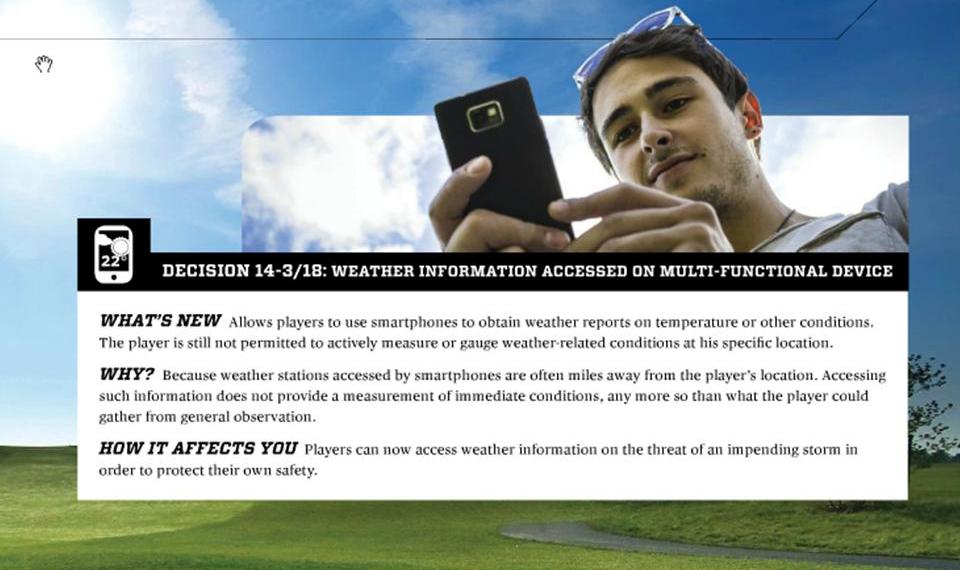
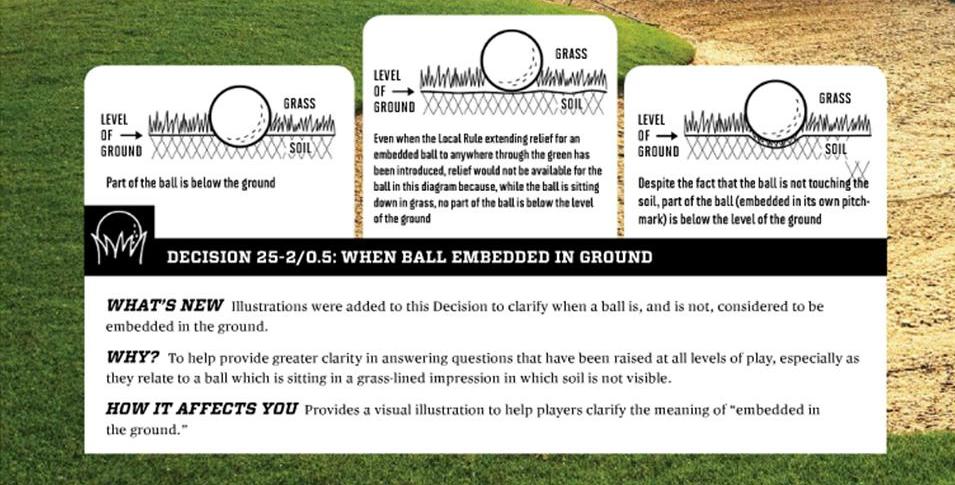
Coincidentally, my copy of Golf Canada Magazine came in the mail on Friday and I came across a two pages of golf decisions that are important for every golfer; specifically, those who like to compete.  I have discussed these rules before, but I want to thank Golf Canada for outstanding information and adding the “How it Affects You” portion. These small tidbits of information make all the difference!

2014 Rule Decisions provisional Ball 2014 Rule Decisions Weather Information 2014 Rule Decisions Imbedded Ball

Staying informed of the changing rules of golf is important. Understanding how to play within the rules is as important as playing golf. I have played in many competitions and every time a question about the rules surfaced. If you are still not convinced, read this article about Rory McIlroy who lost by one stroke at the 2014 Abu Dhabi HSBC Championship

I am a grateful golfer! See you on the links!