Of the many questions I answer relating to the rules of golf, the unplayable lie is one of the most popular. Rule 28 of the RGCA outlines all the details about what constitute an unplayable lie and your options regarding your decision. Additionally, the video below from Golf Canada also explains your options.
Before viewing the video, and I recommend that you do, there is one aspect of Rule 28 – Ball Unplayable that most amateurs do not fully understand. A ball unplayable can only be called by the player who hit the ball. Their playing partners cannot make the call for them. Additionally, an unplayable ball can be called everywhere except in a water hazard. Yup, that means that if you are in the middle of the fairway and for some strange reason you want to call your ball unplayable, you can.
This rule is very important. In my experience, it is a stroke saver and is one of the basic rules all amateurs should know! Now, enjoy the video!
My last post garnered some discussion about application and interpretation of the 2014 Golf Rules. Specifically, Brian Penn from All About Golf pointed out the finer points of rule 25-1 Abnormal Ground Conditions. Ultimately, we decided that hitting your ball into a temporary lake (and not being out-of-bounds or in a hazard) warrants a free lift no closer to the hole and to place our ball one club length within the nearest point of relief. Thanks Brian for the great discussion!
Coincidentally, my copy of Golf Canada Magazine came in the mail on Friday and I came across a two pages of golf decisions that are important for every golfer; specifically, those who like to compete. I have discussed these rules before, but I want to thank Golf Canada for outstanding information and adding the “How it Affects You” portion. These small tidbits of information make all the difference!
Staying informed of the changing rules of golf is important. Understanding how to play within the rules is as important as playing golf. I have played in many competitions and every time a question about the rules surfaced. If you are still not convinced, read this article about Rory McIlroy who lost by one stroke at the 2014 Abu Dhabi HSBC Championship.
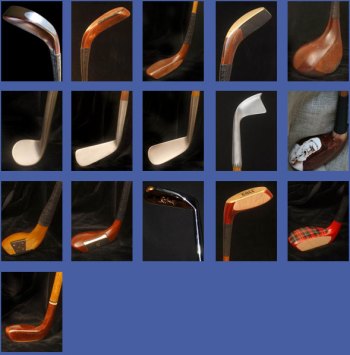
In 1938, the R&A introduce the rule limiting the number of golf clubs in a bag to 14. Prior, there was an unlimited number clubs any player could carry. Amateur golfer Francis Ouimet won the 1913 US Open carrying just seven clubs. Interestingly, 21 years later Lawson Little won the British Amateur using 31. Technology of the day drove the use of different clubs and the inconsistent nature of construction was a factor in the number of clubs used during any round.
As advances in technology, specifically the introduction of metal shafts, the need to carry many clubs seemed to disappear. The evolution of golf clubs is very interesting and the fast evolution of modern technology continues to drive the golf industry. Has the change in golf club construction actually contributed to the greatest changes in golf club performance over the years? Or is it something else?
Depending on what you believe or read changes in club technology might just be a red herring. Regardless, why 14 clubs? Why not 13 or 15?
According to Canada.com, golf historians suggest the 14-club rule was made to benefit caddies, because it was common for golfers before 1939 to use 20-30 clubs of varying styles and uses. Caddies would routinely double-bag – carrying two bags at a time – and many did it twice a day to earn a living. Well I would have hated to be a looper then.
Rule 4-4. Maximum of Fourteen Clubs. The player must not start a stipulated round with more than fourteen clubs. He is limited to the clubs thus selected for that round, except that if he started with fewer than fourteen clubs, he may add any number, provided his total number does not exceed fourteen.
So there you have it, the 14-club rule was introduced for caddies, not technology, not to make if fair for everyone, increase speed of play or even to help drive the golfing industry by reducing the number and types of clubs they have to manufacture. It was all for the caddies.
Announced today are decisions about the rules of golf for 2014 and beyond. According to the USGA and R&A, “decisions” are updated every two years and the actual Rules of Golf are updated every four years. The ability to change the rules of golf to adapt to its evolving nature is extremely important. Most weekend golfers are less concerned about the real rules, but if you have a wish to play in any competition, knowing or not knowing the rules will affect your score.
This year, some of the decisions address important aspects of the game and some of the more trivial areas. I will let you decide. All decisions below taken from the tsn.ca website. The first decision deals with those who analyse video and call into the tournaments to report a rules infraction. Decision 18/4 outlines that a player will not be penalized when “enhanced technological evidence” shows that a ball moved, it will not be deemed to have moved if not “reasonably discernible to the naked eye at the time.” The ever-increasing involvement of arm-chair golfers forced this decision. This is a good rule, because it puts the onus on the player to be his own referee – exactly where it should be!
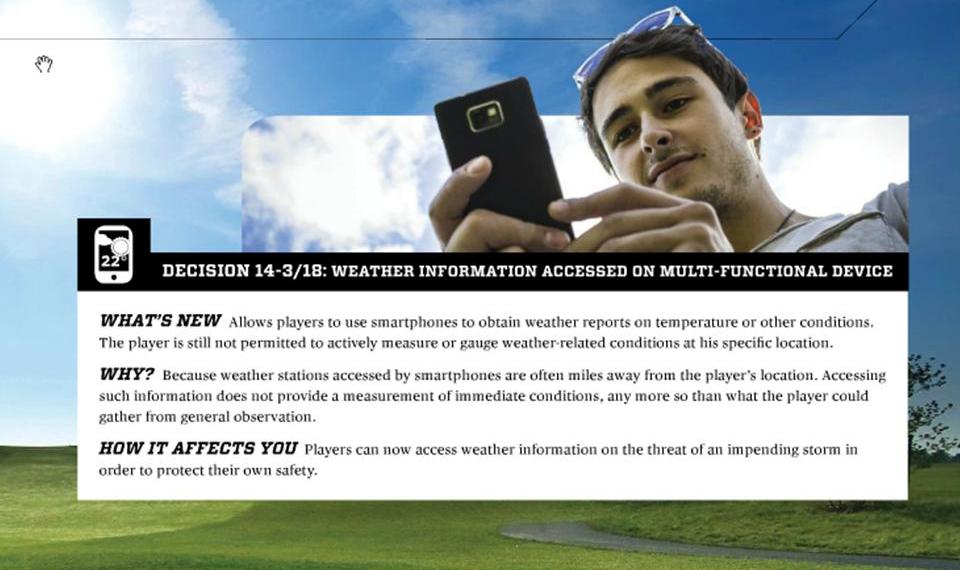
Decision 14-3/18 allows players to use smart phones to access weather reports. The new decision also clarifies that players are permitted access to information on the threat of an approaching storm for their own safety. This rule is more for the amateur than the professional. Being caught many times in questionable weather that turned into a storm makes this decision a smart idea. Actually, I did not know it was against the rules…go figure.
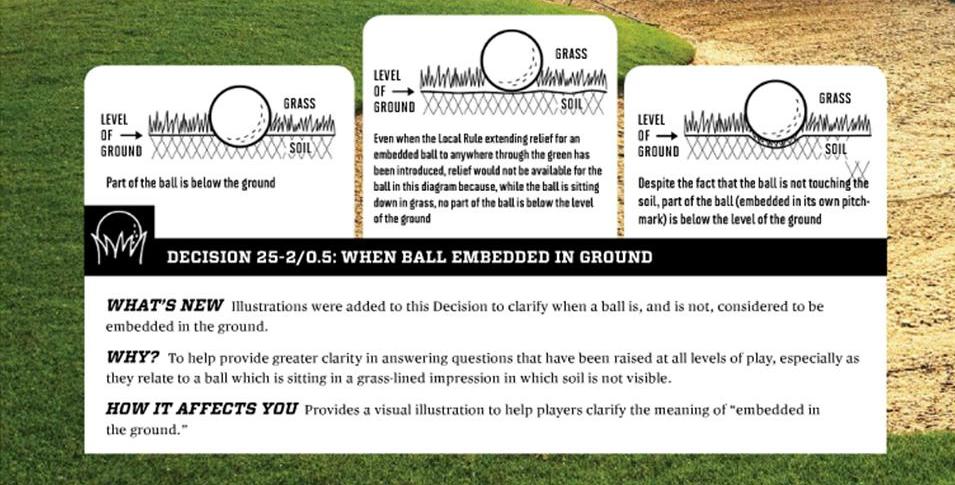
Decision 25-2/0.5 was revised to clarify when a golf ball is embedded. Officials have noticed an increased in tour players asking for relief, and a debate on whether the ball has broken through the soil. The revised decision will be accompanied by illustrations. Ok, I am sure there will be many who suggest that is really not an issue, however, if you hit the ball hit like the pros and play on soft courses, embedded golf balls does pose a problem. Not 100% sure this decision will fix the issue, but time will tell.
Decision 27-2a/1.5 was revised to allow players to go forward 50 yards without losing their right to return to play a provisional ball. Okay, I know Phil Mickelson walked 120 yards to the green, fixed the pin and almost jugged it, but really. You know someone is going to count the steps and determine the yardage by the players gait and…..well I think you get the point!
The rules of golf are ever evolving. It is good for the game to keep up with new technology and course design. I am not convinced that some rule changes are driven by the golfing industry, but that is a discussion for another day. A great website on the rules of golf is found at http://www.rulesofgolf.ca/.



 The Grateful Golfer