Seeing and Believing

Welcome to the second installment of “Seeing What is Important” when playing golf. As we prepare to watch The Masters, it would be in our best interest to pay attention to what the players and caddies are saying and where they are looking while preparing to make a shot. Value is gained by focusing on their conversations and the language they use to discuss influences on their game.  The last post dealt with knowing your yardage, what the wind was doing and how the ground felt.  I wonder if the pros at the Shell Huston Open are talking about how these variables affect their score!

Learning the finer points of golf can occur anywhere; watching the pros, your buddies or complete strangers navigate around the links. Rarely is a golf course hazard free. Every hole as something that will catch your eye; something the makes your hair on your neck stand up; or something that makes the voices in your head start to speak!

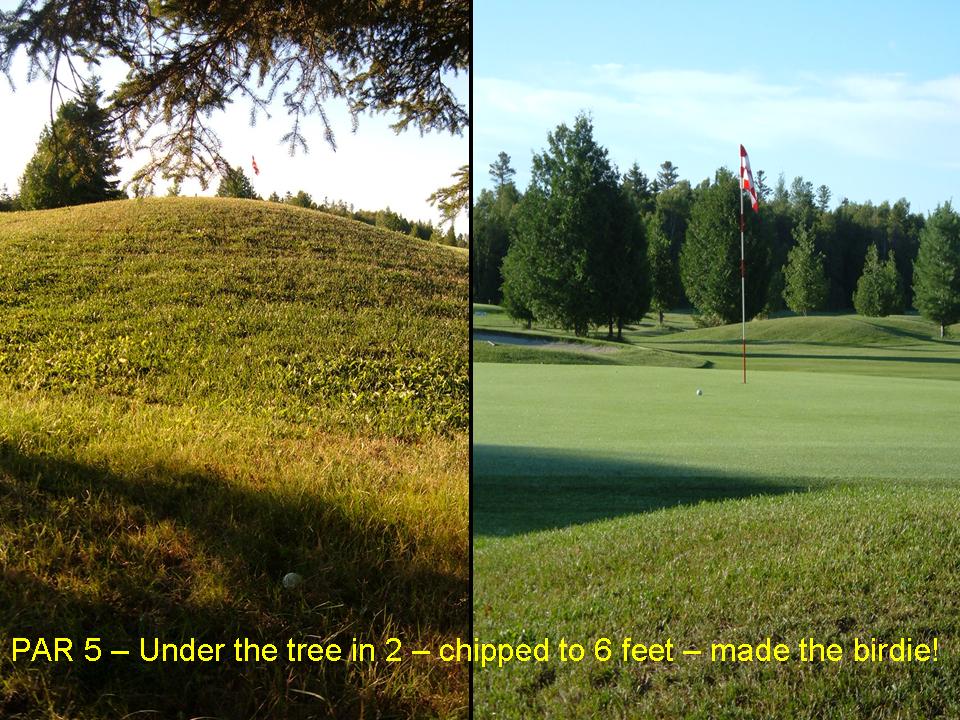
Uphill shot

Landing area is higher than tee. Expect to hit shorter off the tee.

down hill shot

The green is below the ball. Time to throttle back!

Unlike a mirage, most changes in elevation on the course are real. Elevation changes are the most misunderstood challenge on any golf hole.  Modest changes to the elevation will create a 1/2 to 1 club difference regardless of the yardage.  The challenge for most players is to determine if the modest changes in elevation are real or not.  Here is my guideline – if I can see the entire fairway leading to the green without it looking smaller – throttle back and think about hitting one less club.  If the fairway looks like a railroad track going away, the yardage is as paced.  If the fairway disappears quicker; add one club to your approach shot.  This rule of thumb works for me.  Thanks to the Dave at One Bearded Golfer for this topic!
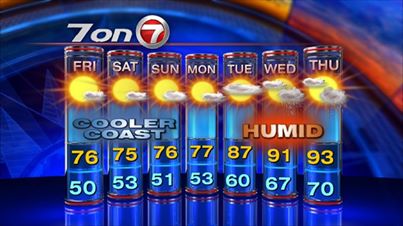
Cooler and Humid

Your ball will travel further on Tuesday, Wednesday, and Thursday!

The second point for today deals with the temperature! Most experienced golfers are saying that the colder the temperature the shorter the shot; but wait, there is more. Temperature is really broken down into three categories: Temperature, Barometric Pressure and Humidity.  As an overview, the ball travels further if it is hot, your golfing at a higher elevation like my buddy Craig in Denver, and the greater the humidity. For amateurs, this is hard to believe, but it is true.  For a more detailed explanation, check out Golf Digest.

Last tip is to believe is what you see and visualize what you want.  How many times have I heard the saying, “come on, this is ridiculous!”  There will be many times over a round when a player thinks they hit the perfect shot; only to walk up to the green and wonder what happened.  After shaking their head in disbelieve, they walk to their ball and hit a poor shot and blame it on their lie.  As an experienced golfer, I would have to tell that player that the lie did not cause the problem – it was caused by disbelief; then frustration.  Acceptance to the situation is extremely important to lower scores.  Everyone hits poor shots, it is the next shot the will determine if you score a par or double bogey – you get to choose.
Slide1

There are many optical illusions in golf and it takes an experienced eye to identify them and adjust their shot accordingly.  Understanding and recognizing the potential hazards is one of the first steps to lowering your score.  Anyone can do it, it is a matter of “Seeing and Believing!”

I am a grateful golfer!  See you on the links!

Seeing What’s Important!

Jims EyeGolf is a unique sport that requires mental focus and attention to detail.  Most beginners miss the subtle signs and sometimes the obvious signs while walking the links.  It is very important to read the signs the course, weather, and your surroundings tell you while you are walking to your ball, visualizing your shot, or reading the greens.  The challenge for most inexperience players is they do not know what the do not know.

To rectify that problem, it is important to break down the signs and explain them in the context of any golf shot.  So, over the next couple weeks, we will address this knowledge gap and explain what is important to see ‘what is happening’ when you’re hitting the links.

Along the way, if anyone has suggestions, please speak up to improve the quality of the information.

The first area of “Seeing what’s important” is while walking to your ball.  The little signs around you are more significant than finding it and looking at the green.  Although those are important, a couple other things many be just as important.

First, what is your yardage?  If you have a Garmin Approach 6, (no affiliation) determining your yardage is easy.  However, if not then it is time to pace the distance.  Some courses have the yardage on the sprinkler heads, but most of the courses use the 200 (blue), 150 (white) and 100 (red) yard stakes placed in the middle of the fairway or off to the side.  The key to pacing off your yardage is to start at your ball and walk in a straight line forward or backward keeping the pin and ball on that line.  Walk to the closest yardage marker and do the math. Pacing your yardage will help with club selection.

Second, what is the wind doing?  This may be obvious, but it is important to understand that the wind at ground level might be different from the wind above the trees or in an open area.  The key to knowing the wind direction is to look at the top of the trees.  The direction they lean is the direction of the wind.  Lastly, look at the flag on the pin.  This is a good indicator unless trees on all sides, except the fairway, surround it.  However, I think you get the point.

Third and last for today, how does the ground feel under your feet?  Is it soft, hard, or normal?  Why is that important?  Well if the ground is hard the club will bounce and therefore prevent the player from getting a clean hit on the ball.  If the ground is soft, there is a very good chance a player will dig in with their club and only it the ball a couple of yards.  I am sure you understand what to do with ground that feels normal.

As you can see, we have only scratched the surface of “seeing what is important” when preparing for a golf shot.  These tips were learned over the years through trial and error. Wisdom says that the more I pay attention, the better I score.

I am a grateful golfer!  See you on the links!
Seven Days in Utopia

Recently, I was surprised by a golf movie called Seven Days in Utopia. The movie dealt with how golf is not just a game, but has an impact on our entire life.  As I am always on the hunt for a good golf movie, Seven Days in Utopia is one I would watch again next winter.

Utopia

The overview of the move is: After a disastrous début on the pro circuit, a young golfer finds himself unexpectedly stranded in Utopia, Texas and welcomed by an eccentric rancher.

Robert Duvall is Johnny Crawford and ex PGA player.  He says the classic line about Luke Chisholm (Lucas Black): How can a game have such an effect on a man’s soul? The way I see it, how can it not? You don’t chose the game, it choses you. And when it does, life and golf become forever connected. That’s how it was for a young man named Luke Chisholm.

I do not want to give to much of the movie away, but I do think it is worth a watch.  The movie can go two ways for the viewer.  As a golfer, It offers some great advice that can help anyone’s game.  As a feel good movie, it talks about how the world around us affects all aspects of your game.  I found the movie enjoyable.  I hope you do as well!

I am a grateful golfer!  See you on the links…..soon!

White Noise

I received an excellent golfing book as a present at Christmas; 365 Golf Tips and Tricks from the Pros by Jay Morelli.  This book talks about the basics, rules, sand play, equipment and much more.  It is a very quick read and the tips are concise and to the point.  I recommend it.

This very thoughtful gift started me thinking.  How do I know the difference between a good tip and well…..white noise.

White Noise - Make it Stop!Yes, we all know: white noise  does not add to the situation and drowns out the important information.  This noise can be anything from your 20 handicap playing partner advising you how he they would play the shot while you are thinking; 50 things you are trying to remember during your golf shot or the reams of information (4,930,000 hits to be exact) that that overwhelms you when searching on “how to improve my golf swing”. White noise is all around us all the time. It is a distraction that does slow anyone’s ability to improve their golf game and for $19.95 I can guarantee to improve your mental skills while playing golf….okay, just kidding. But, this is the exact type of white noise that many amateurs will here day in and day out that causes confusion.  Can it really be avoided?  Well, that depends….

Golf is a unique sport.  It is difficult and easy, played as teams and individuals at the same time, or creates inclusiveness or solidarity.  It really is the one sport where a person can play their entire life, compete against no one and yet compete every day.  Golf is a sport where a player can challenge themselves everyday and feel a sense of accomplishment after each round.  No other sport provides this type of dynamic.

Everyone has their own process to cut white noise.  Everyday, we are bombarded with information that is filter, processed, acted upon, or discarded.  The difficulty is to figure out what is important and which process works best; then apply it to golf.  For me, the process is simple:

  1. Identify the problem;
  2. Collect information on the problem;
  3. Analyse the information;
  4. Determine possible solutions or courses of action; and
  5. Decide on way ahead. (repeat as necessary and as often as needed)

Everyone does this process everyday for practically every situation.  However, some golfers looking for a quick fix seem to skip steps 2 and 3.  As an example, Player A always slice the ball off the tee.  They jump to the solution to change their grip because their 20 handicap partner noticed something.  It worked….once.  They decide to change their grip and ultimately, no success!

Instead, the process could look like this:

  1. Player A slices off the tee;
  2. Talk to local Pro or low handicap player, read about why this happens, watch golf training videos;
  3. Compare information gathered to current swing (whole swing not just a specific point);
  4. Try possible solutions on the practice range.  Try different things.  Select several possible solutions (ask local pro for help); and
  5. Decide on the best fix for Player A.

To adjust something in your golf game does take time.  This process does work (at least for me) and is very been very effective in improving my game.  The question always boils down to how much time are willing to commit to making improvements. This is the balancing act that all players must do to achieve their golfing goals.

I am a grateful golfer!  See you on the links!

Generate More Power In Your Golf Swing

Generating more power in your golf swing usually equates to greater distance.  And who wouldn’t want more distance off the tee and fairway.  Would increasing your distance off the tee by 10-20 yards make that much difference in your game.  Most golfers would yell a resounding YES!  Unfortunately, most amateurs do not have the skill to just change their swing and generate that extra power needed to move to the next level.

After a quick search, answering the question – how to generate more power in your golf swing – may not be as easy as it seems.  There are many reasons for not generating power in your golf swing and Professional golfer Micheal Campbell outlines six possible reasons:

  • Reverse Pivot
  • Sway or Sliding
  • Early Turn
  • Over Turn
  • Collapsing at the Top
  • Rolling Arms

If you are novice player, you are saying okay….but…..how do I tell if any of these reasons apply to me?  These six points are very important and he provides solutions that make sense.  I am sure there are other reasons, but to list everything that can possibly go wrong is not really helpful for the weekend looper.

So, where do we start?  What exactly are we doing wrong?  How do we know if it is helping?  Where do I find the answers?  These are all great questions.

The first step is to set a goal.  Through the winter, I traditionally set three.  The first for this year is to focus on generating more power to consistently gain 20 yards off the tee.

Second step is to do the research.  Reading golf blogs like Hitting It Solid by Troy Vayanos or All About Golf by Brian Penn, provides an endless supply advice on a wide variety of topics.  Personally, I find this very helpful.  I enjoy reading and trying new tips, skills and ideas to improve my swing.

Last step is to use your newly learned skills on the range.  In my case that will be next March!  Unfortunately, an eight-month golfing season is the price you pay for living in an awesome country like Canada.  Regardless, using the skills is a vital step to improving your game.

One last point, if you do not know where to turn, try taking lessons from a pro.  It definitely provides a positive environment with a knowledgeable instructor that will improve your game.  Going to PGA members like Rick Williams at mindbodygolf.com may be the best investment you make in a while!

I am a grateful golfer!  See you on the links….in four months!