Hitting the ball first with our iron has many benefits. The goal to hit consistent iron shots is one technique most amateurs struggle to achieve. We may have some success with the shorter irons, but venturing into the mid and long irons usually poses fits for most golfers. All of this is because we have the wrong view on where the divot should be made and where our swing bottoms out. Following this path of understanding a bit farther, knowing about the angle of attack is where all of the above discussion leads. Knowing about the angle of attack with our irons will definitely improve our overall game and lower our golf scores.
Continue readinglaunch angle
Teeing The Golf Ball at the Proper Height
Teeing the ball at the proper height is a common theme in golf. It is a fundamental skill that all amateurs must master to produce those “Rory McIlroy” drives to which they aspire!
The challenge for non-professionals is the contradictory information on the subject! There is a consensus on the height of the tee and where to the ball should make contact with the club face. This is what most analyst agree on:
Teeing too low – This causes lower spin rates and therefore a lower trajectory when striking the ball. Which will combine to seriously decrease the distance you are obtaining when hitting your driver.
Teeing too high – Inversely this will give you too much backspin, and create a launch angle that is steeper and therefore affect the distance with the ball travelling upward rather than forward. (National Club Golfer)
I wrote an article on this subject before and espoused the common themes of teeing height, but now I am not so sure. I struggled with my driver this year. My new Titleist D2 12-degree and I did not get along for much of the season. The new shaft caused a slightly different ‘kick point’ and the 12-degrees was something I am having a hard time adjusting too!
With my new driver, using my normal teeing pattern, my ball would travel too high and I lost about 20 yards off my average drive. As a result, this challenged the rest of my game; sometimes I played well and others times……! This was very frustrating and I struggled to understand why only this part of my game had not immediately improved with my new sticks!
Well after much soul-searching I decided that the normal convention of teeing up the ball may not work for me. I found this video from My and My Golf. The information was not just about tee height, but also about types of swings and their relation to teeing the ball.
Off the range I went; I experimented with the height of ball on the tee and hit some pretty ugly shots. After a medium bucket, about 50 balls, I still did not find the proper height of the ball for my swing. Knowing that any change in my golf swing takes time, I was not discouraged. I went back to the range a couple of days later and still had no real success (still not discouraged). I was closer, but not fully satisfied that I found what I was looking for. My third time to the range, which was about 3 weeks ago, was the charm.
I realized I had several challenges with my swing and teeing the ball was just one of them. Many of those challenges will be discussed in future posts, however the height of the ball on the tee was solved (I think). For me, the ball should just be peeking over the top of my driver. I guess it would be considered low for most, but given my type of swing it works best for me.
One aspect of golf I did learn is that the norm or convention is only a starting point. It generally offers a solution, however it many not offer the exact fix you are looking for in your swing. Take the time to experiment on the range, sometimes you will be astounded by the results!
Unfortunately my golf season is over, so I will have to wait until next spring to see if I actually fixed my challenges with my driver. This will definitely give me something to look forward to! How high do you tee your ball?
I am a grateful golfer! See you on the links!
Being Fitted for Golf Clubs
Golf Season is Almost Here!
Thank you to everyone who commented on my last post about buying new golf clubs. The advice and recommendations were fantastic. The one take away that has stuck with me: it is time to invest in being properly fitted for a golf club. Thanks everyone for setting me straight!
So, being my normal self, I started researching how to be fitted for a golf club. After a fair bit time, this is what I came up with: the only consistent aspect about club fitting is that it is inconsistent! Depending on who you ask, which video you watch or which company’s website you visit, there are many aspects of club fitting that amateurs should focus upon….or should they?
Not to be deterred, here is what I think I should focus on when I go for my club fitting:
- Length of the club. I am about 5′ 11″ (182 cm) with golf shoes on. Depending on how low my arms hang will help find my club length.
- Next is where my arms drop during my swing. This will help find my lie of my golf club. This is the angle of the shaft into the head of a golf club.
- Launch angle. Given my swing speed (around 95 mph) my optimum launch angle is 11 degrees. This angle will provide the best carry and roll of the ball during my swing.
- Ball speed. Apparently swing speed is not really that important, but ball speed is; I guess this makes sense considering the other factors of a golf swing that could cut your ball speed such as poor contact, swing plane and swing angle.
- Spin rate. I actually have never considered spin rate, but given my current numbers, a spin rate between 2-3 thousand rpm is ideal.
As I sift through the mountain of data, I will not be deterred. I will continue doing research in the hopes that my understanding about being custom fitted will grow and fog will clear.
However, I am not fully comfortable about the entire process. If anyone can recommend a good website or video the will help explain golf club fitting, I would be very grateful!
The only thing I am confident about is that it is time to be custom fitted for a driver. This should happen in the near future.
I am a grateful golfer! See you on the links!
Volleyball and Golf
There are many transferable skills between sports. As a volleyball coach, my training focus for beginners was on foot work and proper body position when contacting the ball. By reinforcing the fundamentals early produced greater results as the young players developed. Again and again results prove that proper, repetitive movements in sports build the positive foundations required for success.
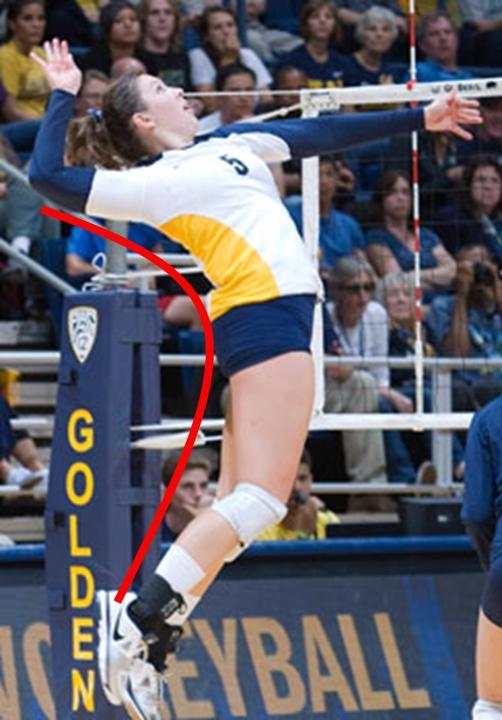 One specific skill in volleyball is call the ‘reverse C’. This specific technique requires a volleyball player to arch their back to add tension to their hitting stoke. This technique is difficult to master, but once they do – the results are amazing. The movement to spike the ball has players arch their back and ‘load’ their hitting arm. At the proper time, the hitting motion starts with uncoiling of their back. As they extend their arm to strike the ball, the momentum of their back uncoiling added to the arm motion generates more power and thus greater arm speed. The result is greater speed of the ball that is hard to dig. The ‘reverse C’ is a valuable skill that generates power.
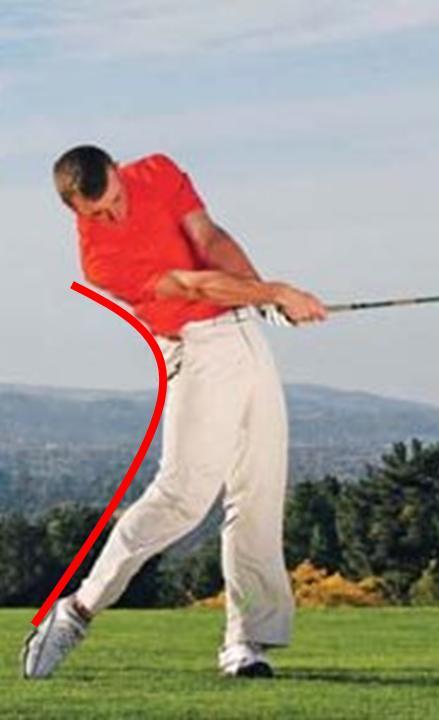 Golf uses a very similar skill. The ‘reverse C’ in golf is used to generate power and improve launch angle. A key part of this fundamental skill is ball position; placing the ball off your lead toe is a great place to start. The ‘reverse C’ is created by sliding your hips towards the target before you start to uncoil the club from the top of the takeaway, this movement helps maintain the proper position when contacting the ball. Additionally, it creates tension by tightening the coil of the shoulder rotation. The result will be greater distance with more consistent contact, improved angle of attack and increase height on the ball during flight. The ‘reverse C’ is a fundamental skill used to hlep break 100 and lower, focus on creating the ‘reverse C’ when contacting the ball. You may be surprised at the results of your efforts.
Many sports skills are transferable. The ‘reverse C’ is definitely one that all élite volleyball players and golfers master. Focusing on core fundamental movements from other sports maybe a new way to improve your game and lower your scores.
I am a grateful golfer! See you on the links!
Launching for Distance
Recently, my golf ball is travelling 20 yards further off the tee. It only started two weeks ago and I am extremely grateful for the extra distance. Every reader will agree that being 20 yards closer on an approach shot is a gift from heaven. To accomplish this wonderful feat, I only changed one thing in my swing – the launch angle of my ball! Yup, that is it. Nope, nothing more complicated than that.
In an earlier post, I brushed over launch angle by discussion how high to tee my ball. But this is not the case this time. All I did was drop my right shoulder! I dropped my right shoulder and continued to swing the same way. The result was to catch the ball on the up side of my swing that results in 20 yards further….I am gob-smacked to say the least.
Stephen Salzberg at Forbes discusses launch angle and the optimum for the driver; Brent Kelly at About.com defines launch angle very well, Leaderboard.com also defines launch angle, but is slightly different, and Golf AcademyOne explains Golf Science and its relation to distance; all these articles are a great read if you want to see how a simple change can make a monstrous difference.
The video below is great to explain about launch angles and how they vary depending on swing speed, set up, etc. It was very helpful when I made my adjustment.
Hitting the ball further has really helped me enjoy the game of golf more….I wonder what else I can fix. I am a grateful golfer! See you on the links!
 The Grateful Golfer