The Fall Blues

It is cold and the courses have been closed for at least 3 weeks.  Northern Canada is beautiful, spacious, and has a short golf season.  So what to do in the fall to keep my spirits up and reduce the anxiety of not hitting the links.

The thing I like to do at this time of year is look at the new technology from last year.  I never rush to try any new club, bag, or miscellaneous equipment.  I research, ponder, check reviews and watch for sales.  I also prepare for the big Christmas sales.

I do not mean the Christmas sales before the big day, I mean the sales between Christmas and New Years.  That is when most places want to clear out inventory and make room for next years kit.  With a pocket full of money (well not really) I hit the stores to save money and buy new equipment for next year.

I know it does not sound like fun, but it helps pass the time until the courses open in April.  What do you do to pass away the time during the off-season?

Focused Club Selection

What the heck!  You are playing the game of your life; you are in the middle of the fairway 130 yards from the par 5 – 18th green.  If you shoot par, you beat your best score ever…if you birdie the hole you won the lottery!  Then the thought hits you, 130 yards….you are in between a hard 9 or easy 8 iron.  What to do?

Thoughts go through your head like choking down on the 8 iron or hitting a normal 9 iron and rely on our short game to your goal.  Well, I suggest that most players would hit the hard 9.  There are less chances of error and if you come up short, it will not be by much.  If you hit the 8 too smooth, you will be over the green or worse.

Okay, let’s back up.  The problem of being in between clubs is not uncommon.  Additionally, it is completely preventable.  I would say that the problem started on the tee or as a minimum, the second shot was not played with a focus on club selection.

As you approach every tee box and start setting up for the hole; you should play the hole in your head before you even swing a club.  You know how far you can hit a ball with each club.  So use that knowledge to set the hole up and reduce your chances of being in between clubs.  Using a 3 wood instead of a driver off the tee or a 3 hybrid instead of 3 wood off the deck would make about a 10 to 20 yard difference in your overall distance; thus you are no longer in between clubs!

Focused club selection on the tee will help lower your score and improve your overall game.

What do you think?  Will it work?  See you on the links.

When to Fix Your Swing

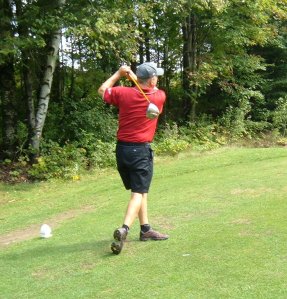
Fixing a SwingWhen is the best time to fix your swing?  Each year, I pick one thing to fix about my swing, how I approach the game, my grip, my stance, etc.  I examine my successes and challenges from the previous year and then decide which skill I want to improve (fix).

For example, I felt my wedge play this year was not where it needs to be….so next year, I will devote more time using my 60 degree wedge around the green and my 52 degree wedge from 100 yards.  I will still work on the other parts of my swing, but I will purposely work on my wedge play.  So when is the best time to practice!

Ian Hardie at golfhabits.com has an article with a very cool line – ‘Does your mechanic fix your car while you’re driving on the highway?’  This is an awesome statement.  My take on this analogy is that playing around of golf, even with some better than you, is not the place to try to fix something.  It never really works.

At eHow.com, the article says, “Do people take cover when you come to the tee? Did your last set of golf balls head for the Bermuda Triangle? It’s time to visit the driving range and work on your swing. You should bring a friend who’s an experienced golfer that can watch you and observe what part of the golf swing you need to improve.”  The first step to fixing a problem is to get off the links.

From GOLFTIPS.com, LPGA player Paige MacKenzie says: On practicing vs. playing – “The range is where you work on your golf swing; the course is where you go to play…”  Again, most high level players understand that it is extremely difficult to change anything on the course.

Ultimately, it really comes down to time.  Most amateurs do not have the hours required to spend on the range to improve their game.  We want to play, have fun, and dream about getting better.  I would suggest that if we took just 1 hour a week and practiced something, our game would drastically improve!

See you on the links.

Golfing in the Off Season!

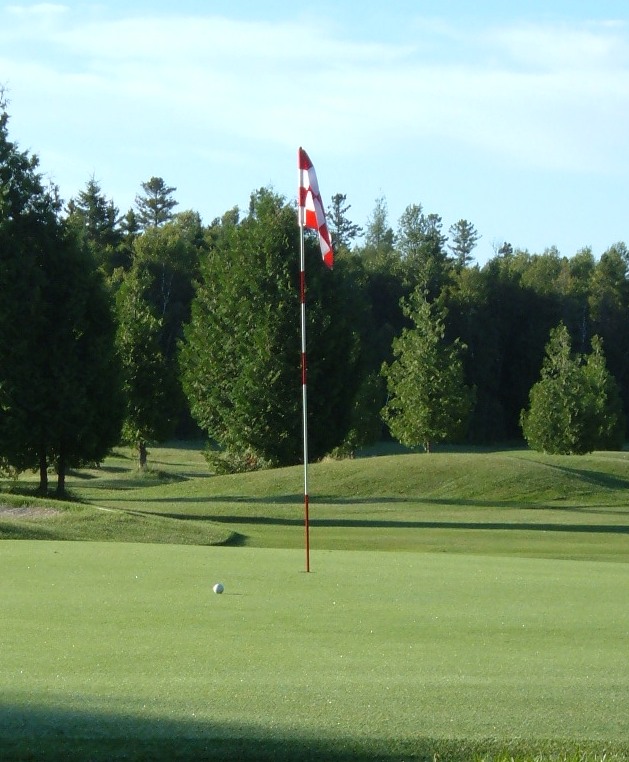
Ball Close to HoleI bet you are wondering what I mean by golfing in the off-season!  Some may think I mean taking a trip down south or some place exotic to play a few rounds of golf in the dead of winter.  Well, that is not what I mean at all.  Golfing in the off Season is not about playing golf, but preparing for next year.

At info.com, “Golfers can improve their balance and posture while increasing the strength and technicality of their golf swing” by staying active and adopting an exercise program.  They offer several exercises and programs that will help any golfer prepare for next year.

Sports Fitness Advisor suggests that “strength, power, flexibility, balance, core stability, body awareness, even endurance… they’re all physical traits that every consistent golfer (even the fair-weather players) must possess. The golf industry is littered with gadgets and gimmicks for increasing accuracy and shot distance. Yet for all their claims and guarantees most remain independently unproven.”  I believe that an overall approach to fitness will improve your game better than any piece of equipment.

Greg Norman “The Shark” says that “as you achieve higher levels of fitness, you can generate more power with less effort, thereby producing a smoother swing with greater club head speed. You will develop more force without forcing the action, which is essential for long and consistent drives.”  He also provides a program to become physically stronger  to effortlessly achieve success in all aspects of your golf game.

Ian Hardie at Golf Habits.com has identified in his article “Are you running out of steam” that most amateurs do not perform as well on the last 6 holes compared to the first 6.  I totally agree with him.  A round of golf lasts for 4 hours.  Those of us that walk and carry our clubs can attest to the fact that we get tired near the end of a round.  I suggest that success down the stretch can be attributed to your physical condition.

Golfing in the off-season is about training and preparing for next season.  I would suggest that now is the time to start.  See you in the gym!

How to Align Your Shot

Aligning your shot is far from easy.   I have heard of many methods to align a shot.  For example: point your left shoulder towards your target; draw an imaginary line along your toes; place a club on your thighs and let it point to the target; align your elbows, stick out your tongue and close your right eye…. OK, I made the last on up, but my point is that there are hundreds of suggestions on how to align your shot while playing golf.

Recently, I came across a method I had never heard before and it actually is repeatable, simple and makes sense.  This is a recipe for success if you asked me!  In my Golf Canada Magazine, David Hearn provides a unique tip on how to be successful when aiming at a target.  Align your heels!  He says it is “imperative that the club be placed on the ground flush against your heels and not your toes.  Because feet tend to flare out, the heel line is the best indicator of where you’re currently aimed.”  This is brilliant.  It makes absolute sense to me.

Aiming your shot has many variables, but the important point about this tip and many others is to consistently have the same set up routine.  That is what really ensures success.

If you have a tip about aligning your shot, please pass it on; we would love to hear about it!