Ground Under Repair – Rule 25

Down the left side of the fairway on the fifth hole of our course, a large areas is marked as ground under repair. Due to storms late last year and the lack of time to clean up the mess, our managing committee has declared this area as Ground Under Repair. It is a well know local rule and the area is marked by a white line.
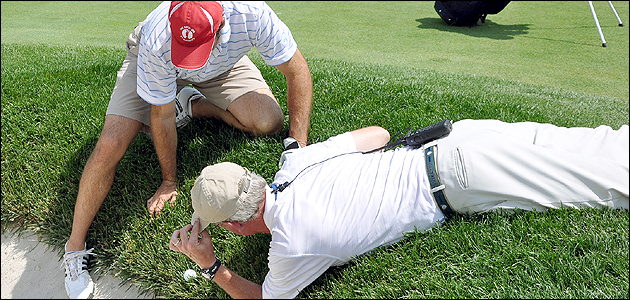
rules_official_new_webRecently, I was playing a round of golf with my usual friends and one of us hit their ball into this area. We searched and searched, but we did not find the ball. As the default rule guy, they asked me for a ruling. I stated that since we did not find the ball, it had to be declared lost, and he had to go back to the tee to rehit.

Well, I started thinking and after a bit of research, I found out that I was wrong.

According for Rule 25-1c, my friend was able to take a free drop, without penalty. Here is how the rule reads:

Ball in Abnormal Ground Condition Not Found
It is a question of fact whether a ball that has not been found after having
been struck toward an abnormal ground condition is in such a condition. In
order to apply this Rule, it must be known or virtually certain that the ball
is in the abnormal ground condition. In the absence of such knowledge or
certainty, the player must proceed under Rule 27-1.

If it is known or virtually certain that a ball that has not been found is in an
abnormal ground condition, the player may take relief under this Rule. If he
elects to do so, the spot where the ball last crossed the outermost limits of
the abnormal ground condition must be determined and, for the purpose of
applying this Rule, the ball is deemed to lie at this spot and the player must
proceed as follows:

(i)  Through the Green: If the ball last crossed the outermost limits of the
abnormal ground condition at a spot through the green, the player may
substitute another ball, without penalty, and take relief as prescribed in
Rule 25-1b(i).

(ii)  In a Bunker: If the ball last crossed the outermost limits of the abnormal
ground condition at a spot in a bunker, the player may substitute another
ball, without penalty, and take relief as prescribed in Rule 25-1b(ii).
(iii) In a Water Hazard (including a Lateral Water Hazard): If the ball last
crossed the outermost limits of the abnormal ground condition at a spot
in a water hazard, the player is not entitled to relief without penalty. The
player must proceed under Rule 26-1.

(iv)  On the Putting Green: If the ball last crossed the outermost limits of the
abnormal ground condition at a spot on the putting green, the player may
substitute another ball, without penalty, and take relief as prescribed in
Rule 25-1b(iii)

Basically, not remembering and my playing partner not knowing the rules cost him 2 stokes. I will rectify this error this morning as we play our weekly round. With an important tournament approaching, I will have to reread the rules and make sure I am aware of all their nuances.

Rules are important in golf. They even the playing field, only if players actually know them. Have you read the rule so of golf lately? If so, how long ago?

I am a grateful golfer! See you on the links!

Distance Measuring Devices in Golf

Since 2006, distance measuring devices (DMD) are allowed in golf. Although this rule has been around for 9 years, if ask an amateur about a DMD, you might be surprised at the plethora of answers.

What sparked my interest in DMD is a Sean Foley’s article called Ride the Wind from Golf Digest, April 2015. He stated in the article that weather apps on your phone to find wind speed and direction are allowed when playing golf. At first, I was thinking that this could not be right because it was not something I remember reading in the rule book. So, off to the rules I went.

According to the USGA and RCGA, Appendix IV, players cannot use any device that:

  • the gauging or measuring of slope;
  • the gauging or measuring of other conditions that might affect play (e.g., wind speed or direction, or other climate-based information such as temperature, humidity, etc.);
  • recommendations that might assist the player in making a stroke or in his play (e.g., club selection, type of shot to be played, green reading or any other advice related matter); or
  • calculating the effective distance between two points based on slope or other conditions affecting shot distance.

Unless I am interpreting this wrong, a device that measures wind speed or direction is contrary to rule 14-3 – Artificial Devices, Unusual Equipment and Unusual Use of Equipment. So it is not legal to use a weather app that measures wind speed and direction and thus cannot be used during any tournament or round of golf.

To make sure I cover all my bases, I next checked the recent decisions of golf that have not made it into the official rulebook yet. “According to the USGA and R&A, “decisions” are updated every two years and the actual Rules of Golf are updated every four years.”  The ability to change the rules of golf to adapt to its evolving nature is extremely important.  Most weekend golfers are less concerned about the real rules, but if you have a wish to play in any competition, knowing or not knowing the rules could prevent you from being disqualified.

My research in the ‘decision’ section of the official rules revealed: 14-3/18 Weather Information Accessed on Multi-Functional Device

Q. During a stipulated round, may a player access local weather information (e.g., wind, temperature, humidity) through an application or internet browser on a multi-functional device?

A. Yes. The prohibition in Rule 14-3 is only applicable to the specific act of gauging or measuring conditions that might affect a player’s play (e.g., through use of an anemometer or a thermometer). When accessing weather reports provided by a weather station through an application or internet browser, the player is not actively measuring or gauging the conditions.

Basically, a person can use a weather app, but not to check wind speed and direction to make swing decisions or club selection. They can only check for the possibility of stormy weather making its way toward the course.

After rereading the article, I actually think the error was a typo. Foley states that compasses are not allowed and weather apps are allowed during a round of golf. The official rules show that the exact opposite is true.  So as you head to the course, if you use a multi-functional device, make sure it can only measure distances or else you could be disqualified.

On last point about using DMD, they have to be approved by the Local Rules of your course or else they are not allowed either!

Lastly, if I am wrong about my interpretation of the DMD rule, please feel free to correct me and I will pass it on to my readers. It is important that we all understand the rules of golf!

I am a grateful golfer! See you on the links!

Three Rules in Golf Everyone Should Know

The rules of golf are a reoccurring theme at The Grateful Golfer. They are important to the integrity of the game, but more importantly for those aspiring players who want to compete in tournaments. This video below by Golf Monthly is brilliant. It explains three simple rules that will save you strokes in the long run!

The three important points that resonate with me are:

  1. actually saying the words “provisional ball”;
  2. when dropping the ball, it can roll outside two club lengths as long as it goes no closer to the hole; and
  3. when taking free relief, it must be full relief.

Did you know these rules and do you apply them properly?

What caught your attention about these three important rules?

I am a grateful golfer! See you on the links!

Golf Etiquette On The Pro Tour

Etiquette is important to the spirit of golf. They are many unwritten guidelines that make sure everyone enjoys the game of kings. Of all the players involved in golf, I would expect professionals to display the highest levels of etiquette. As the élite of my favorite sport, there is an expectation that they conduct themselves in a reasonable and professional manner.

Loyalist Country Club (12)

Golf Etiquette is Important For Everyone to Know!

A while back, I wrote an article about “Etiquette on the Green“. In it, I outlined many do’s and don’ts of being on the green. It is something I believe is very important and should be on the mind of all players, novice and professional. However, I did not touch on an etiquette incident I notice earlier this week.

While watching Thursday’s round of the Northern Trust Open, I noticed something that I thought was a breach of etiquette, but after discussion with a work mate (who is an avid golfer) I am not so sure. Maybe you can help me out, am I being paranoid or not?

On the 10th green, a player had lined up his putt and was preparing to execute his shot. Off to his left, another player was patiently waiting for his turn to play. As the original player made contact with his ball, the second player started walking towards his ball. Now, I applaud the second players actions to speed up play, but this is where I thought he went over the line.

With the ball still in motion, the second player walked between the person putting and their ball. At first I thought I was seeing things, but after the replay, it was true. The breach of etiquette for me was that he blocked the view of the ball from the person playing while it is still in play. Watching your ball until in completely stops is a great habit to get into because it provides a better understanding of the break on their next shot. So someone blocking your view, in my opinion, is a breach of etiquette.

So, am I crazy or what? Should the second player have stayed still until the ball finished rolling? Maybe walked around the person playing? What are your thoughts?

I am a grateful golfer! See you on the links!

Water in the Bunker! Really?

The rules of golf are sometimes strange and difficult to understand. They seem written by someone who takes pleasure in trying to stump the average golfer with language and interpretations that just do not make any sense. Last year while competing at the Ontario Military Regional Golf Tournament, one particular rule actually changed the score of many of the competitors.

Storming at Garrison Golf CourseOn day one, torrential rains soaked the Garrison Golf and Curling Club in Kingston, Ontario, Canada, for four hours making it almost unplayable. After a further delay of two hours, the officials decided we could start our competition with some local rules.

The first was lift clean and place ‘through the greens’. “Through the green’’ is the whole area of the course except: for the teeing ground and putting green of the hole being played and all hazards on the course. So basically anywhere on the course, even the woods!

The second and more important rule change was that all bunkers were out of play. If your ball landed in the bunker, the player could remove the ball and keeping the point of where the ball came to rest in line with the pin, go back as far as they wanted. After discussion with the players after the round, this was a very popular decision.

The second day was slightly different. Although the course was still extremely wet, the rules officials did not invoke any local rules and the decision was made to play the ball where it lies. This is where knowing the rules was very important!

Many of the bunkers still had water in them from the previous day. Some were still completely filled. Many of the players were dismayed with the decision to keep the bunkers in play and no less than three players had to take a one stroke penalty for an unplayable lie within the bunker.

Water In the Bunker

Water in the Bunker! Now What?

But wait you say! If the ball is in the bunker underwater, would that not be considered casual water? The answer is yes! It is considered casual water and in this case falls under rule 25-1 Abnormal Ground Conditions. Under the relief part of this rule, the interpretation is:

(ii)  In a Bunker: If the ball is in a bunker, the player must lift the ball and drop it either:

(a) Without penalty, in accordance with Clause (i) above, except that the nearest point of relief must be in the bunker and the ball must be dropped in the bunker or, if complete relief is impossible, as near as possible to the spot where the ball lay, but not nearer the hole, on a part of the course in the bunker that affords maximum available relief from the condition; or
(b)  Under penalty of one stroke, outside the bunker keeping the point where the ball lay directly between the hole and the spot on which the ball is dropped, with no limit to how far behind the bunker the ball may be dropped.

I had to use this rule once during the competition and fortunately I was able to drop the ball in the bunker without a penalty stroke. Many of the players complained about the different rules they had to use during the first two days of the tournament and the most popular was rule 25-1. In the clubhouse after each round, I was amused by the many discussions starting with the question, “What about….”

Know the rules in golf is very important. They are meant to even the playing field, but only if you understand what they mean. As a player with over 35 years experience, I reread the rules at the beginning of every season. I helps remind me of the subtle nuances of golf. I also enjoy talking about the rules and hearing the different interpretation from other players, it only makes me smarter about the game I love to play.

I am a grateful golfer! See you on the links!