As promised, I used Brian Penn’s, from All About Golf, technique of visualizing my round before I started. It was a very interesting process and it reinforced several aspects of my game that needed attention.
Continue reading
visualization
Golf Drill: Short Side Chipping
Golf is a funny game. The more we want to succeed, the more challenging it becomes. There are many approaches to improving our games, so I have decided to take a proactive approach this year and practice areas I know will offer the most benefit to my goal of being a scratch golfer. These practice sessions are not a result of poor play (although I do make minor adjustments when things are not going well), but in areas that I know I need to strengthen.
Yesterday, I went to my local practice area to work on my short side chipping. As a benchmark, I consider anything under 10 yards to be the short side. My reasoning is that a delicate chip shot (closer than 10 yards) is required at least once a round. It is a shot I need to perfect to make sure my up and down percentage remains high and my scores go low. Continue reading
Recovery Shots in Golf
It is easy to be a great golfer when hitting the ball down the middle of the fairway. Generally, the short grass provides a great lie for an equally great shot into the green. Unfortunately, most of us are not as consistent as we hope and errant shots occur from time to time.
After watching this video, it is obvious that being able to perform a recovery shot is important to your golf game. I helps lower scores and build confidence; however, the I have to suggest that most amateurs should beware of the consequences of attempting a shot that has great risk. (as a side note, number 6 was my favorite)
When faced with an impossible lie, immovable objects or a crazy shot that requires a special touch, your ability to recover and reduce the damage to your score is paramount to a great round of golf. Through the years, I have heeded the saying “take your medicine” after a poor shot, but sometimes a something special is required keep a great round going. This is when knowing when to make that recovery shot (course management) plays an important role in your game.
For me, recovery shots have three important parts that every golfer must understand. They are the tenants I use when deciding if a risk/reward recovery shot is needed. If you are wondering, this is how I look at these special shots:
Do I need to make that recovery shot – as silly not as this sounds, it has to be the first question. If I do not gain any real advantage from making a special shot, through a small gap as an example, then there is no point in compounding my original error by making another one. This is when I default to a safe shot or punch out. In essence, I take my medicine.
Can I visualize the recovery shot – all the great scramblers can visualize their shot before they make it. The can see exactly what they need to do and know they have a shot in their bag to do it. There is no sense in attempting a recovery shot if I have no idea how to actually perform it! If I proceed without visualizing the shot, then it is just plain ego clouding my judgement. Again, it is time to take my medicine!
Perform the recovery shot with confidence – this may sound simple, but difficult shots weigh heavily on my confidence. If I attempt a shot with doubt in my mind, then it is likely this is wrong shot to be making. Confidence is critical during a recovery shot. It is that special something that allows me to do special things on the course.
Recovery shots are critical to golf. As a single digit handicapper, I have learned the lesson of ego on risk/reward shots many times. My greatest lesson is to ensure I can answer yes to my three criteria for a recovery shot before proceeding. I recommend you do as well.
These are my thoughts on recovery shots. What are yours?
I am a grateful golfer! See you on the links!
Golf’s Jedi Mind Trick

The famous Jedi Mind Trick is the most valuable resource in golf. By using the force, golfers are able to clear their mind of all potential hazards and hit successful shots time after time. This skill is not a difficult as one may think, it really comes down to believing in your swing and course of action chosen for that moment.
I am sure many of you are questioning my sanity right now, but if you really think about it, golfers can eliminate potential hazards all the time. Whether it is a shot over water, sand, a tree or right down the middle of the fairway; we are able to blank out many unwanted distractions in a blink of an eye.
Personally, I use the power of positive thought. I never (or at least hardly ever) think about the negative aspect of any shot. I visualize the end result, pick my target line, look at the desired ball flight, select the proper club to achieve your intended ball flight, set up according to your target line, and then step up to the ball – swing as if I was nothing bad could happen. When I use positive visualization, good things happen a majority of the time.
This is not a difficult skill to learn. I suggest trying it anywhere on the course next time. Stand behind your ball; take a deep breath; let it out slowly and visualize the result you want. Sometimes it takes two breaths. When you are sure of the result, go through the above steps, then step up to your ball and execute! You will be surprised at the results!
Let me know how you make out!
I am a grateful golfer! See you on the links!
Conquering FEAR in Golf
Hitting the ball short of the hole is a constant problem for amateurs. Off all the challenges I face on the links, under-clubbing is the most frustrating and obvious in my game. Using the wrong club can stem from many reasons, but for me it boils down to one thing. FEAR of going long! Yup, that is it. For some reason I am afraid to hit the ball past the hole or even worse over the back of the green.
As of right now, this FEAR is over! I choose not to let this FEAR influence my game anymore! I am exposing this dark cloud to the sunshine and making it disappear!
There are many reasons I can accept for playing a short approach shot. A poor lie, small green, blind approach shot, being outside of 175 yards or poor playing conditions. These challenges are realities while playing golf and proper course management usually helps reduce their effect on my game. Occasionally, I can accept misjudging something that results in a short approach shot, but none of the above cause any real frustration in my round of golf! But, hitting the ball short of the hole because of being afraid of hitting it long….well lets just say it really affects my next shot.
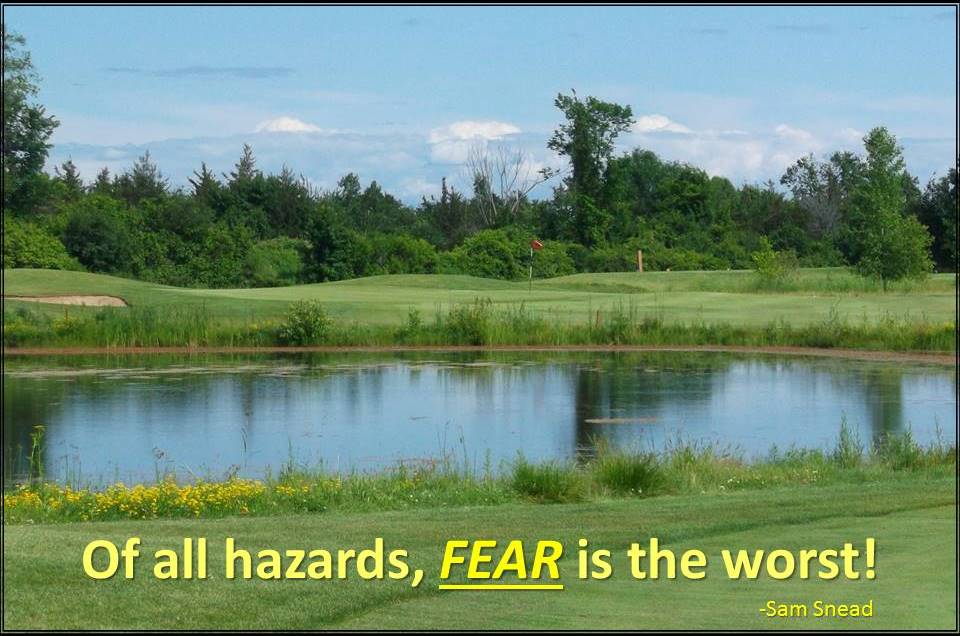
It is time for a change! Proper mental preparation will help me conquer my FEAR of hitting the ball long on approach shots. I must reframe the feeling of hitting the ball long from anxious to relaxed. To accomplish this, I believe that visualization will be the key. As I wait for the golf season to start, I mentally and physically prepare to play golf. This year, my mental preparation will include visualizing hitting the ball to hole on every approach shot!
If there is a situation on the golf course that causes you to feel uncomfortable or afraid, now is the time to address it! It is time to rip off that Band-Aid!
Personally, I like to use visualization. Others like to use positive self-talk to reframe the tough situation. Others hit the range using focused practice. Regardless which method you choose, you have accomplished the toughest part – deciding to make a change.
Improving your golf game is very much about conquering FEAR. Mine is mostly centred around hitting the ball short of the hole. I am choosing to make a positive change!
How about you? Are you ready for a positive change?
I am a grateful golfer! See you on the links!
 The Grateful Golfer