The Ryder Cup – Not Just Another Golf Game!

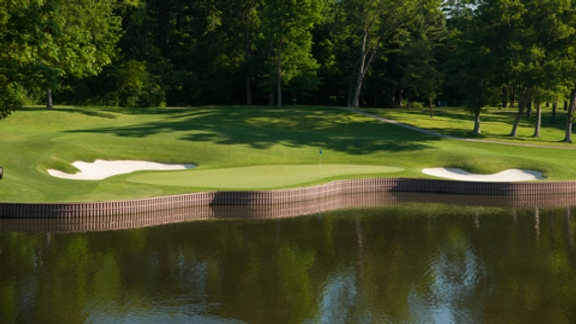
Image from: http://www.rydercup.com/europe/course/1/tour/17

Medina Golf Course – 17th Hole

Wow, what a finish!  Like most avid golfers, I was completely amazed at the last day of the Ryder Cup.  There is no way anyone could have predicted the collapse of the US team…or was it really a collapse?

“Dressed in the colours of the late Seve Ballesteros, Europe tonight pulled off one of his trademark great escapes in what will go down as the “Miracle of Medinah“.”  I suggest that the European team played inspired and refused to give into all the ‘nay sayer’ and ‘the second guesser’!  They believed in themselves and demonstrated winning attitudes throughout the entire match.  This is something that all golfers need to have regardless of your skill.

Regardless of which team you were cheering for; this years Ryder Cup was one of the best competitions in years and I look forward the 2014 Ryder Cup at The Gleneagles Hotel in Perthshire, Scotland.

Iron or Hybrid?

In recent years, hybrid clubs have hit the market, which in turn has sparked a hot debate.  The question most asked is which is better.  I would suggest that the average amateur golfer would benefit from hybrids in their bag verses long irons.  Hybrids are more for giving and have a tendency to hit the ball further.

At PGA.com value guide a comparison of long irons and hybrids are made.  They conclude that hybrids have three advantages over long irons:  club head design, sole design, and shaft and length.  These are three pretty important design points and clearly hybrids come out as the winner.

Laird Small, Dir. of the Pebble Beach Golf Academy explains why hybrids are superior to long irons for the average golfer.  He talks about making better contact and how the club interacts with the ball.  Overall, hybrids are the way to go.

As you can see, hybrids are here to stay.   I have replaced my 3-4-5 irons with hybrids and found that I hit the ball further, straighter and with more confidence.  It has made a difference of two strokes per round on my overall score.  As a single digit handicapper, that is outstanding!

Do you use hybrids?  Tell me what a difference it has made in your game.  See you on the links.  I am a grateful golfer!

How High Do You Tee Your Ball?

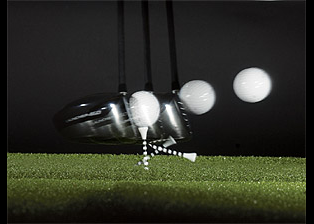
http://i.cdn.turner.com/dr/golf/www/release/sites/default/files/imagecache/article_med_image/article_images/CSmomentofimpact_299_1.jpg

Image from Sports Illustrated Golf.com

I have played with the concept to how high to tee my ball for years.  I have a tendency to tee the ball low with fairly good results.  This year, however, I struggled to get any real distance off the tee.  It appears that I have lost 20 yards with my driver and it has caused me some challenges on the long courses.  Of course, this is not something that any of us can afford.  So I decided to do a little research and this is what I found.

Sports Illustrated Golf.com conducted an outstanding experiment on how high to tee your ball.  It is a quick read and everyone should take a look. It gives advice on using an iron or hybrid. Quoted from SI Golf.com:  “Within each of the three handicap levels, carry distance for mid- and high-tee heights was significantly longer than the low-tee height, largely an effect of the higher tees promoting higher launch angles and less spin. The high tee height provided the most distance, giving the players an average of 12 yards more carry per drive than the low tee height.”  Overall, I would rate this article a 10.

Videojug has a video Golf: How High To Tee Up With Different Clubs that gives an excellent visual overview of where to tee the ball and why.  It supports the Sports Illustrated article.

Brent Kelly at About.com Golf says the same as the others, but at a different location.  Most agree that teeing the ball high will increase your distance.

Well, I am off to the range.  I have never teed the ball up that high.  I have always placed my tee low to medium.  I guess it is never too late to teach and old dog new tricks!  I will practice this new revelation and get back with the results!

How high do you tee the ball?

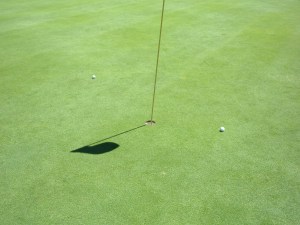
Hitting Ahead of the Tee Blocks

Hitting Ahead of the Tee Markers

2 Stroke Penalty – Stroke Play
Rehit – Match Play

On Friday I was playing match play against some friends.  We had a discussion about teeing the ball up ahead of the tee blocks.  Going around the foursome, I quickly realized that there was not going to be a consensus on the rule.  One said re-tee the ball, it was a two stroke penalty, it was a one stoke penalty, and the last said who cares.

Of course, I was quite curious about the actual rule.  I went to the RCGA website and the 2012 rules are posted in a PDF format.  I quickly read the rules and found out that rule 11-4. Playing from Outside Teeing Ground – applied to our conversation.

The rule states:
a. Match Play
If a player, when starting a hole, plays a ball from outside the teeing ground,
there is no penalty, but the opponent may immediately require the player to
cancel the stroke and play a ball from within the teeing ground.
b. Stroke Play
If a competitor, when starting a hole, plays a ball from outside the teeing
ground, he incurs a penalty of two strokes and must then play a ball from
within the teeing ground.
If the competitor makes a stroke from the next teeing ground without first correcting
his mistake or, in the case of the last hole of the round, leaves the putting green
without first declaring his intention to correct his mistake, he is disqualified.
The stroke from outside the teeing ground and any subsequent strokes by the
competitor on the hole prior to his correction of the mistake do not count in
his score.

I always thought the match play rule applied to all situations….I was shocked to read that in stroke play a 2 stroke penalty is applied and the person must rehit.  And a player can be disqualified from the tournament.  Now that I know, I am better prepared when playing in tournaments.  My day has not been wasted:  I learned something new.  I am a grateful golfer.

Sand Play – Not Just a Day on the Beach!

Out of the Sand

Hitting it close out of the sand!

I was reading a post by Ian Hardie from Golf Habits – Simply Better Golf called “Don’t hit the ball out of a sand trap”.  He talked about how to successfully play out of the sand.  His advice resonated with me because this skill is one of the least practice of all.  There are many aspects to consider when playing out of the sand.  To expand on Ian’s post here are a couple of things to consider.

In a green side bunker that has compacted sand and no lip….use a putter.  This type of shot is called using a Texas Wedge.  Strike the ball with some authority and you will find that the ball will play like a bump and run shot.  It works very well, especially if you are not confident with your sand wedge.

In a green side bunker that has compacted sand and a lip….use a 8 iron.  Play it exactly like a bump and run from the fringe.  Ensure that you do not take any sand and make contact with the ball first.

From a green side bunker with soft sand regardless of the lip…use a sand wedge and follow Ian’s advice.  It really does work.  One important point about this type of sand shot (and all others aswell) is the follow through.  You must follow through towards your target and the club head must finish above your head.  If you follow through your ball will come out of the sand just like the pros!

If you are in a fairway bunker and you are plugged….use your sand wedge or pitching wedge and get the ball in play.  Sometimes it is best to take your medicine and advance the ball 50 yards down the fairway than to hit your next shot from the same bunker.

If you are in a fairway bunker and you are sitting on top of the sand….use one club more than you would from that distance.  If you are right-handed, aim a bit left and opposite if you are a lefty.  Make sure you do not use any legs and the ball will travel the distance you wanted….one club more is the key to this successful shot.

Playing out of the bunker is an important skill.  Making an up and down from the bunker is rewarding and significantly lowers your score.  If you get a chance to practice, take advantage of the opportunity.  Remember, playing out of sand traps is not just another day on the beach!

See you on the links!  I am a grateful golfer.