Golf is an interesting sport. It is the one competition, at the professional level, where a player is also his own referee. This relationship is rooted in the core values of honesty, integrity and fair play. History of golf has demonstrated that calling foul on yourself, and not waiting for your playing partner to step up, gains the admiration of fellow competitors.
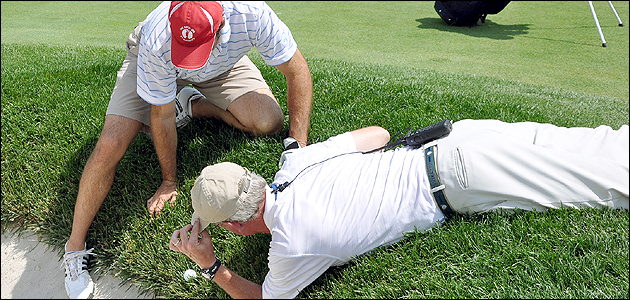 Recently, a rash of fair play questions and rule infractions has plagued the professional tours. The questions regarding stretching or breaking the rules outright has darkened the positive side of golf. More and more, the rules infractions are not being called by players or the referees on the course, but by viewers on television. That is right, one of the million viewers searched through the rules book and decided that a professional player thousands of miles away has broken the rules and must be penalized!
Of course everyone who follows golf knows about the Tiger Woods and Guan Tianlang rules challenges at this year’s Masters. In both cases, the rules officials were under tremendous pressure to make an appropriate call. In the case of Tiger Woods, a television viewer called in and then and only then did the rules committee take action. Tiger Woods was not disqualified for signing an incorrect score card as many had suggested, but was assessed a two stroke penalty.
During the Wells Fargo Championship last weekend, Sergio Garcia experienced the same as Woods and Tianlang. A viewer called the championship and stated that Sergio Garcia had marked his ball incorrectly and should be penalized two strokes. Garcia said if had committed a foul he would accept the ruling because he did not want to be considered a cheater. After review, the rules committee stated there was no foul and Garcia was not penalized.
A person calling in to professional golf tournaments to challenge possible rules infractions is nothing new. Probably the most famous and likely the first incident occurred with Craig Stadler during the 1987 Andy Williams Open at Torrey Pines in San Diego. After hitting his drive under a large overhanging branch, Stadler put down a towel, knelt on it and hit his ball. He continued for the rest of the round and signed his score card. Later it was determined that he had violated rule 13-3, which prohibits a player “building a stance” and was disqualified from the event for signing an incorrect score card.
In golf, it is completely understandable that if a player breaks the rules, they should step up and accept their punishment. Additionally, the game insists that players police themselves and to play with integrity and honour. Unfortunately, the prize money and pressure of playing in front of millions of people may cloud the judgement of some players. This no way suggests that any player would intentionally break the rules, however some rules are broken and penalties need to be assessed.
So who should be the referees in golf? Should golf have 1 million referees ranging from TV viewers to the players to the rules officials on the course? If the TV viewers are included, then golf would be the only sport where fans could directly impact the outcome of a tournament. This may be a good thing because it would provide an interactive aspect that the PGA may build upon.
As an avid golfer, supporting this expansion of rule enforcement is a bad idea. It would detract from the spirit of golf. Players are supposed to play with integrity and honour. If removing the onus of players to police their own actions and those of their playing partners, golf would become less then it should be. Currently, the rules committees and the players of any professional golf tournament are plenty to ensure that the rules of golf are followed and applied equally. Television viewers need to stop calling in when they believe they see an infraction, it only takes away from the spirit of golf.
 The Grateful Golfer
Pingback: New Golf Rules | The Grateful Golfer
I agree with your sentiments. If the officials do not call an infringement during play, then Let it be.
LikeLike
Pete
I completely agree. Besides, these after the fact rulings will only ruin the momentum of players thinking if they have accidentally done something wrong. Thanks for the comment.
Cheers
Jim
LikeLike
Jim,
I agree completely with your sentiment that viewer call-ins are bad for the game. In my opinion, when a player is questioned about a possible infraction, particularly when he did not call it on himself (even if it were a circumstance when he unknowingly broke a rule) there seems to be a cloud of suspicion that forms around him. I think the viewer call-ins are the most dangerous because they foster a witch hunt type of environment. It seems to me that fans might watch to only look for rules infractions. Furthermore, if a player is questioned, it often seems that he must accept a penalty (or disqualification) to avoid questions about his integrity, even if he is deemed to have done nothing wrong.
-Josh
LikeLike
Josh
Exactly! One of my draws to golf is that it is self regulated. Honest and integrity! Thanks for the comment.
Cheers
Jim
LikeLike
Pingback: Referees and Golf | The Grateful Golfer | Golf Tips & Golf Rules