Solid Contact in Golf

Solid contact on the club face is extremely important! It will determine whether your ball will travel the expected distance, on the intended line, and finish in the intended spot. You will see the word ‘intended’ was used quite a bit because unless you are a professional, our real intent does not always match our execution.

What does solid contact actually mean? It is a term used extensively; however terms such as this are sometimes misinterpreted and misunderstood. To me, solid contact means feeling nothing when the ball hits the club face. The ball hits the ‘sweet spot’ and all the energy transfer from the club to the ball is at its optimum level. The leaves the club face with no distribution of energy or forces to the outer areas of the club face or the shaft.

It is very difficult to explain the feel of solid contact, but we all seem to know it when we feel it. The video below explains how to make solid contact with a seven iron. I found it quite informative and thought I would share it with you!

What are your thoughts on how to make solid contact?

I am a grateful golfer! See you on the links!

Ball Position in Your Golf Stance

ball position within golf stance.While on the driving range with a friend a couple of weeks back, we started a discussion about where the ball should be position in your golf stance. Immediately, I mentioned that the position changes depending on whether he was playing a short iron, mid iron, long iron, or wood. I have always used this method and until now, I never realize that there was a second method.

Ted Norby, Director of Instruction for the National University Golf Academy, explains the relationship of ball position to your body position is the real reason for ball placement in your stance. His explanation was excellent and easy to understand. Because of the relationship is between the ball and body, there are actually two methods to determine the correct position of the ball within your stance. Norby explains below:

As stated by Norby, the other method is to pick a position within your stance and widen or narrow your feet as required. This is not something I have tried, however players like Jack Nicklaus and Tiger Woods position their ball in this way.

If you are trying to decide the best method for you, I recommend you hit the range and try each one. One particular method of position your golf ball might feel natural for your swing. Regardless, make sure it is best for you!

Personally, I have no challenges with my current method of moving the ball within my stance, but will try the other method at the range because I want to remain open to all ideas that might help me attain my goal of being a scratch golfer.

I am a grateful golfer! See you on the links!
What to Focus on First at the Start of Golf Season

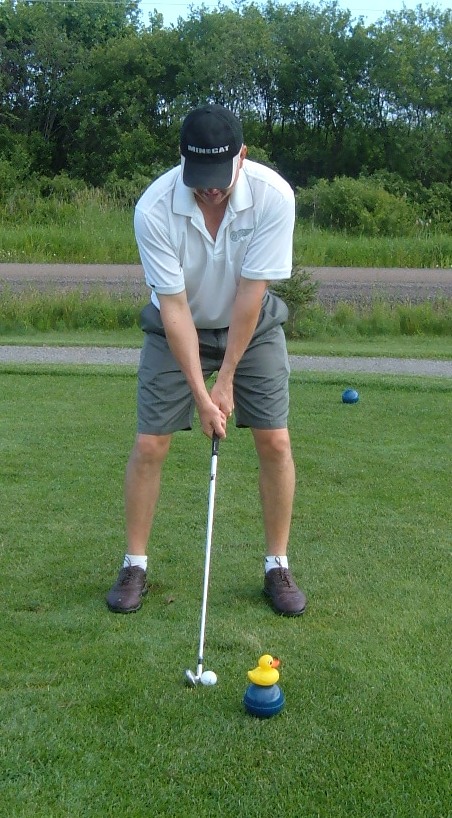
Jim with a DuckGolf is officially here. The crew at Roundel Glen Golf Course spent many long days cleaning up the winter mess and their efforts are greatly appreciated by all the anxious golfers! With the hope of an awesome season ahead, it is time to focus on the fundamentals and execute my plan of being a scratch golfer.

This year, I am going about things a bit differently. I am not actually developing my plan until mid-May. I know many of you are shaking your heads thinking that I will be wasting a precious month, but rest assured there is a method to my madness.

My plan is to work on my fundamentals first, then see where I need to focus my practice time to generate the most ‘bang for my buck’. So after much introspection, this is my initial approach to the 2015 golf season:

Chipping. This year I believe that chipping will be the key to a lower handicap. My GIR stat is not bad (I hope to improve this), however on the days that I am not striking the ball well, chipping is what is going to keep my scores low. On the days that I am doing well, the odd missed green will not have as great an impact on my score. So, chipping is first.

Mid-Irons. Most experts would suggest that putting should be next. Personally, my GIR stat is more important. If I do not give myself the opportunity for birdie more times than not, then being a great putter does not really matter. The distance I will focus on is from 175 – 125 yards.

Putting. Once on the green, putting will help me close the deal. Being a strong putter is critical to low scores. My self-assessment is that I am a strong putter already and that focusing on chipping and mid-irons is a better use of my time so early in the season.

3-wood. I hit my 3-wood on most par 5s and several times off the tee. It is an important club for my game because it helps with my course management. In the past, it was my go-to club, but recently I have relied on it less. Regardless, my 3-wood will be next in line as I practice this spring.

Long-Irons. I do not hit many long irons. My course management is such that hitting long irons is generally avoided. I will hit a short iron and stay 75 yards back, then hit a long iron to 30 yards from the green. Not always mind you, but hitting into the an area of my game that I use 2 or 3 times a round does not make sense, but I do have to practice hitting long-irons just in case I need to during a round.

Driver. Many of you are gasping right about now! Not to worry. I have left my driver until last because I plan to be fitted for a new driver in early June. Mike at my home course is a Master Club Fitter and we are going work together more this year. My focus for the fitting will be the shaft, thus extensive practice with my old driver does not make any sense early in the season.

There you have it. My initial practice plan is in place. My area of focus and overall plan for 2015 will not be formed until around mid-May. This is a new approach for me, but I think focusing on the fundamentals in each area without the pressure of having to score well will be very beneficial. What do you think?

What is your initial plan to prepare for the 2015 golf season?

I am a grateful golfer! See you on the links!
Science of a Golf Swing

The golf swing is amazing. I have studied the almost every aspect of it and thought that I had some of the answers. As I mature as a golfer, I want to know more about the why, than the how when studying a golf swing. I came across this video that really helps me understand the science of generating power which equates into distance when playing golf.

The scientific principles of note are double pendulum, centrifugal force, and torque. After watching the video below, I had several “oh yeah” moments where I understood how these principles affect my golf swing. The more I study, the more I understand that my education was more about how to swing a club, but not why to do it. By understanding the why, I will be able to dissect my swing to make the minor adjustments required to become a better golfer.

What do you think? Did anything in the video give you that “oh yeah” moment?

I am a grateful golfer! See you on the links!

A Winning Mindset in Golf

GrowthI was having the round of my life! As I walked towards the par 5, 18th hole at Laurentide Golf Course (par 71), the realization that an eagle would help me shoot the lowest score of my life…a 68! Positioning ball on the tee box, to avoid the bunker 255 yards out to the right, put my mind in the proper state to execute the required shot. Going through my pre-shot routine, I hit the ball down the left side of the fairway into the first cut, but with a great lie. As I thought about my second shot, I decided the risk – reward is worth pulling my three-wood and going for the green. With a sand trap in the centre of the fairway 25 yards back from the green and a water hazard on the right about 75 yards from the green, the probability of me staying on the elevated green from 240 yards was remote. But, my short game was on fire that day, so I was confident that an up and down birdie was the worst that could happen! I went through my normal pre-shot routine, step of the ball and made solid contact.

The confidence from playing well on that day continued to grow. My ball landed just before trap, took a big bounce and stopped 10 yards from the green at the bottom of elevation. After realizing that my ball was lying in a good spot for my next shot, my thoughts turned to how to navigate the elevated green and sink that chip for my 68. I select my club (56 degree sand wedge) and went through my pre-shot routine. With confidence I hit the ball cleanly, landed it 15 feet from the pin, and watched it roll towards the hole.

As my ball continued to track towards the hole, my excitement started to rise. The ball took the proper break and what seemed like an eternity, everything looked awesome. As my ball struck the pin, I heard what I thought was a clap of thunder! My ball hit the pin, bounced back towards the lip of the hole, bounced forward and hit the pin again! I was yelling “GET IN, GET IN!” Well my ball stopped on the lip of the hole, disappointed and elated at the same time I tapped it for a birdie and a low score of the year a 69!

The ability to perform under pressure is a skill all golfers desire. As you can see from my adventure above, the pressure to hit a great shot on the last hole of an awesome round continued to mount! But, my ultimate success did not start on the 18th hole or even the first hole of that round. It actually started about three weeks before; when, after analysing my performance to date, I realized that I was not improving. I was just treading water!

I decided to change two things in my game. The first was the amount of time I spent chipping and putting. I decided to adopt the 80/20 rule. So I practiced my short game for 80 percent of my practice time. Of that, I divided my time 60/40 – 60 percent chipping and 40 percent putting. During my original 20 percent, I mixed up my clubs on the range with a majority of my focus on the 3, 4, and 5 hybrid. This practice regime significantly improved my up and down percentage and quickly increased my confidence around the green.

The other thing I changed was my attitude! I decided that ‘close’ was not good enough. I tried (and still struggle with from time to time) to eliminate all doubt when swinging a golf club. I decided that: a positive mental attitude, that I could hole every chip, and that all putts would drop, was the way forward. Combine this approach with my new expectation that any score over 75 was just not good enough help expand my winning mindset in golf! This approach helped shape my future successes and over the past 3 years, my handicap has continued to drop. Albeit slowly, it still continues to drop.

As I continue to prepare for the 2015 golf season, I will expand my winning mindset. I will increase my off course mental preparation through visualization, mental imagery, and a positive “I can do anything” attitude! This may sound silly, but everything I have read lately seems to point in this direction. Who am I to turn away from this message of success!

I am a grateful golfer! See you on the links!