Setting Goals for 2014

Roundel Glen Logo (1)As in previous years, I set goals at the beginning of my golf season. I find that by setting goals, it keeps me focused throughout the entire season. Sometimes, I achieved all may goals and more, others….not so much!  I am always excited about each new season because of the fantastic opportunities improves my game it offers.

Today, I hit the range and putting green. I had no expectations and no real plan. It felt fantastic to be be playing again. Normally, I have a plan on the range, but being the first time this year I just wanted to hit balls. I was quite surprise at how well I struck the ball, but I am sure it was beginners luck! A quick note to my buddy in the UK, I still want two strokes aside!

2014 golf season is upon us and it is time to make goals. Experience tells me that reaching for the stars is great for my ego, but not necessarily for my game. So as I progress, I need to build a plan and set goals to achieve my dream of being a scratch golfer. Setting goals in golf is important for players serious about lowering their score.

Previously, I came up with following to prepare me for the season:

  • get fit – focus on exercises designed to improve my golf game;
  • research – the drills and techniques required to improve my game;
  • practice – dedicate time to practice to improve my game; and
  • compete – either formally or informally compete every time I hit the links.

It is fair to say that I have successfully accomplished the first two goals.  I have remained fit and completed my research on different drills to help improve my game.  So now it is on to phase three – practice.

My practice focus will start from the green out. Putting is critical to lower scores. Grooving my putting stroke early will help save strokes in the long run. Next, will be chipping from the fringe and moving further from the green.  I will be using the 3-6-9 drill to simulate playing on the course because it will help hone my short game.

I am not ready to compete. Having swung the club for the firs time today, competing would be stretching even my expectations.

Setting goals is a helpful way to improve anyone’s golf game. This year will be a special year because of my goal to be a scratch golfer.  The plan is in place and my desire is strong…I am ready to succeed!

I am a grateful golfer! See you on the links!


Caring For Your Golf Course

Many of you lucky golfers are joyfully swinging away at your favorite course. Some of you are a bit rusty, but the joy of playing eclipses any self doubts.  Unfortunately, this rust may pose a potential risk to the health of the tee boxes, fairways, and greens.  As the season is early for us northerners, it is important to remember that caring for your beloved playing field is so very important.

Tee box SandTee Boxes. Many players have a misconception about tee boxes. They may not understand that care of the tee box is as important as the green or fairway. Most players do not try to take divots on the tee box unless they are using an iron. Regardless of where, it is important of replace your divots or fill the hole with a sand/dirt/seed mix.  The familiar green box on the teeing area is usually a great sign that the superintendent wants us to fill the hole. It is really very easy; grab the scoop and fill the hole so it is slightly higher than the ground; then smooth.  The little extra mix will make sure that the hole remains filled after it settles from the rain or watering. Tee boxes are important to every golf course – the better we take care of them, the better we enjoy the game.

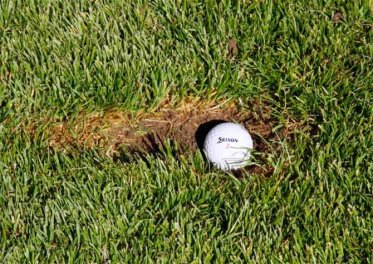
ball in divotFairways. Care and maintenance of a fairway is a no brainer. Every golfer has heard, seen, or understands that replacing their divots is important.  Normally, there are signs all over the golf course.  However, some course superintendents would rather players put a sand/soil/seed mix in the hole because it helps promote grass growth. Not fixing your divots can have a negative impact on your game!

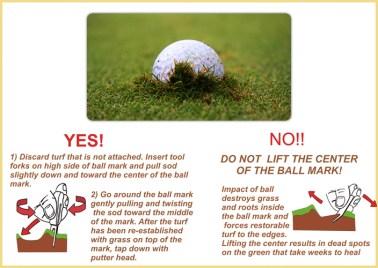
golf-ball-markGreens. Fixing ball marks on the green are a pet peeve of mine. How many times have we walked to the green to realize that most of the players at your course have bad backs.  You know this because of the multiple unfixed ball marks on the green. The green is the most delicate part of the course and extra care is required! In case you do not remember how to fix divots, check out the above image!

With the golfing season upon us I feel like a little kid on Christmas morning. However, I must remember that to fully enjoy the season, it is important to look after the course from the beginning.

As a golfing fanatics, it is our duty to lead by example!

I am the grateful golfer!  See you on the links!


Seeing and Believing

Welcome to the second installment of “Seeing What is Important” when playing golf. As we prepare to watch The Masters, it would be in our best interest to pay attention to what the players and caddies are saying and where they are looking while preparing to make a shot. Value is gained by focusing on their conversations and the language they use to discuss influences on their game.  The last post dealt with knowing your yardage, what the wind was doing and how the ground felt.  I wonder if the pros at the Shell Huston Open are talking about how these variables affect their score!

Learning the finer points of golf can occur anywhere; watching the pros, your buddies or complete strangers navigate around the links. Rarely is a golf course hazard free. Every hole as something that will catch your eye; something the makes your hair on your neck stand up; or something that makes the voices in your head start to speak!

Uphill shot

Landing area is higher than tee. Expect to hit shorter off the tee.

down hill shot

The green is below the ball. Time to throttle back!

Unlike a mirage, most changes in elevation on the course are real. Elevation changes are the most misunderstood challenge on any golf hole.  Modest changes to the elevation will create a 1/2 to 1 club difference regardless of the yardage.  The challenge for most players is to determine if the modest changes in elevation are real or not.  Here is my guideline – if I can see the entire fairway leading to the green without it looking smaller – throttle back and think about hitting one less club.  If the fairway looks like a railroad track going away, the yardage is as paced.  If the fairway disappears quicker; add one club to your approach shot.  This rule of thumb works for me.  Thanks to the Dave at One Bearded Golfer for this topic!

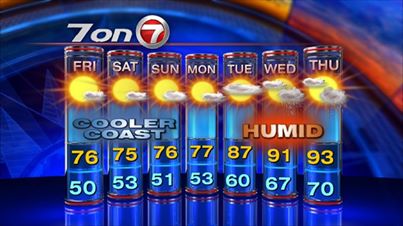
Cooler and Humid

Your ball will travel further on Tuesday, Wednesday, and Thursday!

The second point for today deals with the temperature! Most experienced golfers are saying that the colder the temperature the shorter the shot; but wait, there is more. Temperature is really broken down into three categories: Temperature, Barometric Pressure and Humidity.  As an overview, the ball travels further if it is hot, your golfing at a higher elevation like my buddy Craig in Denver, and the greater the humidity. For amateurs, this is hard to believe, but it is true.  For a more detailed explanation, check out Golf Digest.

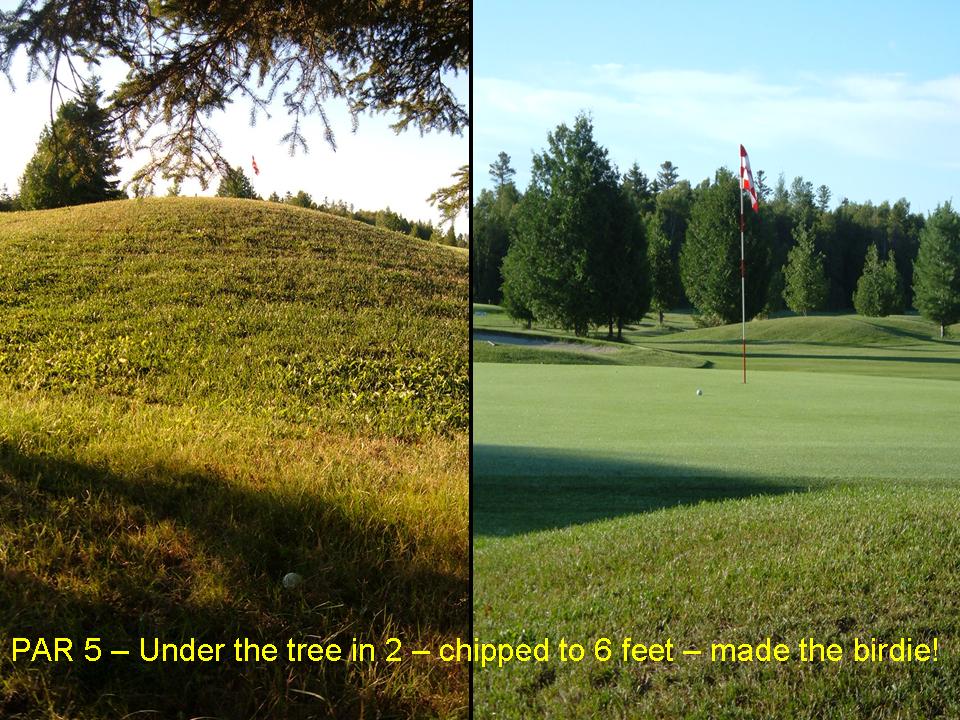
Last tip is to believe is what you see and visualize what you want.  How many times have I heard the saying, “come on, this is ridiculous!”  There will be many times over a round when a player thinks they hit the perfect shot; only to walk up to the green and wonder what happened.  After shaking their head in disbelieve, they walk to their ball and hit a poor shot and blame it on their lie.  As an experienced golfer, I would have to tell that player that the lie did not cause the problem – it was caused by disbelief; then frustration.  Acceptance to the situation is extremely important to lower scores.  Everyone hits poor shots, it is the next shot the will determine if you score a par or double bogey – you get to choose.

Slide1

There are many optical illusions in golf and it takes an experienced eye to identify them and adjust their shot accordingly.  Understanding and recognizing the potential hazards is one of the first steps to lowering your score.  Anyone can do it, it is a matter of “Seeing and Believing!”

I am a grateful golfer!  See you on the links!
Seeing What’s Important!

Jims EyeGolf is a unique sport that requires mental focus and attention to detail.  Most beginners miss the subtle signs and sometimes the obvious signs while walking the links.  It is very important to read the signs the course, weather, and your surroundings tell you while you are walking to your ball, visualizing your shot, or reading the greens.  The challenge for most inexperience players is they do not know what the do not know.

To rectify that problem, it is important to break down the signs and explain them in the context of any golf shot.  So, over the next couple weeks, we will address this knowledge gap and explain what is important to see ‘what is happening’ when you’re hitting the links.

Along the way, if anyone has suggestions, please speak up to improve the quality of the information.

The first area of “Seeing what’s important” is while walking to your ball.  The little signs around you are more significant than finding it and looking at the green.  Although those are important, a couple other things many be just as important.

First, what is your yardage?  If you have a Garmin Approach 6, (no affiliation) determining your yardage is easy.  However, if not then it is time to pace the distance.  Some courses have the yardage on the sprinkler heads, but most of the courses use the 200 (blue), 150 (white) and 100 (red) yard stakes placed in the middle of the fairway or off to the side.  The key to pacing off your yardage is to start at your ball and walk in a straight line forward or backward keeping the pin and ball on that line.  Walk to the closest yardage marker and do the math. Pacing your yardage will help with club selection.

Second, what is the wind doing?  This may be obvious, but it is important to understand that the wind at ground level might be different from the wind above the trees or in an open area.  The key to knowing the wind direction is to look at the top of the trees.  The direction they lean is the direction of the wind.  Lastly, look at the flag on the pin.  This is a good indicator unless trees on all sides, except the fairway, surround it.  However, I think you get the point.

Third and last for today, how does the ground feel under your feet?  Is it soft, hard, or normal?  Why is that important?  Well if the ground is hard the club will bounce and therefore prevent the player from getting a clean hit on the ball.  If the ground is soft, there is a very good chance a player will dig in with their club and only it the ball a couple of yards.  I am sure you understand what to do with ground that feels normal.

As you can see, we have only scratched the surface of “seeing what is important” when preparing for a golf shot.  These tips were learned over the years through trial and error. Wisdom says that the more I pay attention, the better I score.

I am a grateful golfer!  See you on the links!

Are Long Irons Important?

Long Irons are the most misunderstood clubs in a golfer’s bag.  In some cases, these tools are dusty and look like brand new.  Most beginners look at their long irons with fear and contempt because they find them difficult to hit and very unforgiving.  Regardless of what your fears are associated with your long game; there are no secrets to success from 200 yards out.

There are many pundits who have the answers on long irons.  Some will tell you to move your hands forward, others move them back.  Experts talk about where to place the ball; forward, backward, or centre.  Even your buddies talk about swing plane, releasing your hands early, weight shift, and on and on.  Talk about white noise….please make it stop!

The basic mechanics of a golf swing are not supposed to change regardless of which club is in your hands.  Most players take that to mean that exactly everything remains exactly the same. Unfortunately, that is not true.  Using long irons is a perfect example.  Below are two short videos that focus on a couple of aspects when hitting long irons.  They advice is simple and easy to follow.

The discussion about posture and maintaining balance is very important when hitting long irons.  It is important not to over swing, but maintain your normal rhythm.

Hand placement is very important with long irons.  Most players reach when trying to hit long irons and that is a result of improper hand position.

If you are still having difficulty hitting your long irons, take the fear out of your came and consider switching to hybrids.  There are some unique advantages to hybrids over irons especially for a higher handicap player. Although I was not trying to break 100, I switched to hybrids two years ago.  This switch increased my confidence from 200 yards out and help lower my score.

I am a grateful golfer!  See you on the links!