Putt for Dough

“If you say you can or you can’t you are right either way”- Henry Ford
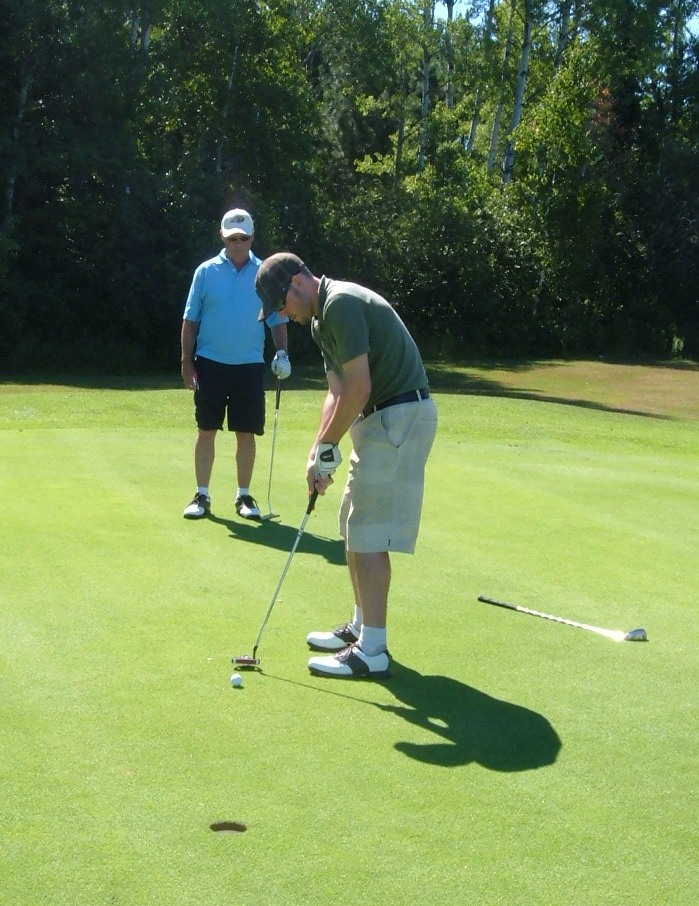
Confidence While Putting!In earlier posts, I outlined 5 steps on the mechanics of a great putter.  As every amateur knows putting is extremely important when trying to break 100, 90, 80 or 70.  All things being equal, if your putting is on, your score is low.  So how can the average golfer elevate their putting so that a great day is a normal day on the green?

George Beardsley suggests that speed is most important on long putts and line is the most important on short putts. He also provides a couple of drills to help with your putting that might be worth a look.

The Putting Doctor, Joseph P. Bermel Jr, suggests that pre-shot routine and alignment are the most important aspects of putting.  He also says visualization and practice are strong enablers for great putting.

Peter Sanders reported from Jack Nicklaus that “regardless of the distance of the putting opportunity, the correct distance is the most important factor in success.”  It reduces three putts and increases the chances of a one putt.  Averaging no more that two putts per hole is ideal.

Well that about covers a wide range of what the pundits and experts say about putting. Further research could uncover another 100 revelations.  Each of the experts is correct, but it may not be best for you!  It is difficult to determine what exactly is required to fix a putting stroke; after much trail and error a solution may be found.

What is the most important point of putting?  On those great days when the hole looks like a manhole; the greens are easy to ready; the greens all run true and are consistent; your stroke is smooth and in control all the time – what is the key?

CONFIDENCE!

Confidence in your ability to hit the ball on-line, with the right speed and far enough to sink the ball.  The first trick to gaining confidence is removing all doubt.  The word ‘can’t’ never enters into your head ever when playing golf.  Start today.  Think positive about your putting, focus on the what works, practice the things that are challenging and work on your putting mechanics.

No matter what – be confident that you are a great putter!  If you do – great things are going to happen!

I am a grateful golfer!  See you on the links!
Quiet Hands to Break 100

The touch is a much debated topic in golf.  Some amateurs confuse touch with quiet hands.  Although ‘how’ a player uses their hands during chipping and putting is extremely important, it is a topic for another day.

Listening to the golf experts, it is obvious that quiet hands are the key to lowering your golf score. The challenge for most amateurs is to figure out what “quiet hands” mean, to what part of the swing it applies, and more importantly how can they get some! Continue reading →

Hitting The Wall

“Hitting the wall In endurance sports such as cycling and running, hitting the wall or the bonk describes a condition caused by the depletion of glycogen stores in the liver and muscles, which manifests itself by sudden fatigue and loss of energy. Milder instances can be remedied by brief rest and the ingestion of food or drinks containing carbohydrates. The condition can usually be avoided by ensuring that glycogen levels are high when the exercise begins, maintaining glucose levels during exercise by eating or drinking carbohydrate-rich substances, or by reducing exercise intensity.”

I bet you were thinking of the 17th hole at St. Andrews Old Course!  It is a famous site that provides once in a life time shots for amateurs and pros alike.  Only the brave will venture a heroic shot off the wall; giving credence to the saying “Where there is no risk; there is no reward!”  Regardless, this is still not what I am talking about.

Hitting the wall is a golf drill with many variations.  There are three specific drills I like and recommend.  I will be using all three as spring approaches with the intent to increase my power off the tee.

Solid-Golf-Shots

For Beginner Golfers

The first is a great wall drill for beginners from Hitting It Solid by Troy Vayanos.  This drill uses a wall or a chair. Troy’s drill works on posture. He states that “the most common reason golfers don’t hit solid golf shots is because they lose their posture on the downswing.”  He provides a simple step by step process to fix this common error.  I will use it in the beginning of my golf season to remind my body the proper position when addressing the ball.

The next drill comes from the National Golf Academy.  It is for intermediate golfers who have the general mechanics of the golf swing down, but want more power.  This particular drill is very good for players like myself who would like an extra 10-15 yards or more off the tee.  This is definitely a drill I will use before the season starts.

The last wall drill comes from David Leadbetter.  This drill is for the advanced player who wants to fine tune or improve their overall swing.  This particular drill is might be difficult and requires an understanding of swing mechanics.  Having said that, anyone can use it with varying degrees of success.  Again, I plan to use this drill in the off season as I wait for the 3 feet of snow to melt!

Hitting the wall can deal with the physical nature of a sport.  However, in this case it means using three outstanding drills by the beginner, intermediate and advanced golfer to improve their game.  Know which drill is best for you might be a challenge; I recommend you try all three and let me know which you like the best!

I am a grateful golfer!  53 days until golf season!

Swing Plane Training

Recently, a friend of mine visited from the UK.  As he bragged about golfing all year around, we shifted the discussion to what else besides playing he was doing to improve his golf game.  He talked about practicing many of the regular things like chipping, putting, working on the range and focusing on course management while hitting the lins.  All these things seem benign, but actually they have really helped him be more consistent and lower his score.  I think he is going to have to give me a couple strokes a side next time we play!

During the many hours of golf talk, he mentioned going to a practice range and working on his swing plane.  Of course, this new topic immediately caught my attention and I eagerly shifted the discussion to this new topic.  He mentioned a swing plane trainer.  It was a large circular device that keeps your club on the right plane during your swing.  He explained how his body movements were out of alignment and how his arms, legs and torso were not working together as well as he thought.  I told him that I have never used a swing plane trainer and he highly recommended that I gave it a try.

After a bit of research here is what I found:

The Swing Plane Trainers permit student and teacher to monitor correct swing plane & shaft angle. By keeping the shaft in continuous contact with the dual arcs, the player allows the club to travel on a proper swing plane while maintaining a correct shaft angle. The Pre-Swing Set Up, Arc, and Plane of the golf swing are the most important and basic elements to be learned by the beginner golfer. Just as important are these basic fundamentals for the intermediate and advanced players, to re-train these proper positions of the golf swing. Using the Swing Plane trainer will help create a consistent set-up position and the muscle memory necessary to perform a more repetitive golf swing.

The Golf Gruva.  The GOLF GRUVA is the ultimate golf swing training system. It leads the entire body through the experience of the modern, multi-plane golf swing. Whether a beginner or advanced golfer, the Gruva system is an invaluable tool for improving your golf swing.  This system seemed very interesting.  The description in the video helps describe a professional golf swing.

There are many more such training aids, but only you can decided if they are right for you.

If you are a more traditional golfer who likes drills and tinkering with your swing on the range, why not try Quarter Drill, Back to Wall Tip, The Tour Sticks Drill, or the tips from Hitting It Solid.  Again, the internet is full of drills, the above few caught my attention and I am going to try them this spring.

Talking to my friend about golf is a favorite thing to do.  Our conversation opened up a new area of growth and for that I am grateful.  Learning something new everyday is awesome; Learning something new everyday about golf is priceless.  Thanks for the tip my friend!

I am a grateful golfer.  See you on the links.


Build Confidence When Putting

DSCF7149Knowing how to putt does not guarantee that a player will be a confident putting.  In earlier posts I presented a 5 part series on putting.  This process works for me and I have been very successful through the years.  Just recently, I realized that I was failing in one very important aspect of putting.  I am not teaching myself to be successful all the time; therefore I am slowly eroding my confidence.

Teaching success is not really that difficult.  “Repetition of the same thought or physical action develops into a habit which, repeated frequently enough, becomes an automatic reflex.” (Norman Vincent Peale)  This quote applies directly to putting and here is how.

Putt out every hole!

That is it.  Looking back at last year, I realized that in none tournament play I wasted at least one putt per round because I was not in the habit of putting out every hole.  I know, but when you are chatting with your buddies, I was lax and my focus was not as it should have been.  So during competitions, as the pressure rose on three footers, I probably missed more than I should.  Talk about the Freddy Couples’ Syndrome! 

So this year, I will putt out every hole.  I expect to increase my confidence in my short putts and thereby reduce my handicap.  Any thoughts?

I am a grateful golfer!  See you on the links!