Visualizing a Shot

Visualizing a shot in golf can be very difficult.  You can search, ask, apply and observe ways to visualize a golf shot, but it may just seem a bit overwhelming.  This skill is one of the most important to great success on the links.

Just watch the Pros pre-shot routine.  They look at all the elements that would affect their shot, choose a club, then stand behind the ball.  Then they just stop.  Focus and visualize the entire shot.  For just a few seconds they zero in on the target and eliminate all distractions.  Just like Bobby Jones in the movie Bagger Vance.

So how does a golfer achieve such clarity and focus?  Each person has the ability to visualize, but it does take practice.  The following are the steps that I go through to visualize shots:

  1. look at the lie of the ball;
  2. check my yardage;
  3. check the wind;
  4. check the elevation of the green;
  5. check the location of the pin;
  6. choose my target;
  7. select my club;
  8. stand over my ball;
  9. take one practice swing;
  10. move to 3 steps behind my ball;
  11. look at my ball – then my target;
  12. draw a mental line from my ball to my target;
  13. focus on the trajectory I need;
  14. return to the ball; then
  15. execute my shot.

The steps may seem like a long process, but all of this happens in 10 seconds or so. Steps 10 – 13 take about 4-5 seconds and is the real visualization portion of my golf shot. It is important to know that visualization is an intentional act.  For me, it is important to do my pre-shot routine because it sets me up the visualization portion of my shot. There is no question that visualizing my shot has enable me to be a single digit golfer. Moving forward, refining my Visualization skills is going to be key to becoming a scratch golfer.

Do you visualize your golf shot?

I am a grateful golfer!  See you on the links!

When to Change Your Golf Ball

Have you ever watched the pros during a tournament?  They spend a tremendous amount of time looking at their golf ball for blemishes, scuffs, dents and deformities – especially when they miss a sort putt!  It makes one ponder if there is something to their obsession with the slightest mark or are they just obsessed.

To check out my bag and found that have my golf balls have scuff, mark, or something.  For the past few years, I used Pro V1 seconds from Walmart.  But, this year, I decided to change to Srixon Q Star.  I know they are completely different balls, but I need a drastic change because …. well just because.  If my experiment does not work, I can always change back.

Back to the topic.  My experience is that a golf ball is really only good for about two rounds tops.  By then, you will hit the ball between 140 – 200+ times.  Not to mention the ground even more times.  I have used balls with all kinds of blemishes and normally did not care, but this year it is going to be different.  For the first part of the season, my rule will be two rounds max….it should make a difference – I think.

I have read that distance, the ability to shape the ball, and accuracy will be affected.  It has to do with aerodynamics of the ball and the science behind an object in motion etc, etc, etc.  I have never really notice the difference, but I am not at the same skill as the pros so, I never worried about it that much.

One place I have noticed a difference is on the greens.  A blemish, scuff or dent will effect the putting line.  Additionally, it has the potential not the leave the putter head square…this is similar to dirt on the ball.

On a side note, Rule 15-1 state that a player must hole out with the ball played from the teeing ground, unless the ball is lost or out-of-bounds or the player substitutes another ball, whether or not substitution is permitted (see Rule 15-2).   Amateurs can change to any type of ball, but the pros use the one ball rule and they must use the same type of ball for the entire round.

The pros are smart about when to change their golf ball, but what degree of damage prompts the change only they know for sure.  I guess it boils down to preference.

When do you change your golf ball that has a scuff or damage?

I am a grateful golfer!  See you on the links!
White Noise

I received an excellent golfing book as a present at Christmas; 365 Golf Tips and Tricks from the Pros by Jay Morelli.  This book talks about the basics, rules, sand play, equipment and much more.  It is a very quick read and the tips are concise and to the point.  I recommend it.

This very thoughtful gift started me thinking.  How do I know the difference between a good tip and well…..white noise.

White Noise - Make it Stop!Yes, we all know: white noise  does not add to the situation and drowns out the important information.  This noise can be anything from your 20 handicap playing partner advising you how he they would play the shot while you are thinking; 50 things you are trying to remember during your golf shot or the reams of information (4,930,000 hits to be exact) that that overwhelms you when searching on “how to improve my golf swing”. White noise is all around us all the time. It is a distraction that does slow anyone’s ability to improve their golf game and for $19.95 I can guarantee to improve your mental skills while playing golf….okay, just kidding. But, this is the exact type of white noise that many amateurs will here day in and day out that causes confusion.  Can it really be avoided?  Well, that depends….

Golf is a unique sport.  It is difficult and easy, played as teams and individuals at the same time, or creates inclusiveness or solidarity.  It really is the one sport where a person can play their entire life, compete against no one and yet compete every day.  Golf is a sport where a player can challenge themselves everyday and feel a sense of accomplishment after each round.  No other sport provides this type of dynamic.

Everyone has their own process to cut white noise.  Everyday, we are bombarded with information that is filter, processed, acted upon, or discarded.  The difficulty is to figure out what is important and which process works best; then apply it to golf.  For me, the process is simple:

  1. Identify the problem;
  2. Collect information on the problem;
  3. Analyse the information;
  4. Determine possible solutions or courses of action; and
  5. Decide on way ahead. (repeat as necessary and as often as needed)

Everyone does this process everyday for practically every situation.  However, some golfers looking for a quick fix seem to skip steps 2 and 3.  As an example, Player A always slice the ball off the tee.  They jump to the solution to change their grip because their 20 handicap partner noticed something.  It worked….once.  They decide to change their grip and ultimately, no success!

Instead, the process could look like this:

  1. Player A slices off the tee;
  2. Talk to local Pro or low handicap player, read about why this happens, watch golf training videos;
  3. Compare information gathered to current swing (whole swing not just a specific point);
  4. Try possible solutions on the practice range.  Try different things.  Select several possible solutions (ask local pro for help); and
  5. Decide on the best fix for Player A.

To adjust something in your golf game does take time.  This process does work (at least for me) and is very been very effective in improving my game.  The question always boils down to how much time are willing to commit to making improvements. This is the balancing act that all players must do to achieve their golfing goals.

I am a grateful golfer!  See you on the links!

The Domino Effect

Everyone wants to hit the ball far like Bubba Watson;  Hit your wedge shots like Phil Mickelson;  Putt like Steve Stricker; Have the mental concentration like Jack Nicklaus.  All golfers know they can do better regardless of their success on the links.  The key is to first identify adjustments required to lower scores and improve your mental toughness. Regardless, there is one critical point that all players must remember when making any change – the Domino Effect!

Similar to the Domino Theory of the 1950s, the domino effect is a chain reaction that occurs when a small change causes a similar change nearby, which then causes another similar change, and so on in linear sequence.  Any changes to a golf swing will directly or indirectly cause changes to other areas you are happy with.  The above video shows that it is critical to keep the sight of the big picture and that minor adjustments to all areas of your swing might be required.

As an example, hitting the ball further off the tee or fairway will have a tremendous impact on your overall game.  However, stepping up to the tee and bashing the cover off the ball is really not the answer.  Chances are it might go further, but who wants to keep hitting their second shot out of the woods!  It will take some major and minor adjustments to make sure the maximum effort produces the maximum results.

It is very important to understand that any change to your golf swing will produce a domino effect in your game.  Knowing and understanding this fact will help shape your golf swing into a birdie machine.  Do not forget that changing your swing and improving different areas of your game will also change how you manage your rounds.  Regardless of what you change, be prepared to adjust the unexpected!

I am a grateful golfer!  See you on the links!

All You Need Is One Club

Have you ever played a round golf with one club?  No really, have you ever played a round of golf with one club?  If you have, how did you do?  If you have not, which club would you use?  A 7-iron? A 5-iron?  A 20 degree hybrid?

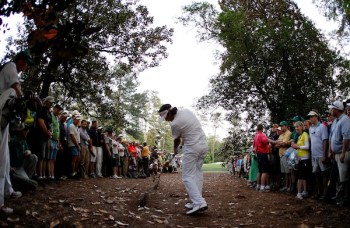
The Masters – Final Round

Recently, Bubba Watson shot an 81 at Pelican Hill Golf Club with a 20 degree hybrid.  According to Golf.com, Watson sometimes gets bored playing with 14 clubs and likes to mix it up.  Quite an impressive feat considering the difficulty of this championship course.

Realistically, Bubba’s methods, although unconventional, does have merit.  By using only one club, it forces players to think out side of their comfort zone when shot making.

The practice of playing around with one to three clubs forces players to think more about shot making then when they are carrying 14 clubs.  Play the same course ten times in a row, I bet most players will use no more that 7-8 clubs.  This is not necessarily due to course management, but routine.

Routine in golf is great when conducting a shot, but not necessarily on the course when routine drives the same shots on the same holes with no improvement in your score.

A great tip by Tim Mitchell to simulate shot making on the course to change-up your routine next practice session on the range. Execute the following five shot patterns below using only your 8 iron, hybrid and driver. Do not hit the same club two times in a row, and do not hit the same shape of shot two times in a row. Also, do not hit to the same target two times in a row.

This exercise will improve your pre-shot, shot, and follow through.  It will help with your alignment and shot execution.  I have used similar exercises on the range with great results.  Ultimately, it will help lower your score by engaging your brain.

So, if you were to play a round with only one club, which would you use?

I am a grateful golfer!  See you on the links!