The Ability to Score

Putting to Win!Do you have the ability to score in golf?

This question has many dimensions.  Each player will have a different answer on which aspect of golf is important enough to enable them to consistently score lower.  This question has nothing to do with establishing a handicap or periodically having a great round.  No, this is not course management either; although course management is extremely important!  The question focuses on consistently identifying moments in a round where strokes can be saved.

How exactly does an amateur golfer excel at identifying these important moments?  To understand the ability to score, answer the following questions:

  • When looking at a shot from the middle of fairway, do you examine all your options?
  • When in the rough, do you look at the grain of the grass before selecting a club?
  • When just off the green, do you use different wedges depending on the slope of the green?
  • When on the tee, do you visualize how to play the entire hole?
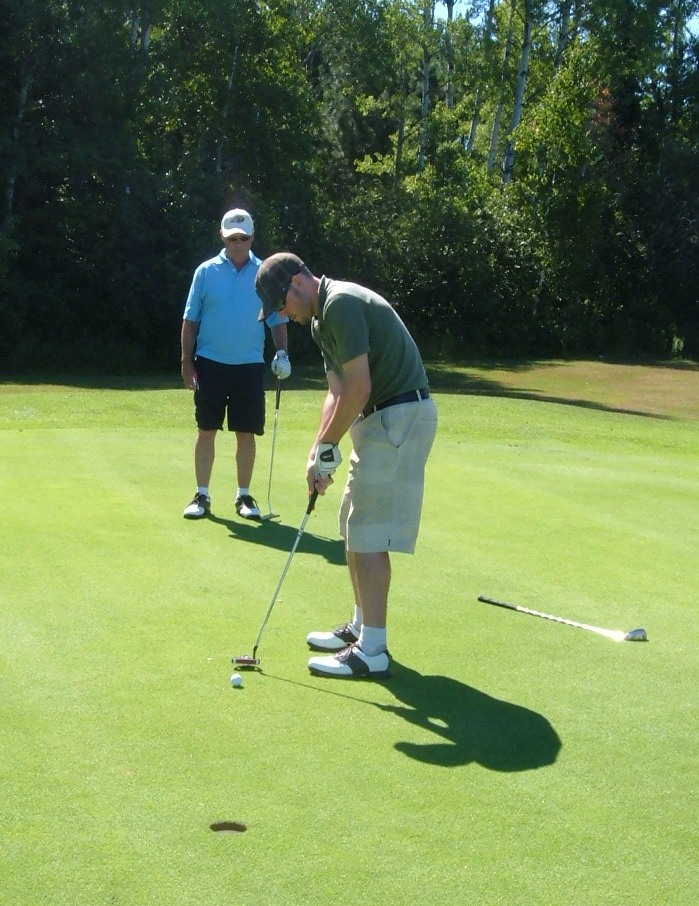
  • When on the green, do you understand the importance of a lag putt?
  • On your approach shot, do you focus on more than just yardage before club selection?

If you answered yes to these questions, then you have the ability to score in golf.  The mental aspect of the game is equally, if not more important than being able to hit the ball a country mile.  Focused attention to the finer points of playing golf will definitely lower your score.

If you’re wondering how to gain this skill, well it starts by asking the above questions. This was not an all-inclusive list, but the start of the many finer points that élite golfers pay attention to while walking the links.

So, I ask again; Do you have the ability to score in golf?

I am a grateful golfer!  See you on the links!

Generate More Power – Part 2

The internet is an awesome resource.  It has almost everything one could image.  This tool has enabled me to make contact with many like-minded golfers who, just for fun, seek the holy grail of golf excellence.  After my earlier post on how to generate more power in your golf swing, I asked a knowledgeable golfer and he provided me with an awesome video about when your hands should release during your golf swing.

Troy Vayanos, Hitting It Solid, is from Brisbane, Queensland, Australia who has played golf for over 20 years. Like the rest of us, enjoys teaching and helping golfers online and loves hearing about improvement in people’s golf game.  Thanks for your help Troy!

I often questioned when to release my hands during my golf swing.  I have tried many different approaches and have not really felt comfortable with the results.  The video below explains and demonstrates exactly what I was looking for.  Mostly, I like the fact that I have a visual aid to help me understand when to release my hands.

What do you think?

As the winter unfolds, I hope to find more experts like Troy to help fill in our knowledge gaps.  Now I just need to try the advice on the range.

I am a grateful golfer!  See you on the links!

Generate More Power In Your Golf Swing

Generating more power in your golf swing usually equates to greater distance.  And who wouldn’t want more distance off the tee and fairway.  Would increasing your distance off the tee by 10-20 yards make that much difference in your game.  Most golfers would yell a resounding YES!  Unfortunately, most amateurs do not have the skill to just change their swing and generate that extra power needed to move to the next level.

After a quick search, answering the question – how to generate more power in your golf swing – may not be as easy as it seems.  There are many reasons for not generating power in your golf swing and Professional golfer Micheal Campbell outlines six possible reasons:

  • Reverse Pivot
  • Sway or Sliding
  • Early Turn
  • Over Turn
  • Collapsing at the Top
  • Rolling Arms

If you are novice player, you are saying okay….but…..how do I tell if any of these reasons apply to me?  These six points are very important and he provides solutions that make sense.  I am sure there are other reasons, but to list everything that can possibly go wrong is not really helpful for the weekend looper.

So, where do we start?  What exactly are we doing wrong?  How do we know if it is helping?  Where do I find the answers?  These are all great questions.

The first step is to set a goal.  Through the winter, I traditionally set three.  The first for this year is to focus on generating more power to consistently gain 20 yards off the tee.

Second step is to do the research.  Reading golf blogs like Hitting It Solid by Troy Vayanos or All About Golf by Brian Penn, provides an endless supply advice on a wide variety of topics.  Personally, I find this very helpful.  I enjoy reading and trying new tips, skills and ideas to improve my swing.

Last step is to use your newly learned skills on the range.  In my case that will be next March!  Unfortunately, an eight-month golfing season is the price you pay for living in an awesome country like Canada.  Regardless, using the skills is a vital step to improving your game.

One last point, if you do not know where to turn, try taking lessons from a pro.  It definitely provides a positive environment with a knowledgeable instructor that will improve your game.  Going to PGA members like Rick Williams at mindbodygolf.com may be the best investment you make in a while!

I am a grateful golfer!  See you on the links….in four months!

Choosing A Golf Ball

Image from:http://www.golfwrx.com/forums/topic/744835-halloween-custom-iron-set-sale/


Happy Halloween!

Does a golf ball really make a difference to your game?  Is there any significant difference between the top-of-the-line manufacturers’?  After some research, I would suggest there is a big difference.  Through the years, I started off with Canada Cup (Spalding), Canada Club (Acushnet), Ultra (Wilson), Slanzenger (Slanzenger), many varies of Titleist and Callaway.   Each change was driven by my increase in skill level.

For the past 3 years, I played Pro V1 and Pro V1x.  However, I have found that I do not have the same feel or touch or something from them, so I have looked for another ball.  At the end of last year, I won a dozen Srixon Q Star golf balls at men’s night and decided to give them a try.  I really like them.  So, I think during the upcoming season, I will start using the Q Star as my primary ball; with the right to change if needed.

Choosing a ball is difficult.  Deciding which ball is best for you is no easy feat.  Really, it comes down to personal preference.  You can use a ball selector from Global Golf, which I did an ended up being directed to Q Star (go figure), or do research with the criteria at Golf Smith.  Galaxy Golf has a great chart to compare all the golf balls and more importantly why the ball was designed.  It provides an overview of most golf balls and is a good resource.

Image from:  http://www.nicklaus.com/golfballs/#homeEven Jack Nicklaus has a newly released system for choosing a golf ball to simplify the entire process.  On a side note, his golf balls are sold to support his and Barbara’s charity:  Nicklaus Children’s Health Care Foundation.  Jack’s efforts to simply the ball selection process is something that most manufacturers try to accomplish, but their advertising hype seems to get in the way.  I like Jack’s simple approach and would be interested to hear of anyone has played his golf balls.

Regardless of how you choose your golf ball, ensure it feels right for you.  I have played with scratch handicappers who use inexpensive balls and those who play the top-rated balls.  I could provide lots of advice, but unfortunately it would only apply to my game.

If I was to provide any advice it would be this: try different types and do not be afraid to change.  Once you find the ball you like, stick to it for a bit to make sure.  The choice is all yours and the right ball for your game will build confidence and ultimately lower your score.  Which ball do you use?

I am a grateful golfer!  See you on the links!

Slow But Steady

Turtle1

Golf is a Game of Patience!

Golf is a game of patience. Those willing to be the tortoise generally enjoy the game far greater than those trying to be the hare.  It is sometimes difficult to describe the inner thought process when playing a shot, but watching the pros and elite golfers they all take their time.  Sometimes watching them play equates to watching paint dry, but you will never see Tiger Woods or Phil Mickelson rush through their pre-shot routine or their actual shot.

Golf is a game of patience.  Many golfers have the best equipment, a gadget or two, and change putters routinely. They follow golfing innovations and always seem to have the newest driver in their bag. They are chasing the dream of shooting low, but never seem to play better than they did the year before.  I have often heard “I am 20 yards farther with my new clubs!” or “this new putter makes the ball roll truer!” Unfortunately, they never seem to score better.

Golf is a game of patience.  It is important to work on your game in little increments.  Too many changes at one time has the tendency to cause more harm than good.  Many players ask that if they practice, which part of the game will reap the most benefits.  My response is usually, which club do they use the most when they play?  As they think for a minute, the usually say their putter, followed by their short irons around the green.  I respond “well that answers your question, your short game to reap the most benefit, most of the time.

Golf is a game of patience.  It takes practice and more practice to become an elite golfer. It takes the willingness to put in the time to hone you golfing skills.  This thought is not always popular because playing is way more fun than practicing.  However, it improve your score and really enjoy the finer aspects of golf, practice is required.

Golf is a game of patience.  I am a grateful golfer.  See you on the links!