Keeping Your Composure!

Young DeerKeeping your composure when the wheels fall off is the most difficult skill in golf.  All of us have played the front nine as if we were pros.  We start to count things up, figure that we are going to set a personal recorded…..the poof, our game comes crashing to earth.

I am sure many of you are thinking….yeah too many times.  So how does an amateur keep their composure when things are falling apart.  This does not mean showing zero emotion like Jason Dufner;  it means keeping calm like Rory Mcilroy during the 2011 Masters.  Staying focused when the whole world is falling down around you.  So what to do?

The great Bobby Jones referred to composure when he said that “Competitive golf is played mainly on a five-and-a-half-inch course, the space between your ears.”  I have read many different methods to keep your composure and I have my several techniques.

One technique is to laugh and smile at my silly shot.  I do not hop around like a fool, but smile to myself and give a little chuckle.  I find that I remain calm and I can easily refocus and prepare for my next shot.

Another technique is to say my name to myself like I am correcting something.  It is sharp, quick and allows me to move on without carrying pent up emotions.

Lastly, I walk to my ball, look around at the beautiful surroundings, the sun shining, the birds singing, the gratitude of being able to play golf in an awesome country….I feel calm already.  I guess you get my point.

The one thing in common with all three techniques is they quickly eliminate the negative focus of making a bad shot and focuses on the positive aspect of playing the game.  Golf is meant to challenge your inner sportsman and remaining calm and enjoying your time on the links will only enhance your inner pro.  I am a grateful golfer;  see you on the links!
Which Shot Was the Worst?

Today, I learned a valuable lesson.  I was golfing with a friend and we were playing pretty well.  We were enjoying the beautiful weather, excellent conditions at Osprey Links, and great conversation.  I am a grateful golfer just for the outstanding time on the links.

All was going well until the 16th hole.  It is a long uphill par 5 with a difficult approach shot.  I hit the ball a little long and rolled off the back into the long grass.  Now the fun begins.  I hit my 52 degree and chilly dipped the shot.  Frustrated, I walked up to the ball on the fringe and sculled it 25 feet from the pin.  A smooth 2 putt and ta da – 7.

So which was the worst shot….you are right.  It was the 5th shot I sculled across the green.  Every once in a while, I make silly mistakes like this.  I should have walked over to my bag, grabbed the proper club and my putter.  Then walk back to the ball and focus and visualize the ball going in the hole.  This is an important lesson I continue to relearn.

Everyone makes a bad shot, it is what you do next that counts.  Reducing strokes by staying focused and accepting that sometimes bad shots happen will reduce your overall score.  Besides, on such a fantastic day what did I have to complain about…I am a grateful golfer!

Visualization to Success!

Visualizing for Success!Visualizing is the key to success in golf.  I believe that visualizing your ball path will have nothing but positive results.  So what does this really mean?  How does one visualize anything?  These are very good questions.

The Golf Sage says that “A perfect golf swing extends well beyond just having the best equipment to play the game. Yes, you need quality, reliable equipment and a lot of practice but that practice needs to be both physically and mentally as perfect as possible. Don’t replay your negative or unsuccessful plays  in your head. You must focus on thinking about the positive and successful visualization of your game experience in every way.”

Jack Nicklaus said that:  “I never hit a shot, not even in practice, without having a very sharp, in-focus picture of it in my head. First I see the ball where I want it to finish, nice and white and sitting up high on the bright green grass. Then the scene quickly changes, and I see the ball going there; its path, trajectory, and shape, even its behavior on landing. Then there is a sort of fade-out, and the next scene shows me making the kind of swing that will turn the previous images into reality.”

At Golfblogger.com the method described is the one I use.  I pick a spot one foot ahead of my ball and visualize the flight path along that line.  I focus on where I want it to land and how far.  On the green, I do the exact same thing with one small change…..it goes in the hole every time.  I find that I can easily duplicate this process and it enables me to quickly visualize success.

There is one thing in common in all the above comments.  Visualization works and is important to improving your game.  I visualize success everyday and while playing I visualize the perfect golf swing.  I am a grateful golfer.


Chipping – Being Aggressive

I have been off golfing lately and was wondering why most of my approach shots are significantly short.  I watch the pros and see them discussing which club to use, the wind, the ball location, what they are going to eat for lunch….ok not so much.  Ultimately, they take in many factors that most of us do not consider.  So what makes them so special that most of the pros are putting from 10 feet instead of 20 feet like the majority of amateur golfers.

Well it has to do with how aggressive they are when hitting their approach shots.  Whether they are 100 yards out or 10 yards; the pros try to sink the ball every time.  They figure it is best to be long the consistently short.  As my friend once told me, 100 percent of short shots do not go in!  I tend to agree with that analogy.

So what to do?  I recommend that you try to sink your approach shot with no fear.  It is easier to adjust distance if you are aggressive and you also have the line if the ball goes past the hole.  I know it sounds difficult, but actually it is not.  Focus on sinking your approach shot and you will find that your putt (if you miss the hole) will shorter and the chances of making it will significantly increase.

Putting From the Fringe

As I watch Vijay Singh use his belly putter from the fringe at the PGA Championship, I wonder if the putter is the best club to use.  Granted the The Ocean Course at Kiawah Island Golf Resort is in fantastic condition and their fairways are as manicured as most greens, I still wonder if using a putter from 10 yards off the green is a wise move.  Obviously, for Vijay Singh, it was a good move as he went up and down for par.  But in reality was it really the smart play?

The courses I primarily play (Laurentide Golf Course, Osprey Links, Clear Springs Golf Course) it is unlikely that a putter would be the club of choice from 10 yards off the green.  Since the putter cannot be use, now what?  I have discussed this many times with a multitude of golfers and suggest that there is no clear answer.  However, given a choice I would prefer to use my 7 iron first and my 52 degree wedge second.

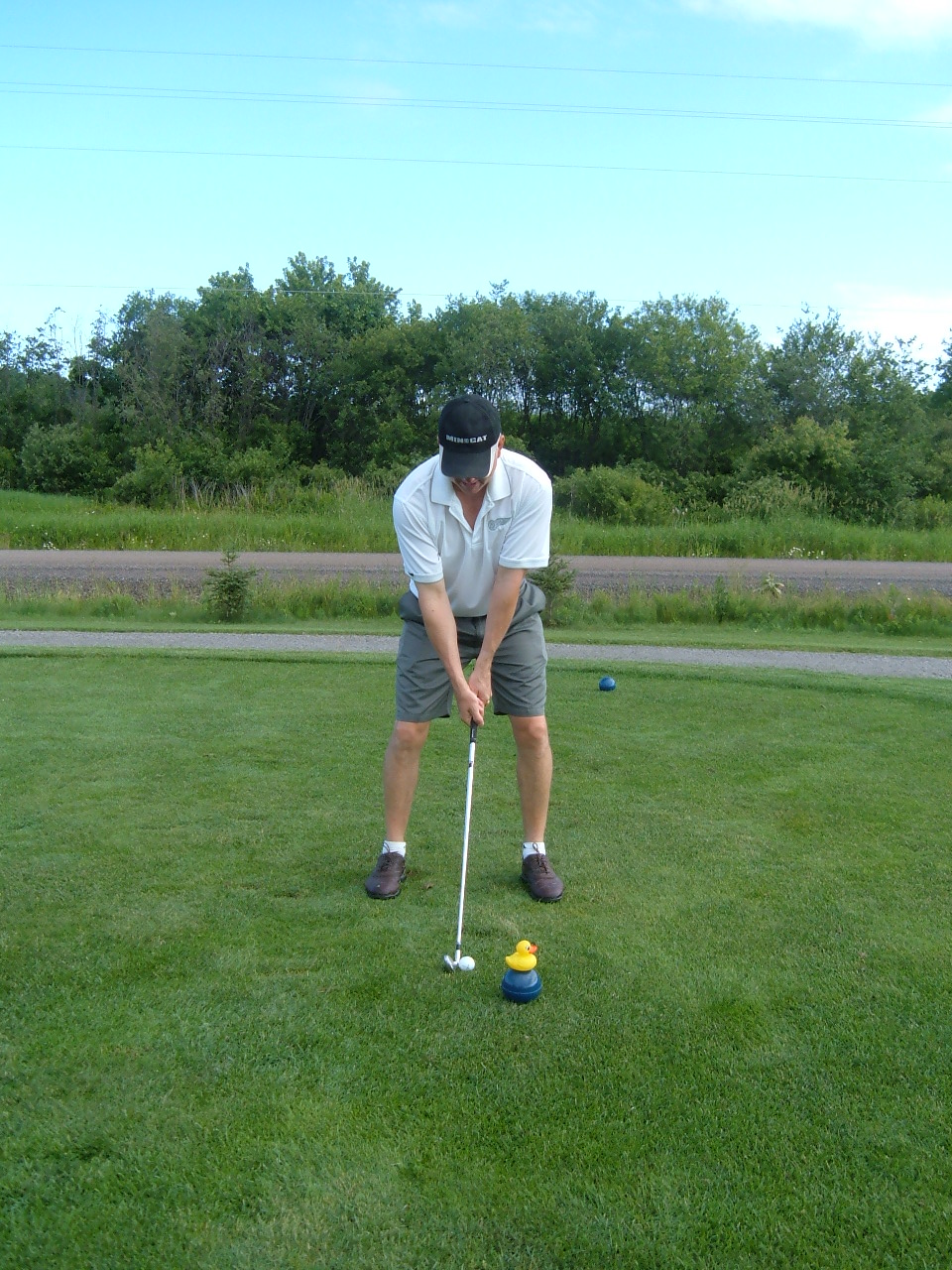
The 7 iron shot is a bump and run pitch.  I use this shot only when the ball is on the short grass.  I set the club up like a putter and often use the same grip.  I press my hands slightly forward and lead slightly on my left foot (I am a right-handed golfer).  I ensure that more weight is on the inside of my left foot to ensure crisp contact on the ball.  Next I lock my wrists and swing the club with my shoulders.

A very important aspect of this shot selection, and I cannot overstate this point, is to keep focusing on my club hitting the ball.  Then I count to 2, still looking at the point where my club struck the ball, then I look up.  Keeping your head down will ensure that your ball remains on the line you chose and that solid contact occurs every time.

There you have it, my solution to lowering your score.  I plan to use this shot tomorrow.  I am a grateful golfer.

What club do you like to use from 10 yards off the green on the short grass?