Are you confident with your golf shots?

Glen Abby Golf Course
I am a grateful golfer! See you on the links!
Are you confident with your golf shots?
Glen Abby Golf Course
I am a grateful golfer! See you on the links!
I recently asked the question about being offered a guarantee two putt from 15 feet or further during your entire round. My intent was that you had to take the every time. I was wondering how many players would take the offer. There is the results:
I have to say that I am not really surprised. Most players, including myself, think that if you are putting, no matter the distance, we are confident that we can sink the putt. This poll brought an idea to mind that I would like to share.
Confidence is critical to low golf scores. You have heard me discuss this in the past, but it is a topic that warrants repeating. I still like David MacKenzie from Golf State of Mind views of how to build confidence in your golf game. (for a more detailed explanation click here) Here is what he has to say:
Confidence in your golf swing, course management, and the mental side of golf goes along way to being a scratch golfer. Every time I tee it up, I hope to shoot my best score ever and have the confidence in my game to do it! I continually work on my game in my perceived areas of weakness and in turn this builds my confidence to perform well on the course.
How confident are you in your game?
I am a grateful golfer! See you on the links!
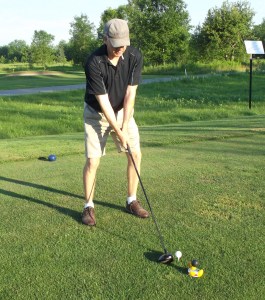 In my earlier golfing career, my biggest challenge in my game was staying in play off the tee. I have always hit the ball straight, yet my game continued to be hindered by poor tee shots. This frustrating challenge actually prevented me from maintaining a single digit handicap. Not knowing what to do, I ask the Club Pro, Gary Corriveau at Circle Pines Golf Course in Borden, Ontario.
Gary was always a great resource of information. He was approachable and always had time for players who had questions about improving their golf game. I remember talking to him about a particular hole at Circle Pine and explained my challenges off the tee. After listening to my diatribe, he patiently explained about teeing up on the side of the potential hazard; to avoid the potential hazard.
Gary explained how I would naturally adjust my alignment to avoid the hazard. He took 5 minutes to show me how my set up changed without me thinking about the potential challenges that faced me off the tee.
I have used and expanded this lesson over the years. I expanded this tip to include how I am hitting the ball on any given day. If I am pushing the ball (for some unknown reason) I tee it up on the right side of the tee box. This, without thinking too much, forces me to aim left to allow for my swing flaw. It opposite applies if I am pulling the ball.
Here is what Hank Haney has to say:
Adjusting where you stand on the tee box to avoid potential hazards is one of fundamental steps to great course management. Taking the time to understand your natural swing and using the above tip will also help. Course management is not just about club selection; it also deals with how to avoid trouble before you start. Standing on the right side of the tee box to avoid the potential hazards on the course will help lower your scores and reduce your frustration while looping the links.
I am a grateful golfer! See you on the links!
I cannot count the number of times I am asked about the rules of golf. What is really surprising is that most of those times, the requests happen during a tournament. Normally, I am not fussed about citing the rules, but when it comes to the “nearest point of relief”, I generally have to referee as well.
Most players do not mind taking relief, but they generally try to interpret the rule to gain an unfair advantage. I will always assume they are honestly misinterpreting the rule, but sometimes I am just not sure. So for those who are unsure, I thought it would be great to review this rule.
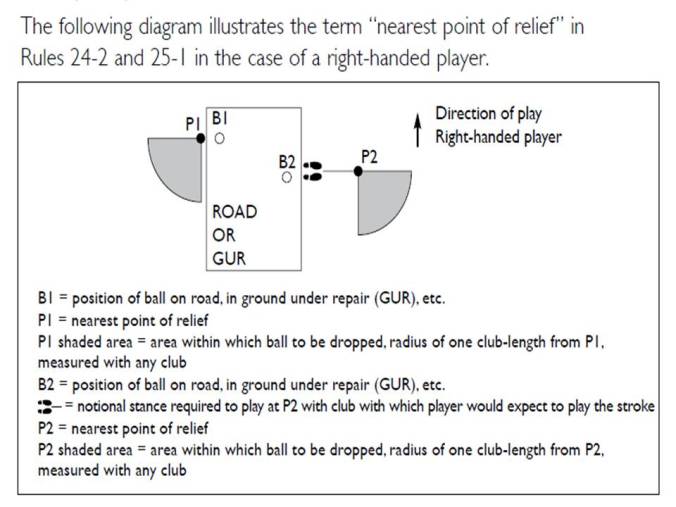
The “nearest point of relief” is the reference point for taking relief without penalty from interference by an immovable obstruction (Rule 24-2), an abnormal ground condition (Rule 25-1) or a wrong putting green (Rule 25-3).(Golf Canada)
It is the point on the course nearest to where the ball lies:
(i) that is not nearer the hole, and
(ii) where, if the ball were so positioned, no interference by the condition from which relief is sought would exist for the stroke the player would have made from the original position if the condition were not there.Note: In order to determine the nearest point of relief accurately, the player should use the club with which he would have made his next stroke if the condition were not there to simulate the address position, direction of play and swing for such a stroke.
If you are still not sure, here is that diagram that might help.
At last, I found a video that perfectly explains how to take relief:
The “nearest point of relief” is the most misunderstood rule in golf. This and all rules of golf can help or hurt your game. Understanding how to interpret rules properly will help your game and lower your scores!
I am a grateful golfer! See you on the links!
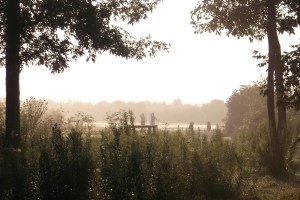
The Golfing Haze!
Have you ever played a round of golf and when you were finished could not really remember how the round went? You perform each stroke like a robot; basically going through the motions with no real intent! The slightest things distract you and you actually welcome the distraction. This scenario happens a couple of times a year; I am all excited to play, yet my mind is now where near the course.
This is what my golf haze is like:
Golfing in a haze is caused by many reasons! It could be caused by a lack of coffee, too much work, your favorite sports team lost, the sun is shining, or your playing partner is a non-stop chatter! Everyone has a different intensity of haze, but ultimately it the effects on their golf game is the same.
The haze is not a bad thing, it just happens. I think ever golfer experiences the golfing haze at one time. The trick is to respond in a positive way next time you hit the links! Have you ever played golf in a haze?
I am a grateful golfer! See you on the links!
 The Grateful Golfer