Iron or Hybrid?

In recent years, hybrid clubs have hit the market, which in turn has sparked a hot debate.  The question most asked is which is better.  I would suggest that the average amateur golfer would benefit from hybrids in their bag verses long irons.  Hybrids are more for giving and have a tendency to hit the ball further.

At PGA.com value guide a comparison of long irons and hybrids are made.  They conclude that hybrids have three advantages over long irons:  club head design, sole design, and shaft and length.  These are three pretty important design points and clearly hybrids come out as the winner.

Laird Small, Dir. of the Pebble Beach Golf Academy explains why hybrids are superior to long irons for the average golfer.  He talks about making better contact and how the club interacts with the ball.  Overall, hybrids are the way to go.

As you can see, hybrids are here to stay.   I have replaced my 3-4-5 irons with hybrids and found that I hit the ball further, straighter and with more confidence.  It has made a difference of two strokes per round on my overall score.  As a single digit handicapper, that is outstanding!

Do you use hybrids?  Tell me what a difference it has made in your game.  See you on the links.  I am a grateful golfer!

Playing Golf for Fun!

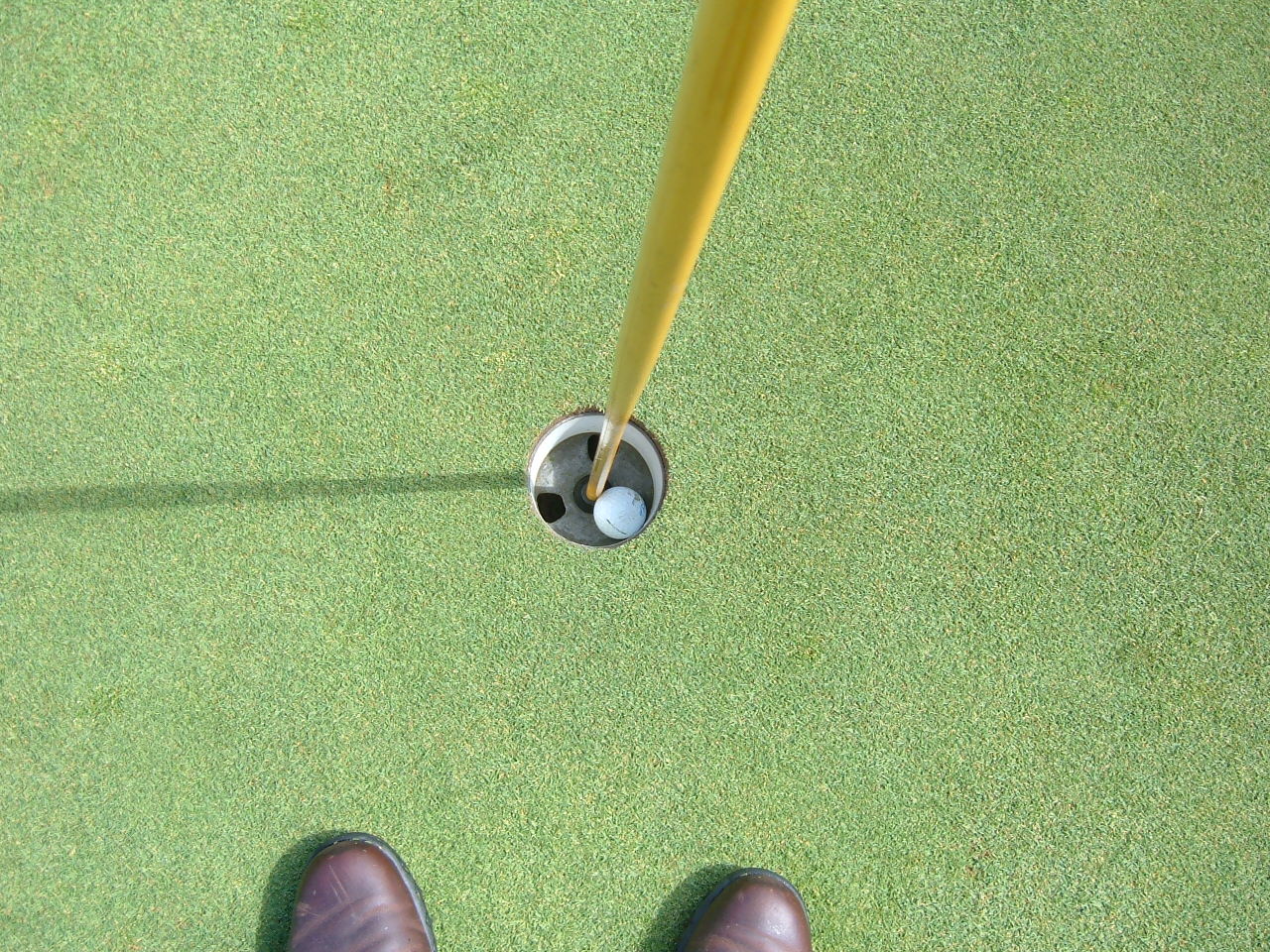
Hole In One from 208 Yards

Hole In One from 208 Yards
Man I Love This Game!

Fundamentally, golf is a game!  I know this is a profound statement, but it really is just a game.  I realize that this blasphemous statement does not sit well with many of you, however it is important to take stock of why we play.

Take me for instance, I have played golf for 35+ years.  I have had many ups and downs throughout my golfing days.  My game has  continued to evolve and I can honestly say that I still have plenty to things to learn.  So what drives me to continue, to push the edge, to challenge myself….the love of the game.  I love the competition (both in tournaments and against myself on regular days), the social aspect of playing, learning from my fellow competitors and hoping for that one perfect shot….the elusive hole in one.

Many golfers may not look at golf this way.  They look at the game of what they cannot do…not what they can do.  They see the negative aspects of a bogey instead of the positive view that it could have been worse.  A positive attitude will drive every golfer to great successes and real appreciation for the game.

An article in the New York Times outlines some very good aspects of why we play golf.  The following is from that article:  “Does being a golfer mean enduring clumsy embarrassment? Well, yes, it does sometimes, but that wasn’t the point. Being a golfer is to join a tribe with an elaborate set of tenets and canons, one with its own mores and protocols and no definable mission other than to chase a little ball into a hole.

It is a silly game, somewhat childish, a good walk spoiled, as Mark Twain said. It is all those things. So why do we love this game?

The allure of golf is its simplicity, which leads to a thousand complexities. It is sophisticated because it is subtle. It is perfect because it is wholly and forever imperfect.

I once asked David Duval, a British Open champion, what made golf so difficult and yet so appealing. He said, “It’s all the time to think between shots.”

I asked the great Phil Mickelson the same question and he said, “It’s all the choices you have.”

I asked Jack Nicklaus and he replied, “Because you must master so many elements, including yourself.”

I asked the golf commentator and author David Feherty and he said, “Because it’s a ridiculous game and it’s our fault for playing it.”

There you have it.  Golf means something different to everyone.  I can say that the reasons for playing golf over the years has morphed.  Now, I play to enjoy the walk, talk to my friends (old and new), and challenge myself hitting a little white ball into a hole.  I am a grateful golfer!

What to you love about Golf?
Keeping Your Composure!

Young DeerKeeping your composure when the wheels fall off is the most difficult skill in golf.  All of us have played the front nine as if we were pros.  We start to count things up, figure that we are going to set a personal recorded…..the poof, our game comes crashing to earth.

I am sure many of you are thinking….yeah too many times.  So how does an amateur keep their composure when things are falling apart.  This does not mean showing zero emotion like Jason Dufner;  it means keeping calm like Rory Mcilroy during the 2011 Masters.  Staying focused when the whole world is falling down around you.  So what to do?

The great Bobby Jones referred to composure when he said that “Competitive golf is played mainly on a five-and-a-half-inch course, the space between your ears.”  I have read many different methods to keep your composure and I have my several techniques.

One technique is to laugh and smile at my silly shot.  I do not hop around like a fool, but smile to myself and give a little chuckle.  I find that I remain calm and I can easily refocus and prepare for my next shot.

Another technique is to say my name to myself like I am correcting something.  It is sharp, quick and allows me to move on without carrying pent up emotions.

Lastly, I walk to my ball, look around at the beautiful surroundings, the sun shining, the birds singing, the gratitude of being able to play golf in an awesome country….I feel calm already.  I guess you get my point.

The one thing in common with all three techniques is they quickly eliminate the negative focus of making a bad shot and focuses on the positive aspect of playing the game.  Golf is meant to challenge your inner sportsman and remaining calm and enjoying your time on the links will only enhance your inner pro.  I am a grateful golfer;  see you on the links!

Which Shot Was the Worst?

Today, I learned a valuable lesson.  I was golfing with a friend and we were playing pretty well.  We were enjoying the beautiful weather, excellent conditions at Osprey Links, and great conversation.  I am a grateful golfer just for the outstanding time on the links.

All was going well until the 16th hole.  It is a long uphill par 5 with a difficult approach shot.  I hit the ball a little long and rolled off the back into the long grass.  Now the fun begins.  I hit my 52 degree and chilly dipped the shot.  Frustrated, I walked up to the ball on the fringe and sculled it 25 feet from the pin.  A smooth 2 putt and ta da – 7.

So which was the worst shot….you are right.  It was the 5th shot I sculled across the green.  Every once in a while, I make silly mistakes like this.  I should have walked over to my bag, grabbed the proper club and my putter.  Then walk back to the ball and focus and visualize the ball going in the hole.  This is an important lesson I continue to relearn.

Everyone makes a bad shot, it is what you do next that counts.  Reducing strokes by staying focused and accepting that sometimes bad shots happen will reduce your overall score.  Besides, on such a fantastic day what did I have to complain about…I am a grateful golfer!

Chipping – Being Aggressive

I have been off golfing lately and was wondering why most of my approach shots are significantly short.  I watch the pros and see them discussing which club to use, the wind, the ball location, what they are going to eat for lunch….ok not so much.  Ultimately, they take in many factors that most of us do not consider.  So what makes them so special that most of the pros are putting from 10 feet instead of 20 feet like the majority of amateur golfers.

Well it has to do with how aggressive they are when hitting their approach shots.  Whether they are 100 yards out or 10 yards; the pros try to sink the ball every time.  They figure it is best to be long the consistently short.  As my friend once told me, 100 percent of short shots do not go in!  I tend to agree with that analogy.

So what to do?  I recommend that you try to sink your approach shot with no fear.  It is easier to adjust distance if you are aggressive and you also have the line if the ball goes past the hole.  I know it sounds difficult, but actually it is not.  Focus on sinking your approach shot and you will find that your putt (if you miss the hole) will shorter and the chances of making it will significantly increase.