National Golf Day

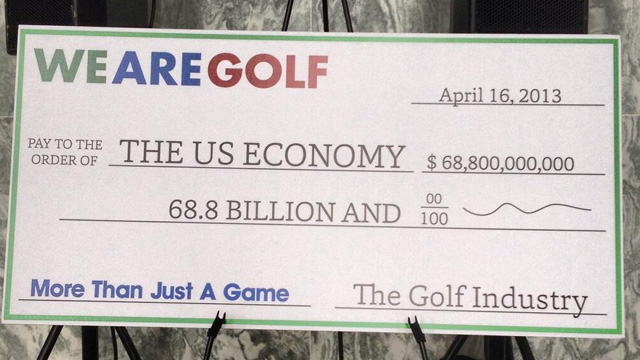
Today is National Golf Day! Who knew! Well, it is National Golf Day in the US. It is all about how the golf industry affects the US economy and it is not a far stretch to see how the golf industry effects all economies.

Supported by Jack Nicklaus, how could National Golf Day not be a success!

Interestingly, We Are Golf spearheads the initiative and today is the seventh year in a row that the golf industry lobbied the US Congress. What a great idea! In case you wonder what kind of impact the US golf industry has……
nationalgolfday

Yes, that is BILLION! National Golf Day is also about charities. We Are Golf tells us that “Golf is a key driver of charitable giving in the U.S – $3.9 billion a year to be exact. Philanthropic contributions, including those from professional tournaments, are a huge part of the industry, with the majority of funds going to causes outside of the sport. Beneficiaries include health, youth, education, environmental and cultural groups nationally, regionally and locally.

According to a 2011 study conducted by the National Golf Foundation, golf as a fundraising vehicle includes an estimated:

  • 12,000 golf facilities (75 percent of U.S. total)
  • 143,000 events
  • 12 million participants
  • $26,300 average per function”

I for one did not realize it was National Golf Day! For all my friends in the US, I hope you hit the links today!

I am a grateful golfer! See you on the links!

Jumping to Confusion

Lost and Confused SignpostHave you ever walked up to your ball with a club already in your hand before you actually looked at what was going on around you? This usually happens when a player is familiar with the course and draws conclusion before their next shot. We are all guilty of it, but is it really a case of familiarity or confusion?

One of the major challenges to members of a golf course is familiarity. Many players use the same club off the same tee all the time. Next they walk to their ball with the exact distance in mind; then select their club because it is the one they always use! After shooting the same score over and over, they question what is wrong!

Complacency on the golf course is a real challenge for most players. It causes them to stop thinking and to play golf on autopilot. Playing without thinking is the root of many challenges for amateurs. Having a preset plan on each hole stagnates the development of the famous Jack Nicklaus course management, degrades the Seve Ballesteros shot ingenuity, and limits their Lee Trevino’s love of the game!

Ultimately, by jumping to confusion players limit their ability to lower their score. Fortunately, there is a fix to this quagmire – change your approach to playing your favorite course. Instead of using your driver, use your three wood off the tee. Instead of bashing the ball each time, play to your favorite distance to the green. Instead of pin hunting, shoot for the middle of the green. There are many fixes, the real approach is just deciding to make a change.

As Jack Nicklaus says: Success depends almost entirely on how effectively you learn to manage the game’s two ultimate adversaries: the course and yourself. The only thing that a player can control is themselves; so instead of jumping to confusion, try something different. Only you can decide what changes are required, but changes are required if you want to lower your score!

I am a grateful golfer! See you on the links!

Masters – Tough First Day

Day one of the Masters is over. All the pundits are frantically justifying why their pick is not at the top of the leaderboard. They are talking about the wind, the pressure, their starting position, nagging injuries, etc, etc, etc. The performance of any professional during the Masters will vary depending on an infinite number of reasons.  But, there was always one factor that never changes!

Before I go into the one constant of the Masters, I thought I would share some interesting highlights of the 2014 first round.  Interestingly, it was what everyone expected and it was nothing like anyone expected.  Here is what I found interesting:

Back to the original point – the one constant of all the Masters is the course!  Golf monthly has a great overview of each hole that is worth checking out. However, that is not what I noticed.

Augusta National ArchiveThe only flat section at Augusta National Golf Club is the practice area and tee boxes!

As I watched the players navigate around the course, not one of them had a flat lie. Not one!  In the fairway, the ball was above or below their feet.  The hazards on the course are sculpted perfectly. The announcers constantly talked about the quick breaks and how important it is to be on the right side of the hole! The course is a monster and course management will be the deciding factor to who wins this weekend! Augusta National Golf Course is truly a gem and the next three rounds are going to be exciting.

I am a grateful golfer!  See you on the links…..soon!

Which Golf Grip is Best for You?

Holding a golf club is one of the most important fundamentals to a great golf swing.  The slightest change to the position of the hands has a tremendous impact on whether the ball finishes in the woods or in the middle of the fairway.  Focusing on how to hold a golf club is the first step to developing a great golf swing.

There are three basic golf swings: the baseball grip, the overlapping grip and the interlocking grip.  Each grip has its own unique advantages and disadvantages.  As each player evolves, many have experimented with each grip to suit their game. Continue reading

Putt for Dough

“If you say you can or you can’t you are right either way”- Henry Ford

Confidence While Putting!In earlier posts, I outlined 5 steps on the mechanics of a great putter.  As every amateur knows putting is extremely important when trying to break 100, 90, 80 or 70.  All things being equal, if your putting is on, your score is low.  So how can the average golfer elevate their putting so that a great day is a normal day on the green?

George Beardsley suggests that speed is most important on long putts and line is the most important on short putts. He also provides a couple of drills to help with your putting that might be worth a look.

The Putting Doctor, Joseph P. Bermel Jr, suggests that pre-shot routine and alignment are the most important aspects of putting.  He also says visualization and practice are strong enablers for great putting.

Peter Sanders reported from Jack Nicklaus that “regardless of the distance of the putting opportunity, the correct distance is the most important factor in success.”  It reduces three putts and increases the chances of a one putt.  Averaging no more that two putts per hole is ideal.

Well that about covers a wide range of what the pundits and experts say about putting. Further research could uncover another 100 revelations.  Each of the experts is correct, but it may not be best for you!  It is difficult to determine what exactly is required to fix a putting stroke; after much trail and error a solution may be found.

What is the most important point of putting?  On those great days when the hole looks like a manhole; the greens are easy to ready; the greens all run true and are consistent; your stroke is smooth and in control all the time – what is the key?

CONFIDENCE!

Confidence in your ability to hit the ball on-line, with the right speed and far enough to sink the ball.  The first trick to gaining confidence is removing all doubt.  The word ‘can’t’ never enters into your head ever when playing golf.  Start today.  Think positive about your putting, focus on the what works, practice the things that are challenging and work on your putting mechanics.

No matter what – be confident that you are a great putter!  If you do – great things are going to happen!

I am a grateful golfer!  See you on the links!