Belly Putter Banned!

Although Keegan Bradley has found success using a belly putter, the American is confident he will find a new way to putt should long putters be banned. (Lucy Nicholson/Reuters)

Let the games begin!  The National Post ran a very good article about what is next in the process of banning the belly putter.  Basically, there is a three-month period for input, then they make a decision and in 2016 no more belly putter.  Yawn!

Actually, this is one of those topics I really don’t care about.  I believe that a long putter, short putter, belly butter, hockey stick or pool cue makes no difference.  Every player still has to hit the shot.  I also believe that if the hinged belly putter was so great, everyone would be doing it.  That is what happens; golfers adopt anything that will make their game better.

I have tried a belly putter and do not like it.  I did not feel more comfortable and my putting stoke was not smooth or consistent.  Overall, I think this is one of those rules that should not be a rule.  Is there not something more important to worry about like a rule regarding the colour of clothes on tour or to many sponsor labels on your shirt!

Well you know how I feel about this topic; what do you think?

Importance of Marking Your Ball

Jim BallI was playing a round with a mentor of mine, Bob Fortune, and he told me a story.  Bob was one of the top golfers in Canadian Forces for years.  He played in many international competitions and his story of the importance of marking your ball really hit home.

While playing in a tournament, Bob watched his competitor tee off 4 times on one hole.  Each time the ball went to the same general location.  After the 4th ball they decided that they should be able to find one of them.  After a short search, they found a ball.  Of course the first question was, “What were you shooting?”  The competitor said, “Titleist 4.”  His next question was, “What was your second ball?”  The response, “Titleist 4.”  Bob’s third question, “Your third ball?” Again the response, “Titleist 4.”  The fourth question received the same response, “Titlest 4!”

Bob said he was shocked.  His competitor had not marked his ball in order to specifically identify it as his own.  Bob said, “I am sorry, but you are lying 7.”  His competitor did not agree and challenged his interpretation of the rules.  They agreed to ask the judge when they ended the round.

At the completion of the round, they brought their claim to the tournament judge and the ruling was in favor of Bob’s interpretation.  At the time, I was not know rules and asked him why.  According 2012 RCGA rules, it is the responsibility of each play to put an identification mark on your ball; many golfers play the same brand of ball and if you can’t identify your ball, it is considered lost (Rules 12-2 and 27-1).  Thus 2 stroke penalty for each ball not found.  In this case 6 strokes.

Since Bob’s story, I have always marked my ball.  I use blue and read ink.  I use blue for regular play and red for a provisional ball.  I have never been caught by this rule, but I can easily see the average player could be quickly be assessed a two-stroke penalty.

Have you ever been caught by this rule?

2 Stroke Penalty – Really?

While playing a round of golf in a tournament, Tim, Dave, Chris and Kirk were talking quite a bit. They seemed to get along very well and the round was quite pleasant. As they continued through the round Tim and Dave talked the most. While walking down the 12th hole, Tim asked Dave what club he used on the par 3 – 11th tee. Dave, not thinking anything about it said a 7 iron.

On the tee box of the par 3 – 16th hole, Dave asked Tim what club he just used. Tim said 6 iron and was smiling because he hit it on the green. Dave thought for a second, grabbed a 7 iron and hit the ball on to the green as well.  Both players two putted and were happy with their par. When they said their score, Chris piped up and said, “Ah, no, that will be a 5 for both of you.”

Both Tim and Dave said, “No Way!  A 2 stroke penalty – Really?  For What?

Asking for and giving advice.  Tim and Dave were not convinced and pulled out the rule book right then and there.

First they looked at the definition of advice which is defined by the 2012 RCGA Rules as “Advice’’ is any counsel or suggestion that could influence a player in determining his play, the choice of a club or the method of making a stroke. Information on the Rules, distance or matters of public information, such as the position of hazards or the flagstick on the putting green, is not advice.

The penalty for breaching the rules falls under Rule 8-1. Advice:  During a stipulated round, a player must not:

a. give advice to anyone in the competition playing on the course other than his partner, or b. ask for advice from anyone other than his partner or either of their caddies.

Both players were very disappointed and said they do this all the time.  I would suggest we all have given advice during a practice round and never gave it a second thought.  It is important to know the rules because during a tournament, it could cost you more than 2 strokes.

I am a grateful golfer.  See you on the links!

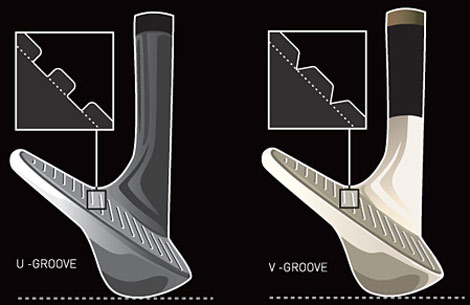
V-Grooves. U-Grooves. Really?

I was reading the rules of golf from Golf Canada and came across the changes to the grooves on clubs.  I read their intent and have concluded that technology is making the game of golf too easy.  Well, I for one completely agree….haha!  I will concede that technology has allowed the amateur to hit the ball a bit further, lob the ball higher, and hit recovery shots easier.  But, a player still must hit the shot straight, strike the ball to obtain the proper distance, and manage the course to lower their score.

So what is the big deal about V-Grooves or U-Grooves!  The table below from the RCGA outlines when the rule will take effect.

Date
Change
Effecting…
Jan 1, 2010
New specifications introduced on club-face markings.
All new models of clubs launched after January 1, 2010.  Existing models of clubs will continue to conform to the Rules of Golf.
Jan 1, 2010
Condition of Competition will be available to Committees requiring players to use clubs with markings which conform to the new specifications.
Strongly recommended that this Condition should be introduced only on the major Professional Tours.
All other golfers, playing in competitions where this condition has not been introduced, can and should be permitted to continue to use old model clubs which do not satisfy the new specifications.
Jan 1, 2014
Condition of Competition will continue to be available to Committees.
Strongly recommended that this Condition should be extended only to lower level Professional events and expert level amateur events.
Club level golfers can and should be permitted to continue to use old model clubs, which do not satisfy the new specifications.
Jan 1, 2024
Earliest date that the Rules will be applied to clubs manufactured prior to 2010.  This date will be reviewed in 2020 and may be extended.
All players, all abilities, all forms of play.

V Grooves - Golf DigestGolf Digest’s excellent article on grooves explains why they are changing….or not changing the face of golf.  I never really understood the reasons before, but I guess it make sense.  The sharper the edges the more grip the club face will have in the rough or wet conditions.


Titleist.com has the best guide I could find.  It explains everything.  Their view is that the design of the grooves really do not make any difference.  The main point of the guide is the angle of the groove face and the volume of the groove.  This article is very good and will explain much about this issue.

So What?  Why am I telling you this!  Rules are changing.  It is important that we stay on top of the changes so it does not have a negative impact on our game in the future.   The rules are an important part of golf and levels the playing field.  I am not fussed about the rule change on grooves, but would not change my clubs because of the rule change.

What do you think about the change in the groove rule?

Hitting Ahead of the Tee Blocks

Hitting Ahead of the Tee Markers

2 Stroke Penalty – Stroke Play
Rehit – Match Play

On Friday I was playing match play against some friends.  We had a discussion about teeing the ball up ahead of the tee blocks.  Going around the foursome, I quickly realized that there was not going to be a consensus on the rule.  One said re-tee the ball, it was a two stroke penalty, it was a one stoke penalty, and the last said who cares.

Of course, I was quite curious about the actual rule.  I went to the RCGA website and the 2012 rules are posted in a PDF format.  I quickly read the rules and found out that rule 11-4. Playing from Outside Teeing Ground – applied to our conversation.

The rule states:
a. Match Play
If a player, when starting a hole, plays a ball from outside the teeing ground,
there is no penalty, but the opponent may immediately require the player to
cancel the stroke and play a ball from within the teeing ground.
b. Stroke Play
If a competitor, when starting a hole, plays a ball from outside the teeing
ground, he incurs a penalty of two strokes and must then play a ball from
within the teeing ground.
If the competitor makes a stroke from the next teeing ground without first correcting
his mistake or, in the case of the last hole of the round, leaves the putting green
without first declaring his intention to correct his mistake, he is disqualified.
The stroke from outside the teeing ground and any subsequent strokes by the
competitor on the hole prior to his correction of the mistake do not count in
his score.

I always thought the match play rule applied to all situations….I was shocked to read that in stroke play a 2 stroke penalty is applied and the person must rehit.  And a player can be disqualified from the tournament.  Now that I know, I am better prepared when playing in tournaments.  My day has not been wasted:  I learned something new.  I am a grateful golfer.