Putting Guides – Part 5 of 5

Reading the greens!  This is the most difficult part of putting and why I left it until last.  Reading the greens sets up your entire stroke.  If someone cannot read the greens it is like playing darts with your eyes closed – you generally know which direction to through the dart, but that is about it.  So here are my tips on how to read a green.

First, I pace off the distance of my putt.  I know how to putt the ball from 5, 10, 15, 20, and 25 feet with relative accuracy.  This skill is honed by going to the putting green and placing a tee at each distance and practicing.  Once I have determined the distance of the ball from the hole, I look at the slope of the green.

The slope of the green will determine if it the putt will break left or right.  Additionally, it will determine home much.  My general rule is 1 inch to one foot.  For every inch the ball is below or above hole, I adjust my putting distance accordingly.   So if the hole is two inches above my ball on a 12 foot putt, I will adjust my distance to 14 feet.  It is something that I have used over the years with good success.  This rule is affected by the cut and grain of the green.

If the green is playing fast (cut low), I increase my ration from 1:1 to 1:1.5 or 1:2 (inches of elevation to distance).  Additionally, the grain is important, especially in the evening.  The grass follows the sun, so this will determine if you are putting into the grain or with the grain of the green.  Again, I adjust my putting distance accordingly.  This leaves determining your line.

Determining your line is not as difficult as one may think.  Once you have applied the above, it comes down to speed.  Picking a line has much to do about confidence.  Once you have decided that the ball breaks a specific amount, be confident and go for it.  Something to keep in mind, the softer you hit the ball, the more break you must play!  If you play the ball 2 inches outside the right edge, but you are putting down hill with the grain and you barely have to hit the ball to get it to the hole.  You will need to play about 3-4 inches of break.  The softer you hit the ball, the more break you must play.

Lastly, except in rare instances, if the ball is within 3 feet of the hole, forget the break and hit the ball into the hole.  Most amateurs, myself included, over-think short putts.  I have found that if I just hit the ball into the hole, I will make 9 out of 10.  So on short putts, think less and bang the ball into the hole.

Well that is it for me on reading the greens.  I will say that I am going to try and plumb-bob this year because it might come in handy on the difficult greens.  Ian Hardie at golfhabits.com explains this skill very well.

I hope you are having a fantastic holiday season!  I wish you all the best.  I am a grateful golfer!
Putting Guides – Part 4 of 5

“As regards stance and manner of hitting the ball, it is for the individual to discover on the green the means that suit him best with the club that gives him most confidence.”       Harry Vardon – How To Play Golf

Any building, bridge, tree or person have one thing in common – a strong foundation.  In golf, a strong foundation starts in the legs and hips.  This is where power is generated and where a smooth consistent swing starts and ends.  Well putting is no different, except it has less moving parts in the upper body.  So our next step to consistent putting deals three important aspects of putting that will improve your game.

Everyone is shaped differently.  So it is very difficult to tell you exactly how to stand.  Additionally, some people have physical challenges that prohibit certain motions; so do what you can and what you are comfortable with.  As you go through the various tips, make sure you are comfortable and standing with complete control of your body.  Here we go:

Image by Angus Murray from:  http://www.golf.com/instruction/how-find-and-use-your-dominant-eye

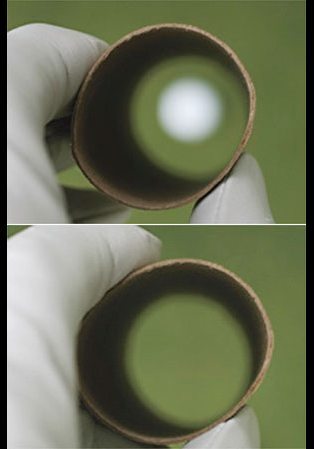
Eyes – I always start with my eyes.  I stand with my dominant eye over the ball.  I believe it is the best way to line up the center of your ball with the two marks you have chosen 3-feet in front and the further.  Golf.com talks about your dominant eye and putting.  The article is very good and will help explain the importance of your dominant eye when putting.  It is very important to keep your eyes on the ball when making contact.  Additionally, I count to two before following the ball on its path; this ensures you follow through on your line and focusing on initial contact.

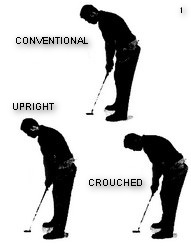
Image from: http://www.better-golf-by-putting-better.com/putting-in-sync.htmlPosture  – Once your dominant eye is over the ball, bend your knees slightly so if you drew a line from your right shoulder to your toes and your knee are touching that line.  Now, straighten your knees so you are standing comfortably.  It is impossible for anyone to tell you how to stand, but your stance should be comfortable and allow a smooth shoulder movement.

Image from:  http://www.better-golf-by-putting-better.com/putting-triangle.htmlBuilding a Triangle – The putting triangle is not unique.  Virtually all the resources I checked stated that the triangle between your shoulders, arms, head and hands is the key to good putting.  I agree.  Once you have formed your triangle, it is important to keep it solid through the entire swing.  It is the foundation to a great putter. When putting your elbows and wrists must remain locked in position and the swinging motion is completed with a shoulder turn with very little lower body movement.  This is something that is different for every player, but the mechanics are the same.

Well that is it!  These three points are my keys to putting success.  The mechanics of putting is different to every player and unique to their skills.  If you follow these three tips, I believe your putting will significantly improve.

While researching putting, I found a few websites that may be helpful – Enjoy

http://www.youtube.com/watch?v=P60F_wu1pBk&list=UUuXIBwKQeH9cnLOv7w66cJg&index=16 – Lots of golf videos – Putting Triangle Drill is very good.

http://www.golftipsmag.com/instruction/putting.html  – Golf Tips Mag has many tips and an extensive putting library.

http://golfhabits.com/ – Ian Hardie has many tips on putting and other aspects of the game worth reading.

I am a grateful golfer – see you on the links!

Putting Guides – Part 3 of 5

Image from:  http://scoregolf.com/articles/x-feature-instruction/learn-to-lagMy next putting tip has to do with how aggressive you want to play.  Many advisers, coaches, pros, and friends have varying views on this topic.  It is very difficult to determine what is best and when.

Many will say that if the greens are playing tough to lag putt outside of 15 feet.  Others will suggest to always attack the hole.  Dave Pelz at Scoregolf.com says that for putts 35 feet or longer to image the hole is 6 feet wide.  This lag putt will hopefully cut down 3 putts.

Chris Czaja from Golfinstruction.com states that “One basic rule I have golfers follow is that if you are outside four paces from the hole, just go for a two putt.”  He is also a strong supporter of practicing you putting stroke for 30 minutes a few times a week.

Ask yourself,  when you have to make an approach shot or long putt….how often are you short of the hole?  I would suggest that you are short most of the time.  As a result, here is my view:

100% of short putts don’t go in!

I never intend to lag putt.  I believe that by trying to sink every putt is the only way to play golf.  I know that many players will not agree with my view, but I think that most players need to be more aggressive when they play and it starts on the green.

What do you think?  Is lag putting the way to go or is being aggressive a valid alternative?

Putting Guides – Part 2 of 5

Image from:  http://www.sirshanksalot.com/golf-drills/short-game-drills/putting-tips/895-spot-vs-line-putting/Back 6 forward 12!  Now that you have made solid contact on the ball, where are you putting it too?  There are many ways to line up your putt, determine the slope, the grain, hole location, etc. and we will talk about that in later posts.  Right now I want to talk about hitting your line.

How do we consistently keep the ball on line?  At SirShanksAlot.com, they talk about the difference between spot putting and line putting.  Spot putters do not have to look at the hole and only focus the spot they are putting too.  Line putters focus on the hole and take the whole shot into account.  I remember about 30 years ago when Jack Nicklaus gave an interview and he talked about putting.  He said that he picked a spot about 3 feet in front of the ball and putted to that spot.  I took his point to heart (and if it is good enough for Jack……), but added my own little twist.

First thing I do is determine my line.  Then I pick a point three feet in front of the ball.  This is the point I must hit first when putting.  Right now you are saying sounds simple; well here is my twist.

I additionally want to determine the speed of the putt.  Therefore, I pick another point on my line (past the 3 foot point) that the ball has to go over to make sure I have enough speed on the putt.  Additionally, these two points help make sure your putter head follows through on the intended line.  I have found that if I hit both points, I one putt quite often and rarely three putt.  This style really works for me.

It is a simple way to ensure consistency when putting!

It is snowing right now….looks beautiful.  Only 4 months to go before golf season!  I am a grateful golfer.  See you on the links!


Putting Guides – Part 1 of 5

Image from: http://timmilburn.com/3-things-putting-a-golf-ball-taught-me-about-decision-makingI believe that improving your putting will reduce your overall score by 10% or more.  I can make this bold statement because experience has proven that when a person scores extremely well, they usually have putted lights out.  Take the pros for instance, anyone who scores really low credits their success to chipping and putting.  Personally, all of my low rounds have resulted from 27 putts or less per round.

There are many websites dedicated to improving your putting.  These sites include selling attachments for your putter, a gadget to make your stroke consistent, how to visualize your smooth stroke, being aggressive, lagging your putt, being confident…..well oh my!  There are many things that can help with your putting; but only you can decide which method will work for you.

I figured that I should provide my tips to success on the green.  You will likely have heard of them before, but they work for me and I use them every round.  So, here is the first of five suggestions that the average golfer can use without having to pay anything.

My putting tip from May 2012 is the first.  It is very simple.  Ensure your putter head follows through twice as far as you take it back.  This will allow for solid ball striking and a greater chance the ball will travel on its intended line.

I know it sounds simple, but I can assure you that your miss hits (either by line or distance) will be significantly reduced because of the solid contact.  Additionally, your lag putts will be close and chances of three putting will fade away.

Ultimately, I believe that if your putter head travels back 6 and forward 12, it will significantly cut your number of putts per round.  Give it a try and let me know what you think!  See you on the links.