Golf Strategy: How to Play a Tight Lie

How to play a tight lie is one of the most challenging shots in golf. Proper execution is undoubtedly important, but selecting the proper shot is really the key to success! Do you putt the ball, chip it or flop it are just some of the things that go through your head as you look over the situation. I came across the picture below and thought I would get your advice on how you would play it.

Chipping for Success

How would you play this golf shot?

This shot happened a few years ago at a scramble golf tournament. My three playing partners and I were lying 2 on a par 5. As we surveyed the shot, each of us played it differently. Here is what happened:

  • The first player tried putt the ball and you can see the results in the picture.
  • The second player hit a bump and run. He tried to hit the ball short and hoped it would bounce up to the pin. His shot was short and the player picked up.
  • The third player flopped the ball, it landed on the fringe and the ball rolled up about 8 inches from the pin. It was an easy tap in for birdie.
  • I tried to flop the ball to the pin with the hopes of the ball landing just short and slowly rolling into the hole. I was unable to put a spin on the ball, so my ball released 4 feet past the hole.

As you can see, we tried a different shots to make the up and down. The success of the third player made my shot easier and thus I was more aggressive than normal. How I would play the shot is really not important; what is important is how you would play the shot!

How would you approach this shot?

I am a grateful golfer! See you on the links!

Golf Tip: Using Your Dominant Eye

Loyalist Country Club (12)

Eye Dominance and Putting – Important?

As kids, he have all made a circle with our thumb and index finger to encircle a distant object. Then we opened and closed our eyes and notice that the object flips in and out of the circle. Little did we know that the movement of our circle was an indication of which eye was considered dominant. I have found that as I age, my dominant eye is becoming more and more dominant; as a result of this physical change, in need to adjust my golf game.

Before we move forward, it is important to determine which is your dominate eye. Look at something on the wall across the room. With your index finger and thumb make a circle. Place the object in the circle – be sure you can clearly see the object in the circle. Close your left eye – did the object move? Close our right eye – did the object move? Whichever eye was open with no movement is your dominant eye. I have determined that I am left-eye dominate.

As a left-eye dominant player who plays right, my alignment must take into account how my eye’s view my golf shots. My primary rule is that my dominate eye must be over or slightly behind the ball during all strokes.

Here is what I mean:

When putting, I putt best when my ball in line with my dominant eye; this means my ball is slightly ahead of center in my stance. I find that if my ball slides back to the middle or behind center, I end up pushing the ball because I am not able to square my putter head through contact. Also, I have a tendency to leave my putts short if the ball is not aligned with my left eye. By placing my dominate eye over the ball during putting, I have great success on the greens.

When chipping, my dominate eye must be slightly ahead of my ball, but not far enough back where my right eye is directly over or in front of the ball. By placing the ball slightly behind my dominate eye, my weight distribution fits my stroke, I do not pull the ball to the left of my intended line and I make crisp contact on instead of hitting it thin or fat.

My dominate eye has the greatest effect on my driver. I must have my dominate eye in line with the ball during my set up. In my case, the ball appears to be back in my stance more, but in fact, it is not. Having the ball on either side of my dominate eye will cause a push or pull. The biggest error I constantly work on is not having the ball too far forward in my stance (forward of my dominate eye); the result of my poor alignment causes me to hit the ball left.

Understanding the effects of eye dominance is important to your golf game. It took many trial and error trips to the range and putting green before I figured out how my eyes were causing fundamental challenges in my swing. Had I known about eye dominance earlier, it would have reduced my range tips and frustration on the links.

I am a grateful golfer! See you on the links!

Golf Tip: Eliminating Trouble off the Tee

Roundel Glen 06 Jul 14 (4)In my earlier golfing career, my biggest challenge in my game was staying in play off the tee. I have always hit the ball straight, yet my game continued to be hindered by poor tee shots. This frustrating challenge actually prevented me from maintaining a single digit handicap. Not knowing what to do, I ask the Club Pro, Gary Corriveau at Circle Pines Golf Course in Borden, Ontario.
Gary was always a great resource of information. He was approachable and always had time for players who had questions about improving their golf game. I remember talking to him about a particular hole at Circle Pine and explained my challenges off the tee. After listening to my diatribe, he patiently explained about teeing up on the side of the potential hazard; to avoid the potential hazard.

Gary explained how I would naturally adjust my alignment to avoid the hazard. He took 5 minutes to show me how my set up changed without me thinking about the potential challenges that faced me off the tee.

I have used and expanded this lesson over the years. I expanded this tip to include how I am hitting the ball on any given day. If I am pushing the ball (for some unknown reason) I tee it up on the right side of the tee box. This, without thinking too much, forces me to aim left to allow for my swing flaw. It opposite applies if I am pulling the ball.

Here is what Hank Haney has to say:

Adjusting where you stand on the tee box to avoid potential hazards is one of fundamental steps to great course management. Taking the time to understand your natural swing and using the above tip will also help. Course management is not just about club selection; it also deals with how to avoid trouble before you start. Standing on the right side of the tee box to avoid the potential hazards on the course will help lower your scores and reduce your frustration while looping the links.

I am a grateful golfer! See you on the links!

Golf Tip: Putting to Lower Scores

Putting is the cornerstone of low golf scores. There is no golfer, amateur or professional, who has not questioned, dissected, or overhauled their putting stroke. As a golfing fanatic, who is always trying to expand my golf knowledge, I like to ask golf questions to, well, anyone who will listen.

A couple of years ago, I penned a 5 part series on how to putt. It dealt with several different parts of golfing and I think they are still valid. If you are interested, click here to start at Part 1.

So, here was my question from a couple of days ago:

I have to say I was a bit surprised by the results. I have always been taught to roll the ball 8 inches past the hole. Putting 8 inches past the hole will make sure, more often than not, that the ball will drop, but not so fast as to stay out if the center of gravity of the ball is on the inside of the lip of the cup.

Putting is a tough skill to master in golf!

Putting is a tough skill to master in golf!

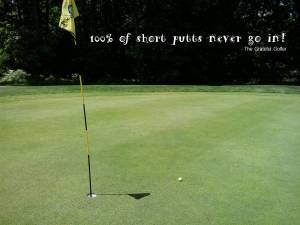
There are many different views on putting. The 17-inch rule by Dave Pelz has guided many amateur golfers through the years. Personally, I find hitting the ball almost 2 feet past the hole a bit too aggressive for my game.

Other pundits recommend that just dropping the ball in the cup is the way to go. I find that by trying to hit the ball so it just drops in, my putt generally ends up short. There is nothing wrong with this approach, but the yips become more of an issue when I am putting tentatively.

The consensus from my Twitter question suggests that dropping the ball in the hole is what works for most of the respondents. Ultimately, it is up to the player and what they find most comfortable. personally, I am sticking to putting the ball 8-inches past the hole.

I would be interested in what your preference is: past the hole or just in?

I am a grateful golfer! See you on the links!

If You Could Change One Thing….

Swing Changes

What would you change in your swing?

If you could change one thing about your golf swing, what would it be? Would you adjust your shoulder turn? Would you increase your hip rotation? Would you delay your wrist release? What would your one change be?

Through the years I have attempted to change every aspect of my swing. It was all a very slow process and I am far from finished. My changes have had mixed reviews, but each adventure increases my knowledge and understanding of golf.

My journey to scratch golf experienced many peaks and valleys, but the process has been very rewarding. I will have to say that some of my success were the result of changing something different as long as I was paying attention.

In earlier posts, I discussed Opening Pandora’s Box, The Domino Effect, and Pareto’s Theory, and everyone one of these posts have a direct effect on the rest of this article.

So back to my original question; If you could change one thing about your golf swing, what would it be? Before I suggest what I would change and what you think you should change, consider the following:

  • What are the follow-on effects will occur by making the change?
  • What change will have the greatest long-term impact?
  • What change will force a change in other areas of your swing?
  • Will a quick change improve your golf scores?
  • What is the final goal or expectations from the change?
  • Are you mentally prepared for a drastic improvement in your golf game?

These and likely many other questions should be addressed before making any change – quick or deliberate. Even simple changes to your golf swing change several secondary aspects of your swing mechanics! So beware of what you ask!

As I have stated before, I like to tinker with all aspects of my game. So, if the magical golf fairy gave me one wish, I would change my the amount of torque generated between my initial hip turn and then movement of my shoulders! My choice is founded on much introspection and I decided that to go to the next level a need to develop more power through all my woods, hybrid and irons!

I believe that this change will affect my club choice, alignment, and course management. I am sure there are others that do not immediately come to mind, but I would be ready! So the secondary effects are just as exciting as the initial change.

The question remains: if you could change one thing about your golf swing, what would it be?

I am a grateful golfer! See you on the links!