Chip, Pitch or Putt for Lower Golf Scores

Choosing the right club at the right time is critical to lower golf scores. It haunts all golfers because club selection is the holy grail of knowledge only gained through years of practice and playing lots and lots of golf. (the second part of gaining knowledge is my favorite)

IMG_20140506_165520

Chip, Pitch or Putt, what is your call?

A while back, I wrote an article about a situation where the ball was on the fringe and I was left with a choice to chip or putt.  There was many opinions and for the most part, choosing between putting or chipping was about 50/50.

Recently, I asked the same question without the picture and the response was different. I am not sure whether it was because the picture was not present, but the 25% increase for players wanting to putt was not really surprising.

Apart from the qualifying remarks such as: is the ball above the hole, is there a mound between the ball and the hole, what time of day is it, is the green freshly cut or how am I playing, most amateurs seem to agree that putting the ball when possible is the best option.

I generally agree, however it is important to have other shots in your bag for those times when either chipping, pitching or putting is required. My years of experience have taught me that relying on just one type of shot is not conducive to consistent low scores.

As someone who likes to always move forward, I like trying new methods to lower my score. My constant pursuit for improvement does not always meet my overall expectations.

Have you ever heard the saying ‘3 steps forward, 2 steps back’? That is what happened to me when I decided to putt more from the fringe. I focused all my attention on the flat stick and as a result, my chipping and pitching started to atrophy.

Although I had developed a new skill by putting more often, I lost my touch with my chipping and putting irons. Fortunately, with a little practice, my “feel” returned and now I have 3 solid types of shots when the ball is on the fringe. I am happy now at the end of the journey, but during the transition, I found it frustrating and sometimes wondered if I was on the right path.

Generally, when the a player is developing a new skill, there is a point of frustration when the new skill is not meeting expectations and their old skills are starting to rust. It is usually at this time when players stop learning the new skill and revert back to their old ways. As a result, the player concludes that the new skill is not worth the effort.

Golf is a challenging sport. It provides the opportunity for a player to be as good as they want. I believe that being a great golfer, we amateurs must find our own path to success. What works for me, may not work for you. I also believe that being a grateful golfer we need to keep trying to improve and be thankful for the journey to lower golf scores.

How do you handle learning a new skill? How much practice time do you devote to it?

I am a grateful golfer! See you on the links!

Drive for Show, Putt for Dough

Chipping it Close

A strong short game in golf saves strokes!

How many times have I heard this statement! And how many times have we ignored this critical advice! My 2015 season was riddled with unsuccessful efforts to increase my distance off the tee. Actually, I was so obsessed to hit it like the “big boys” that I forgot the fundamental rule of successful golf.

The short game rules!

I have trusted this simple tenant and followed it for years. To lower my score and consistently shoot in the 70s, I always worked on my short game. But, for some reason this year I lost focus. I am not sure why I decided to move away from what works, but no matter what I tried, the results to hit longer off the tee did not meet my expectations on any level.

Last night, an epiphany occurred. It was not some earth shattering understanding of golf or some hitch I noticed in my swing. It all started when I asked a simple question on Twitter:

Although my sample group was small – the results cannot be ignored. 100% of the respondents, without hesitation, said they preferred a deadly short game over awesome drives!

Well of course they do! Most amateurs marvel at the booming 300+ yard drives of the Pros or the 250 yard 4 irons, but one critical factor we overlook is that most Pros have a deadly short game!

Anyone who has played, studied, or observed golf understands that the most strokes are saved within 25 yards of the green. The ability to consistently chip or pitch the ball for a “tap in” putt is priceless! A deadly short game is more valuable than hitting the ball long off the tee because if it takes 4 strokes to sink the ball from 25 yards, the advantage of distance is lost!

For my first introspective conclusion for this year, I realize that my 2016 season must include more short game practice if I ever want be a scratch golfer.

I am grateful for those who responded to my question last night. Your feedback was extremely valuable!

I am a grateful golfer! See you on the links!
Golf Tips, We Don’t Need No Stinkin’ Golf Tips!

If you scour the internet for golf tips, 150,000,000 searches appear in 0.41 seconds. Now, I am an avid golf fan and enjoy increasing my knowledge about my favorite sport; but really, 150 million hits for golf tips! The challenge is to sift through all the white noise to figure out which tip is best for us!

Everyone has their own process to cut white noise.  Everyday, we are bombarded with information that is filter, processed, acted upon, or discarded.  The difficulty is to figure out what is important and which process works best; then apply it to golf.  For me, the process is simple:

  1. Identify the problem;
  2. Collect information on the problem;
  3. Analyse the information;
  4. Determine possible solutions or courses of action; and
  5. Decide on way ahead.

This process empowers me to move forward when faced with many challenges. In 2015, I did have the arsenal required to really improve my golf game and lower my scores. So, I have decided to fix that short fall starting next week.

I have decided my way ahead for the my winter golf project. I am going to write on article a week on golf tips. Not my normal, this is the way The Grateful Golfer does it, but a review analysing tips I find while researching golf. I hope to provide a video with each article, but that will depend on the tip that I find.

I cannot guarantee that each tip will be useful to you, but I suggest that it will broaden your library of golf resources that you can tap into at a moments notice. I think that this project will be fun and beneficial to everyone. If nothing else, I look forward to learning new golf tips that will help me reach my goal as a scratch golfer!

What do you think? Any suggestions on which tip should be researched first?

I am a grateful golfer! See you on the links!
 

Golf Tip: Keeping your Head Still!

Recently, I placed an image on Instagram with a caption: “keeping your head down through the entire golf swing is important for consistent low scores.” It was a quick note and I originally thought it was grammatically correct and to the point.

After a short while, Rick Williams from mindbodygolf, a valued member of the Grateful Golfer Community, suggested that keeping your head ‘still’ instead of ‘down’ was the correct message for a consistent golf swing and lower scores. His suggestion started me thinking and wondering if his suggestion of keeping our head still was indeed the correct message.

After much thought, I agree with Rick. To prove this change in wording to myself, I actually grabbed a club and swung it about 25 times. Through the entire process I focused on the position of my head and whether it stayed in the same position through my entire swing. This is what I found out:

  • My head is in the center of my stance during set up
  • My head shifts towards my back foot slightly during my back swing. Additionally, my head turns slightly to the right to make room for my left shoulder at the top of my back swing
  • As my down swing starts, my head returned to the middle of my stance, but remained behind the ball through impact
  • On contact, my head is still and centered until my right shoulder pushes my head to look for the ball

My conclusion about Rick’s comments is that my head does need to stay still, but does slide during my golf swing. An important message to follow this diatribe is that my head stays on the same plane and does not bounce up and down like a bobblehead.

Thanks Rick, my new message to all golfers is to of “keeping your head still through the entire golf swing is important for consistent low scores.”

I am a grateful golfer! See you on the links!

Another Indication Your Golf Season is Over!

I am sure many of you have yearly golf traditions. Recently, you read one of mine when I played my final round at Trillium Woods Golf Club. After my last round, my next tradition is to clean my golf ‘stuff’ and put them in a safe, warm place for the winter!

First, I clean out all my pouches. There is nothing worse than finding a half eaten anything in your bag next spring.

I take all my clothes and wash them. This generally includes my rain suit and other outer wear.

I remove my towels and throw them in the wash. I generally carry two towels and replace at least one each year. This year, my beloved Nipissing University Towel will be recycled for greener pastures.

I take all the broken ‘stuff’ and bin them. Then scour the sales to replace what needs replacing. This year I need to find a new pair of brown golf shoes.

I remove all the golf balls that I will not need next year and replace them with Titleist ProV1 and Srixon. I like to prepare for next year by marking them with my TGG logo! (still working on exactly what it looks like, but I am getting close)

I wipe my bag clean.

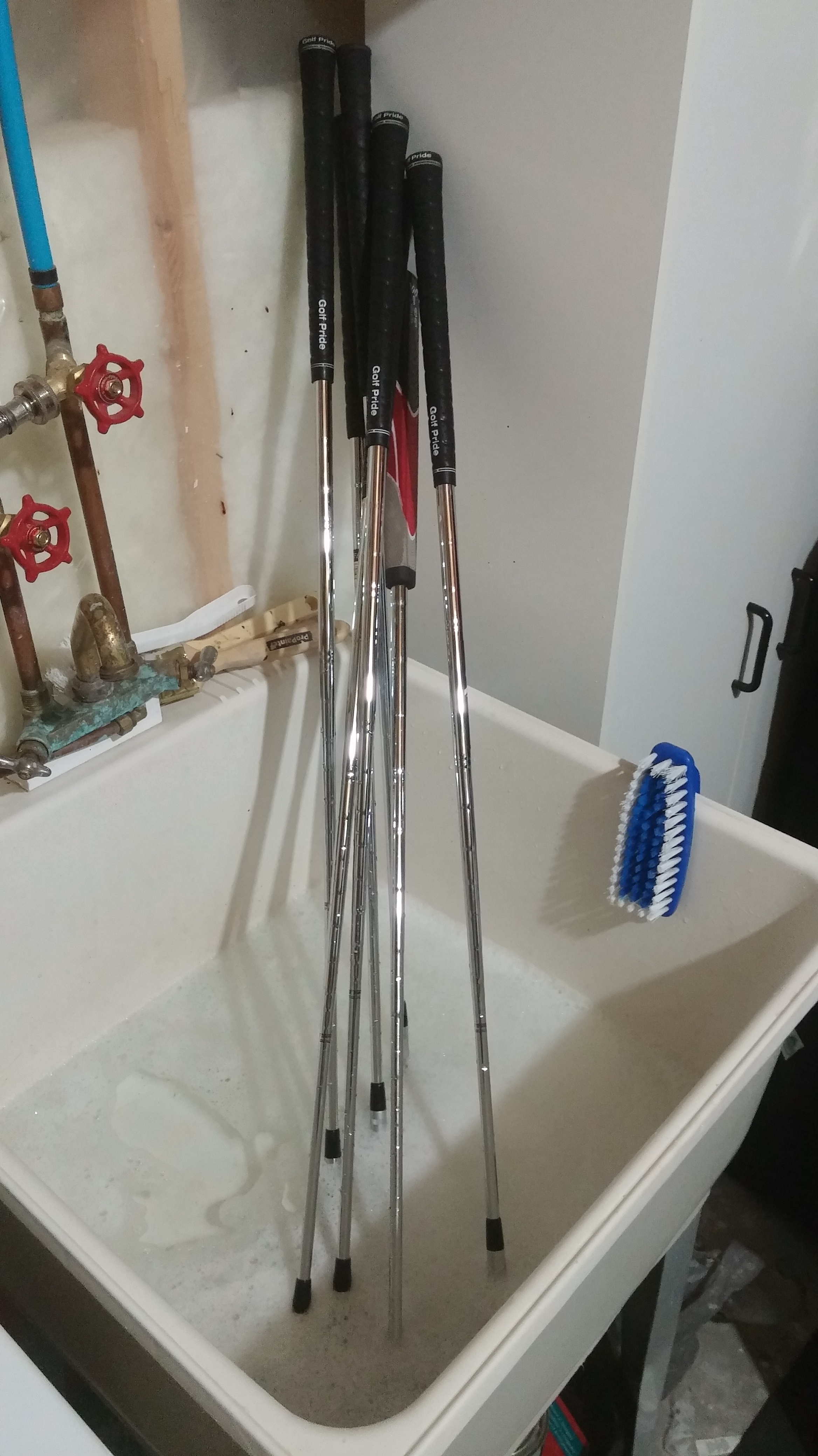
20151018_101014 20151018_10095320151018_101002Lastly, I clean my clubs. I fill the basement sink with warm soapy water and let my irons soak for about 3 minutes. Then, I take a soft brush, scrub clean, and dry them off. Next, I dip my woods in the water for about 10 seconds, scrub clean, and dry off immediately.

Lastly, I take a wet cloth and wipe off the grips and let air dry. This entire process takes about 30 minutes to an hour. After air drying the grips, I place my clubs in my clean bag and anxiously wait for spring!

Cleaning my clubs is an important yearly tradition. I believe that it is important to take care of my equipment. Most of us have a fair bit of money invested in our sport and this is one way of making my kit last longer.

Do you clean your clubs at the end of each season? Do you have any other tips to make your equipment last?

I am a grateful golfer! See you on the links!