Golf Etiquette On The Pro Tour

Etiquette is important to the spirit of golf. They are many unwritten guidelines that make sure everyone enjoys the game of kings. Of all the players involved in golf, I would expect professionals to display the highest levels of etiquette. As the élite of my favorite sport, there is an expectation that they conduct themselves in a reasonable and professional manner.

Loyalist Country Club (12)

Golf Etiquette is Important For Everyone to Know!

A while back, I wrote an article about “Etiquette on the Green“. In it, I outlined many do’s and don’ts of being on the green. It is something I believe is very important and should be on the mind of all players, novice and professional. However, I did not touch on an etiquette incident I notice earlier this week.

While watching Thursday’s round of the Northern Trust Open, I noticed something that I thought was a breach of etiquette, but after discussion with a work mate (who is an avid golfer) I am not so sure. Maybe you can help me out, am I being paranoid or not?

On the 10th green, a player had lined up his putt and was preparing to execute his shot. Off to his left, another player was patiently waiting for his turn to play. As the original player made contact with his ball, the second player started walking towards his ball. Now, I applaud the second players actions to speed up play, but this is where I thought he went over the line.

With the ball still in motion, the second player walked between the person putting and their ball. At first I thought I was seeing things, but after the replay, it was true. The breach of etiquette for me was that he blocked the view of the ball from the person playing while it is still in play. Watching your ball until in completely stops is a great habit to get into because it provides a better understanding of the break on their next shot. So someone blocking your view, in my opinion, is a breach of etiquette.

So, am I crazy or what? Should the second player have stayed still until the ball finished rolling? Maybe walked around the person playing? What are your thoughts?

I am a grateful golfer! See you on the links!

Adjusting to Slow Play in Golf

Jim FinishThe natural flow of a round of golf is something I think is very important to low scores. This flow includes all aspects of your round and must be flexible. Previously, I mention that I use techniques adjust to a slower round, especially during tournament play. These techniques work for me hopefully you will find them useful.

It is important to understand that staying within your natural flow as much as possible during a slow round is important to great golf. Even though the play is slow, the following things I never change:

  • Preshot routine – regardless of what is happening around me or how long I have to wait, I never change my preshot routine. Same routine and same tempo through each shot.
  • Walking to your ball – I walk to my ball at my normal speed. Keeping my same speed helps with my natural flow and preshot routine. Sometimes I have to wait for others to hit, but that is normal. If I am waiting for quite a while see the points below I use to help pass the time. (Attention – if everyone is always waiting for you….well maybe it is time to speed up a bit)
  • Club Distance – knowing generally how far I hit a specific club never changes. The exact yardage may vary slightly depending on conditions, but for the most part, my club distance will never change.
  • Course Management – I try to play within my capabilities all the time. If I never draw the ball, as an example, I do not attempt in during the middle of my round regardless of how inviting the shot may be.

After ensuring the four points above never change, I still find that I still have lots of time to kill before it is my turn. To lower my frustration in these moments, here is what I do:

  • Carry a wet towel – I use a wet towel to clean my golf ball before I putt. I generally clean my ball every 3 or 4 holes, but now it is at every green.
  • Clean your clubs after every shot – I know most of you will say that I should be doing that anyway, however I am talking about giving it a good cleaning. This takes a few moments longer and allows players to get a head start before I walk to my ball.
  • Examine the conditions – while waiting for my turn to hit, I take a closer look at the wind, my lie, the lay for the hole and the location of the pin. Most of the time I do this while walking to my ball, but when things are slow, I wait until I get to my ball on the fairway.
  • Have a snack or drink– I keep some food in my bag. Just snack food or the odd sandwich. I also carry plenty of water. I find that on slow rounds I need to keep my strength and having liquids or food helps pass the time and keep me energized.
  • Stay mentally focused – I hum a tune in my head. It varies from round to round, but it keeps me in the moment. When I am waiting, I find music helps pass the time way. It keeps me calm and relaxed.

The above mentioned techniques are probably not a big surprise to most of you avid or competitive golfers. They work very well for me and the list is definitely not an all-inclusive one.

I would interested in what techniques to you use to keep the slow play monster from bothering your game?

I am a grateful golfer! See you on the links!


Your Next Shot In Golf

Important Golf Shot Ben Hogan

10th Hole – Glen Abbey Golf Club

Ben Hogan is a genius.

Imagine, after three putting the last hole then talking to yourself to the tee box, you face a tee shot like the 10th hole at Glen Abbey Golf Club. As you approach the hitting area, look out over the hole, you start to think….oh my, now what.

Novice golfers worry about their last shot and forget to focus on what is in front of them. Experienced golfers are able to focus on the job at hand. Competitive golfers are able to execute shots under pressure. Professional golfers think about their next shot and how to take advantage of the hole layout. There are many other variations to focused golf, but I think you get the point.

By following Hogan’s advice to only worry about the next shot, many of us amateurs would cut down on the multiple stokes gained from making a mistake. I know that through the years I earned many ‘extra strokes’ because I focused on the past instead of the present. It happens less now, but still happens.

This year, it is time to stay focused  mentally on my next shot and reduce those unwanted errors. Not sure I fully understand how I am going to do this……any suggestions?

I am a grateful golfer. See you on the links!

Conquering FEAR in Golf

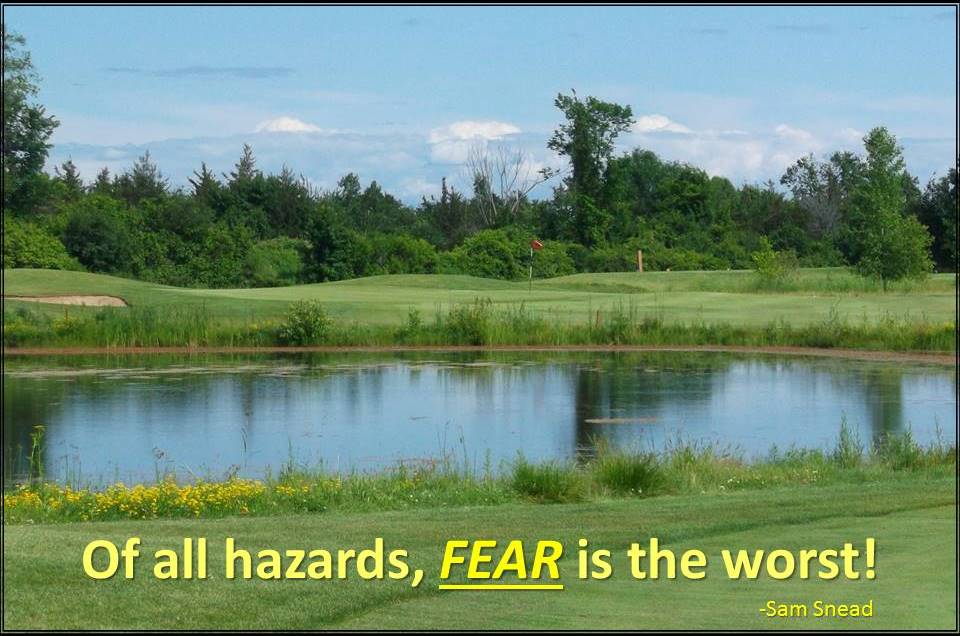
Hitting the ball short of the hole is a constant problem for amateurs. Off all the challenges I face on the links, under-clubbing is the most frustrating and obvious in my game. Using the wrong club can stem from many reasons, but for me it boils down to one thing. FEAR of going long! Yup, that is it. For some reason I am afraid to hit the ball past the hole or even worse over the back of the green.

As of right now, this FEAR is over! I choose not to let this FEAR influence my game anymore! I am exposing this dark cloud to the sunshine and making it disappear!

There are many reasons I can accept for playing a short approach shot. A poor lie, small green, blind approach shot, being outside of 175 yards or poor playing conditions. These challenges are realities while playing golf and proper course management usually helps reduce their effect on my game. Occasionally, I can accept misjudging something that results in a short approach shot, but none of the above cause any real frustration in my round of golf! But, hitting the ball short of the hole because of being afraid of hitting it long….well lets just say it really affects my next shot.

Sam Snead Fear

It is time for a change! Proper mental preparation will help me conquer my FEAR of hitting the ball long on approach shots. I must reframe the feeling of hitting the ball long from anxious to relaxed. To accomplish this, I believe that visualization will be the key. As I wait for the golf season to start, I mentally and physically prepare to play golf. This year, my mental preparation will include visualizing hitting the ball to hole on every approach shot!

If there is a situation on the golf course that causes you to feel uncomfortable or afraid, now is the time to address it! It is time to rip off that Band-Aid!

Personally, I like to use visualization. Others like to use positive self-talk to reframe the tough situation. Others hit the range using focused practice. Regardless which method you choose, you have accomplished the toughest part – deciding to make a change.

Improving your golf game is very much about conquering FEAR. Mine is mostly centred around hitting the ball short of the hole. I am choosing to make a positive change!

How about you? Are you ready for a positive change?

I am a grateful golfer! See you on the links!
Golf Grip – Strong, Weak or Neutral

The golf grip is the singularly most important choice any amateur golfer makes. The slightest change to the position of the hands has a tremendous impact on whether the ball finishes in the woods or in the middle of the fairway.  Focusing on how to hold a golf club is the first step to developing a great golf swing. After choosing how to hold your hands on the club, it is now time to experiment with your hand position to decide if you need to use a strong, weak or neutral grip.

Determining if you naturally hold the club in a strong or weak way is determined by the thumb and index finger of each hand (Vs). A strong grip, the Vs are right of the centre of the shaft. As a visual cue, you can see the knuckles of your left hand. A neutral grip, the Vs are down the center line of the shaft and you can see three knuckles on each hand. A weak grip, the Vs are left of center and you can see the knuckles of your right had. (The above description is for a right-handed player; the opposite is true for a left-handed player) Continue reading →