Canada Wins Gold at the 2015 Special Olympics

Although somewhat dated, I recently heard the awesome news of Canadian golfers at the 2015 Special Olympics held at Los Angeles in the United States. As I started to dig into the details, I was amazed to find out that 1209 golfers are registered in Special Olympics programs across Canada. Special Olympics Canada is an amazing organization that provides awesome opportunities for many athletes.

The Team Canada golf coaches (Head Coach: Nicola McGovern, Male Coach: Ben Postmus, Support Staff: Mike McCarther) are dedicated people whose leadership lead the Canadian athletes to great success. A big shout out to these and all the dedicated volunteers who made the dreams of the Canadian golf team come true!

Special Olympics Golf 2015

Golf Team 2015 Special Olympics – Canada

Meet the team! Click here.

For the Special Olympics golf rules click here.

Here is how the the Canadian Golf team did overall:

On the second-last day of competition at the 2015 Special Olympics World Summer Games, Team Canada earned its first-ever World Games medals in golf and took the overall medal total to 126 (63 gold, 41 silver, 22 bronze).

These World Games mark the first time Special Olympics Team Canada has included golf, basketball, and bocce athletes, and the Canadian golfers served notice on the Harding Course that our country has game.

Danny Peaslee of Manitoba and Tess Trojan of Ontario both won gold in Level 4 nine-hole golf, while Ontario’s Lorrine Russell finished second to Trojan and Kyle Grummett of B.C. captured bronze as the team’s Level 5 golfer playing 18 holes.

Peaslee golfed neck and neck the whole four rounds with Andrew White of Special Olympics South Africa. In the last round, Peaslee shot a 36 to beat out his South African competition by just one stroke to win the 2015 Special Olympics World Games gold medal.

Ontario’s Kyle Koopman finished fourth by one stroke in Level 4 play – he had been eight strokes out of bronze going into the fourth and final round, and he made up seven strokes today, but ultimately could not make that last step onto the podium. His coaches were blown away by his comeback.

All five players had their best round of the Games in today’s final day of competition. (Special Olympics Canada)

The Special Olympics is an amazing organization! I previously mentioned my nephew-in-law’s involvement in the Special Olympics ball hockey team in Sudbury, Ontario; it is he and the other 19,645 volunteers who make a real difference in the lives of 41,301 athletes!

Thank you to everyone involved in the Canadian Special Olympics; your dedication is an inspiration to us all!

I am a grateful golfer! See you on the links!


Golfing In Formation

image


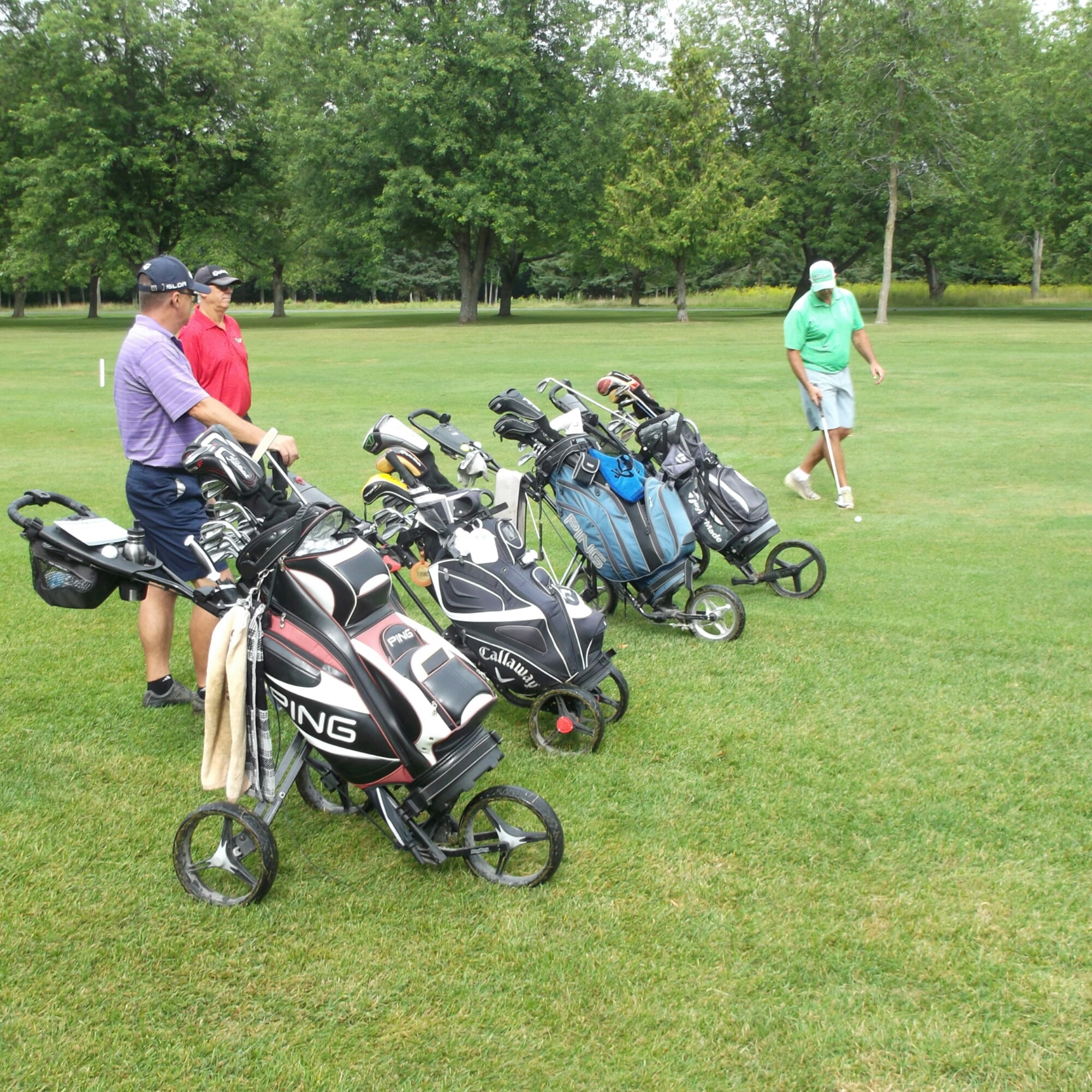
This is a typical sight on a golf course. Everyone moves along at a steady place and as happenstance has it, we are all aligned in a golfing formation the would rival the RCAF Snowbirds or the USAF Thunderbirds!

When playing in a foursome, where people stand during someone’s shot is very important. It is critical to great golf etiquette and has a direct impact to the shooter. When waiting for someone to play it is important to understand field of view, proximity, and respecting their personal space.

Field of view is pretty self explanatory. It is important that the waiting player not stand in a sport where the player can see them during their shot. So, those players who stand directing behind the player during a swing should move off the side to stay out of the field of view of the player. Everyone golfer is different and it is important to know where to stand. Personally, I am not usually fussed where people stand, but I would prefer if they stood at a 45 degree angle,   about 10 feet away. However, that is not always possible, so I have learned to be flexible.

Proximity is important for noise. If you are close enough for a player to hear you doing anything, you are too close. I have played with many players who fidget with things while waiting, they end up breaking the ambient noise of the golf course. All I can suggest is that the person waiting stop fidgeting or move further away from the person making the shot.

Last is personal space. I enjoy talking to my fiends on the golf course. That usually means that we stand nearer to each other when playing. Unfortunately, some strangers like to stand to close and quietly chat when someone is talking. I do not like this, actually I suggest most golfers feel the same way. I recommend that a 5 foot ring when talking to someone you do not know well is a good distance. If you have to get closer because you a have to whisper something during someone’s shot, maybe it can wait.

Golfing in formation is important. Proper etiquette is important so everyone can enjoy their precious time on the links. What do you think? Do you have other formation tips?

I am a grateful golfer. See you on the links!

Journey to Scratch Golf: A New Hope

Being GratefulA long time ago in a galaxy far far away…..

Of course we all know this epic line to the original Star Wars movie! I bet the song is going off in your head right now! Before the rest of the opening scenes explain the challenges faced by the rebels against the empire, our minds soar to new possibilities in almost every area of our lives.

That is where I sit right now. Golf season is over, I have 5 months before the links open, and I need to prepare for next season if I ever expect to be a scratch golfer. As with previous years, I like to take time to think about where I can most effectively make changes to lower my scores.

For me, it is a creative time. It is a time to be grateful for great 2015 golf season! It is a time to be introspective. It is a time envision the how to take my game to the next level. It is a time to embrace a new hope in my golf game.

I am a grateful golfer! See you on the links!


Hole-In-One or Albatross?

It is the best round of your life! You are playing 4 strokes under your best score ever! The only thing at would top off this fantastic round is ……. a hole-in-one or albatross?

I have played about 1500 rounds of golf in my life. That equates to approximately 27,000 holes and 123,000 strokes on the links. This does not include any partial rounds or fun tournaments I have played in over the years. Through all this time, I have only had 3 holes-in-one. I have never had an albatross! I have been close a couple of times, but I have never felt the exuberance of conquering a 500+ yard hole in two.

If you think about it, an albatross would be better for your round; going 3 under in one shot is what dreams are made of! But for some reason, everyone thinks a hole-in-one is the only metric worth using when talking about a great golf.

I actually believe I have a better chance at shooting a hole-in-one than an albatross. During each round, I have four opportunities for a hole-in-one and maybe one or two chances for an albatross. Do not get me wrong, I would take a hole-in-one every round, but I think I would like to shoot an albatross at least once!

I am a grateful golfer! See you on the links!

Golf Tip: Using Your Dominant Eye

Loyalist Country Club (12)

Eye Dominance and Putting – Important?

As kids, he have all made a circle with our thumb and index finger to encircle a distant object. Then we opened and closed our eyes and notice that the object flips in and out of the circle. Little did we know that the movement of our circle was an indication of which eye was considered dominant. I have found that as I age, my dominant eye is becoming more and more dominant; as a result of this physical change, in need to adjust my golf game.

Before we move forward, it is important to determine which is your dominate eye. Look at something on the wall across the room. With your index finger and thumb make a circle. Place the object in the circle – be sure you can clearly see the object in the circle. Close your left eye – did the object move? Close our right eye – did the object move? Whichever eye was open with no movement is your dominant eye. I have determined that I am left-eye dominate.

As a left-eye dominant player who plays right, my alignment must take into account how my eye’s view my golf shots. My primary rule is that my dominate eye must be over or slightly behind the ball during all strokes.

Here is what I mean:

When putting, I putt best when my ball in line with my dominant eye; this means my ball is slightly ahead of center in my stance. I find that if my ball slides back to the middle or behind center, I end up pushing the ball because I am not able to square my putter head through contact. Also, I have a tendency to leave my putts short if the ball is not aligned with my left eye. By placing my dominate eye over the ball during putting, I have great success on the greens.

When chipping, my dominate eye must be slightly ahead of my ball, but not far enough back where my right eye is directly over or in front of the ball. By placing the ball slightly behind my dominate eye, my weight distribution fits my stroke, I do not pull the ball to the left of my intended line and I make crisp contact on instead of hitting it thin or fat.

My dominate eye has the greatest effect on my driver. I must have my dominate eye in line with the ball during my set up. In my case, the ball appears to be back in my stance more, but in fact, it is not. Having the ball on either side of my dominate eye will cause a push or pull. The biggest error I constantly work on is not having the ball too far forward in my stance (forward of my dominate eye); the result of my poor alignment causes me to hit the ball left.

Understanding the effects of eye dominance is important to your golf game. It took many trial and error trips to the range and putting green before I figured out how my eyes were causing fundamental challenges in my swing. Had I known about eye dominance earlier, it would have reduced my range tips and frustration on the links.

I am a grateful golfer! See you on the links!