Golf is an interesting game. You can swing less to hit far; hit to a shorter yardage on the fairway to set-up your next shot; hit a 3-wood of the tee to play safe; and use course management to avoid all trouble. But every once in a while, a player must hit an aggressive shot to score low! Continue reading
lower golf scores
Decide – The Only Off Season Golf Strategy You Need
Decide!
This is the ultimate off-season golf strategy for any golfer. You have heard me mention it before, but now it is time to get the details!
This one little word changes in-action into action!
It empowers all players to get active and do something; anything to help improve their golf game.
Recently, I asked players what they did in the off-season to prepare for the time they hit the links. 50% of the players said that they putt. That was about it. Well, I applaud the fact they do something, I would suggest that it may not be enough to help lower their scores early in the 2016 golf season.
Decide!
This is the most difficult step in using your off-season to your advantage is to make the decision to do something! Deciding to get of the couch and work on your game will be the best decision you ever make to lower your golf scores. Here is what I think:
- Decide build A Growth Mindset About Golf
- Decide to become a student of the game
- Decide to get fit
- Decide to practice
- Decide to read about more than mainstream golfing news
- Decide to decide to improve your game
Well this is it, my fool-proof off-season plan for anyone to improve their golf game! Anyone can do it, anyone, if they decide, can change what they are currently doing to lower their golf scores in 2016!
I have made the decision to do something and I am currently formulating a plan. I hope to share it with you over the next few weeks, but in the meantime, it is your turn to:
Decide!
Golf Rules: Nearest Point of Relief
I cannot count the number of times I am asked about the rules of golf. What is really surprising is that most of those times, the requests happen during a tournament. Normally, I am not fussed about citing the rules, but when it comes to the “nearest point of relief”, I generally have to referee as well.
Most players do not mind taking relief, but they generally try to interpret the rule to gain an unfair advantage. I will always assume they are honestly misinterpreting the rule, but sometimes I am just not sure. So for those who are unsure, I thought it would be great to review this rule.
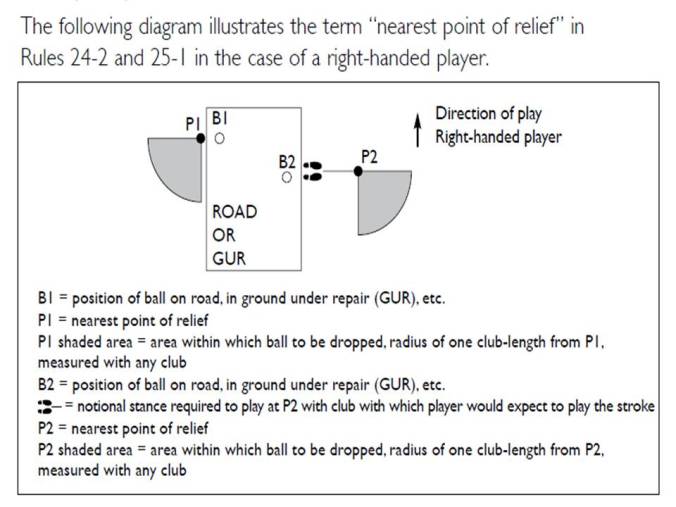
The “nearest point of relief” is the reference point for taking relief without penalty from interference by an immovable obstruction (Rule 24-2), an abnormal ground condition (Rule 25-1) or a wrong putting green (Rule 25-3).(Golf Canada)
It is the point on the course nearest to where the ball lies:
(i) that is not nearer the hole, and
(ii) where, if the ball were so positioned, no interference by the condition from which relief is sought would exist for the stroke the player would have made from the original position if the condition were not there.Note: In order to determine the nearest point of relief accurately, the player should use the club with which he would have made his next stroke if the condition were not there to simulate the address position, direction of play and swing for such a stroke.
If you are still not sure, here is that diagram that might help.
At last, I found a video that perfectly explains how to take relief:
The “nearest point of relief” is the most misunderstood rule in golf. This and all rules of golf can help or hurt your game. Understanding how to interpret rules properly will help your game and lower your scores!
I am a grateful golfer! See you on the links!
Golf Tip: Keeping your Head Still!
Recently, I placed an image on Instagram with a caption: “keeping your head down through the entire golf swing is important for consistent low scores.” It was a quick note and I originally thought it was grammatically correct and to the point.
After a short while, Rick Williams from mindbodygolf, a valued member of the Grateful Golfer Community, suggested that keeping your head ‘still’ instead of ‘down’ was the correct message for a consistent golf swing and lower scores. His suggestion started me thinking and wondering if his suggestion of keeping our head still was indeed the correct message.
After much thought, I agree with Rick. To prove this change in wording to myself, I actually grabbed a club and swung it about 25 times. Through the entire process I focused on the position of my head and whether it stayed in the same position through my entire swing. This is what I found out:
- My head is in the center of my stance during set up
- My head shifts towards my back foot slightly during my back swing. Additionally, my head turns slightly to the right to make room for my left shoulder at the top of my back swing
- As my down swing starts, my head returned to the middle of my stance, but remained behind the ball through impact
- On contact, my head is still and centered until my right shoulder pushes my head to look for the ball
My conclusion about Rick’s comments is that my head does need to stay still, but does slide during my golf swing. An important message to follow this diatribe is that my head stays on the same plane and does not bounce up and down like a bobblehead.
Thanks Rick, my new message to all golfers is to of “keeping your head still through the entire golf swing is important for consistent low scores.”
I am a grateful golfer! See you on the links!
Being Engaged in Golf
Scoring in golf is sometimes very challenging. A player can play well and score poorly. Conversely, a player can play poorly, but score well. Regardless of where you fit into this spectrum, being engaged in each shot is very important.
To explain what I mean, golf pro Darren Everett, from National Club Golfer, explains the importance of engaging with your target during all phases of your swing. Everett’s point of being engaged and focused on your target during your pre-swing routine, during contact, and after contact is a simple, yet extremely important lesson for all amateur and professional golfers alike.
Next time I am on the range or the course, I will engage the my target with intent. This important point will help me stay focused and should result in lower scores! We shall see tomorrow.
I am a grateful golfer! See you on the links!

