Making A Difference In Someone’s Life

Making a difference in someone’s life as easy as smiling and saying hello! Sometimes, it only  takes a second change someone’s world.  Just listening or offering a helping hand may be enough to make a difference.  Any small positive token of acceptance can occur anywhere; even on the golf course.  Golfers have a long history of helping others.  There are many golf charities that raise money for the military, the homeless, cancer research, under privileged kids, and many more.  All are important and provide support to those who may need it most.

Each year I try to play in charity golf tournaments or events to promote worth causes. It is a great way to give, play golf and support many charities.  Last year, I participated in the True Patriot Love Foundation event in North Bay, Ontario and in the 8 Wing Commander’s Golf Tournament in support of the local United Way Charity.

Next year, I plan on helping organize some events because giving your time is as important was a financial donation.  I believe it is important that everyone gives back and if we can do it through golf charities, then why not!  The PGA leads by example by giving back all year; Together, anything’s possible.

On an unrelated note, but in the spirit of Christmas and giving, I wanted to bring your attention to a young 17-year-old Winnipeg artist whose video went viral back in 2011. Sean Quigley isn’t just a musician but is very involved in charity and social justice movements. When “little Drummer Boy” and its music video where released, CD’s were sold under one condition, “All the money has to go to charity” said Quigley. In collaboration with a local radio station, CD’s where pressed and sold out in a matter of hours. Their agreement was honoured and every penny made from CD sales went to an organization whose goal is to end homelessness and poverty in Quigley’s hometown of Winnipeg.  Enjoy the video!

I am a grateful golfer!  See you on the links!
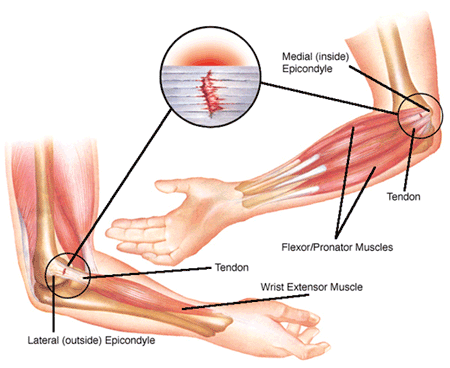
Golfers Elbow or Tennis Elbow

Ouch That Hurts!  Have you ever felt a sharp pain in your elbow while playing golf.  It usually happens when making contact with the ball.  When the pain is noticeable, some start to adjust their swing; change their grip; avoid sand shots; or use more foot wedges to place the ball on soft grass.  As avid golfer continues to hit the links, they find the pain creeping into their everyday life.  It becomes difficult to grasp anything with the affected arm, difficulty rolling your hand left to right and it sometimes aches.  If this sounds familiar, well then you may have Golfers Elbow.  Or do you?

Golfphysio.com states that: the elbow is subjected to large forces during a golf swing, especially an amateur golf swing, statistics indicate elbow complaints range from PGA circuit rate of 4% to amateur golfers 24% (includes both medial and lateral complaints in right and left elbows). The most common site of injuries is not on the “inside” – (medial aspect) of the elbow which has the name “golfers elbow”, but on the “outside” – (llateral aspect), traditionally termed “tennis elbow”.  Regardless of the definition, ultimately only a medical professionals can diagnose your problem.

Epicondylosis
Golfers Elbow – medial aspect
Tennis Elbow – lateral aspect

If you have a what you suspect is golfers / tennis elbow, the Mayo Clinic suggests the conservative measures such as:

  • See a doctor.
  • Rest.
  • Ice the affected area.
  • Take an over-the-counter pain reliever.
  • Stretch and strengthen the affected area.
  • Reduce the load on your elbow.
  • Consider other medications. I
  • Gradually return to your usual activities.
  • Ask your doctor when surgery is appropriate.

I have had, by the definition above, tennis elbow a couple of times through the years.  It is not fun.  It usually lasts about 2-3 months once I start to take care of the injury.  To make sure it was nothing serious, I saw my doctor for diagnosis.  Each time, my doctor suggested the Mayo Clinics conservative treatment.

After some research, it becomes difficult to figure out what caused the injury.  It definitely has something to do with your swing or maybe the amount of golfing you are doing.  In my case it the amount of golf (which is not really a bad thing to me) played.  However, some suggest it may be your grip, downswing, follow through, contact point, angle of contact and on and on!  Obviously, fixing your golf swing over the internet is almost impossible, so if the pain continues (besides seeing a doctor) talk to your local pro.  There is a very good chance they can help.

There is one aspect of pain relief that worked very well for me.  As suggested in the above video, it was a tensor bandage.  I used (use) a tensor cuff with a velcro strap to snug it around my elbow.  An important point for my success was that the tensor cuff had a gel square sewn into it. it. I placed the gel on my injured area (as shown above) and tighten it slightly.  I found with this support, I played pain-free and helped promote recovery.

Golfers / Tennis elbow is a pain (sorry I could not help myself).  It is a common injury that does effect all aspects of your game.  It is important to address it quickly so it does not linger for an entire season.  Just to be clear, I am not a medical professional and it is important to see your doctor before you start any medical treatment.

I am a grateful golfer!  See you on the links!
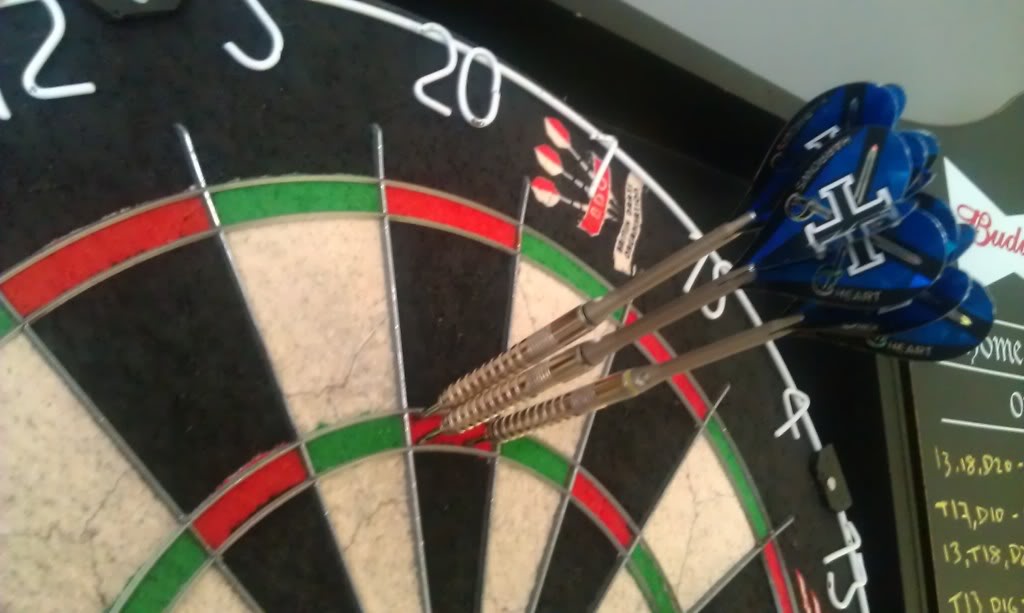
 

Golf and Darts

Golf is a game of precision, patience and skill.  It takes hours of practice, practice and more practice to be considered an outstanding player.  A golfer trying to break any number of milestones will attest that golf is not easy.

Darts, the unwitting spectator will suggest is just the opposite.  It is a game that requires little skill and can be played almost anywhere.

Interestingly, I suggest that golf and darts have many common challenges and to be skilled at both is more difficult that one may think.

Both sports require players to follow certain rules or etiquette.  In darts, no Player or Member shall act in a manner which may reasonably be considered to be prejudicial to the interests or standing of the DRA or which could reasonably be considered to injure or discredit the DRA or bring the game of darts into disrepute.  In golf, the same basic rule applies.

Golf uses cool terms like bogey, birdie, lag putt, big dog, chili dip, and shank.

Darts uses terms like Bed & Breakfast, Diddle for the Middle, Mugs Away, Robin Hood, Ton, and Sunset Strip.  

180 Darts

Score of 180

Golf is played with friends – so is darts.

Drinking while playing darts is fun for some (actually encouraged) – the same for golf.

Finally, the elusive shot in golf happens rarely (hole in one) – same for darts (score of 180 with three darts)!  Well they are extremely rare for us amateurs.

Regardless what you may think, golf and darts are just fun to play.  Both offer unique opportunities to excel and enjoy the company of other players.  My suggestion would be that if you have never played either, then give it a try!  You never know how much fun you are missing.

I am a grateful golfer!  See you on the links!

Lydia Ko Turns Pro

Image from http://www.lydiako.co.nz/media/gallery/2013-isps-handa-australian-openA sixteen year old LPGA phenom turned pro on 23 October.  After four wins at the professional level, Lydia Ko decided it was time to make her mark.  At 16, see will face tremendous pressure to succeed as she chases her dream as a professional golfer.  As the top ranked amateur golfer in the world for 130 weeks, there is not much more she can accomplish at that level.  So why not turn pro?

After finishing runner-up to Suzann Pettersen in The Evian Championship in France, Ko announced that she would turn pro in 2014.  However on 23 October 2013, Ko stated in a YouTube video featuring New Zealand rugby player Israel Dagg, that she was turning professional immediately and would play her first professional tournament in Florida in mid-November (all details taken from Wikipedia).  The video is definitely worth watching!

On October 2013, the LPGA Tour granted Ko’s request to join the LPGA, waiving the Tour’s requirement of members being at least 18 years old.  It is not surprising that the LPGA granted her request because she is quickly becoming a world-wide sensation; why not capitalize on this rising star.  It is not clear what sparked here decision, however if she made the request to turn pro at the beginning of the current golfing season, she would have  earned more than $1 million….tough decision.

This young Kiwi will have some challenges along the way, but with proper coaching and mentoring from the senior players will definitely help to handle the pressures of a professional athlete.  Phil Mickelson mentioned last week that Ko needs to pay attention to where she lives and the income tax implications.  Great advice to someone whose potential Although is almost limitless.

Many pundits will compare Ko’s decision to that of Michelle Wie who turned pro at 16. Although the endorsement deals for Wie have been beneficial; she has not yet reached the same success on the golf course.  Wie’s potential was also through the roof, but the pressure to win was tremendous.  Hopefully, Ko will not experience the same challenges! Current after two rounds, Wie and Ko are tied for 23rd at the CME Group Titleholder’s Event in Naples Flordia.

Golf is an interesting sport.  At 16, Lydia Ko has accomplished more than most players could only dream.  Her future is bright and hopefully she will achieve all her goals and more!  Besides the journey while pursuing your dreams is really the best part.

I am a grateful golfer!  See you on the links!

Steel Vs Graphite

As I put my clubs away for the winter, yes this is a sad day, I notice that half of my clubs have steel shafts and half are graphite.  I know from earlier research that there are benefits to both but, I could not quite remember which was which.  Therefore, after a bit of searching, this is what I came up:

Image from:  http://www.americangolf.com/blog/golf-equipment/steel-vs-graphite-shafts/

Steel shafts are:

  • heavier, therefore produce less vibration during contact;
  • generally more accurate because they have less flexibility;
  • cheaper to replace; and
  • generally have better feel when making contact.

Graphite shafts are:

  • lighter, therefore generate more club head speed – thus more distance;
  • going to last as long as steel clubs if maintained properly; and
  • transmit few vibrations to hands on miss hits.


There really is no right answer.  For those who would like a verbal explanation, the following video sums the steel vs graphite issue up quite well.

Regardless on which shaft you decide to use, it is important that you are confident with your choice.  I use graphite for my long irons (hybrids) and woods and steel for my short irons and wedges.  I find this combination provides me with maximum distance and feel to score low and have fun.

I am a grateful golfer!  See you on the links!