How to improve our golf game is a quest of all aspiring players. I have mentioned this before and trying to find that one golden tip or the perfect swing is daunting. I have researched, tried, invented (or made a version of) and butchered many golf drills. Created golf plans for the off-season. I have used videos, books, blogs, and magazines as a golf library looking for that one drill that will make me a better golfer! Continue reading
Aggressive Golf To Low Scores
Golf is an interesting game. You can swing less to hit far; hit to a shorter yardage on the fairway to set-up your next shot; hit a 3-wood of the tee to play safe; and use course management to avoid all trouble. But every once in a while, a player must hit an aggressive shot to score low! Continue reading
Which Golf Ball is Best for You? – Pt3
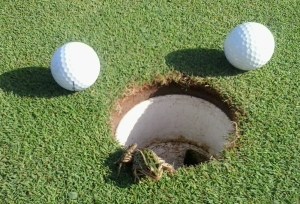
Choosing the right golf ball may lower your score!
The feed back so far on my “Which golf ball is best for you” series has been inconclusive. Many players have selected their golf ball in the same way as me – feel, availability, and cost. The previous two posts, Part 1 and Part 2, have covered topics of construction and the number of pieces of a golf ball. To this point, this information provided a valuable insight into selecting a golf ball, but nothing conclusive.
This installment will include cover type, compression, and dimples. These three topics are important because they offer a greater selection for players who are looking for the right golf ball!
Golf Balls have two basic cover types: surlyn or urethane. Surlyn is a harder surface that is considered more durable and enhances distance. Urethane, which has replaced the balata cover, is softer and offers better feel and control; however urethane marks easier and is not as resilient.
“Golf compression rates determine what balls are used by different levels of golfers. Compression creates density in the golf ball, which may affect distance and loft. The golf ball is compressed and flattened by the force of the impact. The lower compression of the ball results in the ball ;travelling farther as the club’s energy creates energy, transferring it to the ball. The ball’s compression handles the high-speed and impact of the club, and allows flexibility so that the ball can recoil and not break apart.” (Golfsmith.com)
“Dimples on a golf ball create a thin turbulent boundary layer of air that clings to the ball’s surface. This allows the smoothly flowing air to follow the ball’s surface a little farther around the back side of the ball, thereby decreasing the size of the wake.” (Scientific America)
The type of cover, compression and dimples all effect a golf ball’s performance. There are many thoughts and reasons to select a golf ball based on its construction. Yet, the increasing information about golf balls seems to confound my decision on which ball to choose.
As I learn more about golf balls, the more my choice becomes clearer and yet, more confusing. How about you?
I am a grateful golfer! See you on the links!
Giving Bad Advice on the Golf Course
Offering advice on any subject is tricky. Offering advice on a subject that you are not really familiar with does not make good sense. Offering advice while playing golf could be fatal! I have played thousands of rounds of golf and through the years I have offered unsolicited advice, solicited advice, and refused to give advice; but the one constant in everything was that it was always the wrong time!
Before anyone pulls out their Golf Canada rule book and starts quoting rule 8-1, and proceeds to tell me that “Advice’’ is any counsel or suggestion that could influence a player in determining his play, the choice of a club or the method of making a stroke; I never give advice during a competition. If you are wondering, here is what others have to say: Continue reading
When to Change Your Golf Grips
It is that time of year, when players in Canada, or at least the northern regions, start to look at their equipment for next year. We clean out our golf bag and see the state of our clubs, balls, towels, and most importantly their grips. Recently, I asked how often players they changed their grips. This is what they said:
I like to change my golf grips every year; usually during the off-season. There are many factors to consider when changing your grips and it is important we select the right grip to for you! I dug into my achieves and thought it this a good time to remind everyone that golf season is quickly approaching and it is time to get ready!
Continue reading
 The Grateful Golfer