Crazy Golf Rules

This is just a crazy golf rule that I had to share. It is a cut and paste from BarDown website. I take no credit for the original reporting, but I just had to share it!

Bizarre rule leads to golfer having to strip down and jump into a lake!

Water Hazard

Water Hazard

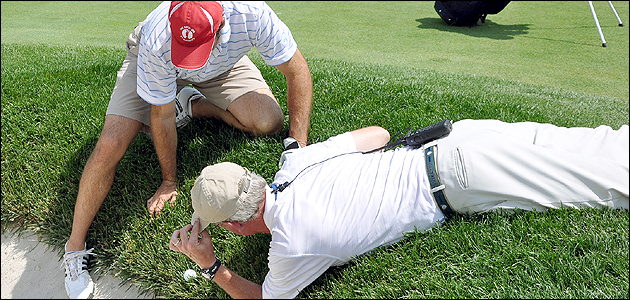
Wednesday, during the NCAA Baton Rouge Regional, Jacksonville golfer David Wicks found out just how serious tournament officials are about certain rules, no matter the circumstances. After hitting a putt close to the pin on the 13th hole, Wicks picked his ball, placed it in his pocket and put down his marker. Moments later, Wicks went to check his scorecard causing him to accidentally drop his ball off his shoe. The ball ended up rolling into the drink, meaning that unless Wicks was able to retrieve his ball, he would face a penalty shot.

So Wicks did what any good team player would do…he took his clothes off and jumped into the lake.

“Wicks stripped down to his underwear and dove in with a five-minute time limit. “David probably found 20 balls in the stretch of five minutes, but he never could find his,” said Blackburn. “It was just a stroke of bad luck. After the five minute period ended the rules officials gave him a two-stroke penalty, which really could’ve hampered our comeback. But David rebounded, finishing the day with five straight pars to keep us in the race.” (JUDolphins.com)

While we understand that rules are rules, that rule just seems a bit silly. Careful of mistakes on the golf course…some can cause you to have to jump in a lake.

(H/T: FTW USA Today)

The Ghost of Golfing Past

We all know the story of Scrooge who was visited by three ghosts on Christmas Eve. After examining his life, Scrooge realized it was not too late to change and have a positive impact on the lives of the people around him. Ultimately, improving his 3 foot space.

To improve my golf game, I need to follow the same general process. Take account of how my game from the past, the current state of my game, and what my future looks like if I do not change. Of course, I do this every year in one form or another in the hopes of being a scratch golfer and this year is not different. Continue reading

Golf Tip – Marking Your Ball on the Green

Marking your ball on the green is as important as making coffee in the morning! There is a procedure to each that if performed properly can have a positive impact on your day. For most of us, marking your ball is a routine action that we give very little thought to when playing.

Here is all the basic details on how and why marking your ball is important:

As I reviewed the video, I was surprised by the first statement about one ball striking another on the green.  So I checked the rules and this is what I found:

Rule 19-5a. If a player’s ball in motion after a stroke is deflected or stopped by a ball in play and at rest, the player must play his ball as it lies. In match play, there is no penalty. In stroke play, there is no penalty, unless both balls lay on the putting green prior to the stroke, in which case the player incurs a penalty of two strokes.

I did not know this rule! During a competition I always mark my ball, so this rule would never apply. However, during our weekly matches we often leave our ball unmarked while one of us is putting. Well, I will stop that practice immediately.

On a side note, I always thank the player for moving his marker. It is my way of reminding the player to move it back. I realize that it could be construed as aiding another player, but I guess in the big scheme of things, I would rather win by shooting a lower score, not by the player incurring a needless penalty!

I am grateful golfer! See you on the links!

Ground Under Repair – Rule 25

Down the left side of the fairway on the fifth hole of our course, a large areas is marked as ground under repair. Due to storms late last year and the lack of time to clean up the mess, our managing committee has declared this area as Ground Under Repair. It is a well know local rule and the area is marked by a white line.

rules_official_new_webRecently, I was playing a round of golf with my usual friends and one of us hit their ball into this area. We searched and searched, but we did not find the ball. As the default rule guy, they asked me for a ruling. I stated that since we did not find the ball, it had to be declared lost, and he had to go back to the tee to rehit.

Well, I started thinking and after a bit of research, I found out that I was wrong.

According for Rule 25-1c, my friend was able to take a free drop, without penalty. Here is how the rule reads:

Ball in Abnormal Ground Condition Not Found
It is a question of fact whether a ball that has not been found after having
been struck toward an abnormal ground condition is in such a condition. In
order to apply this Rule, it must be known or virtually certain that the ball
is in the abnormal ground condition. In the absence of such knowledge or
certainty, the player must proceed under Rule 27-1.

If it is known or virtually certain that a ball that has not been found is in an
abnormal ground condition, the player may take relief under this Rule. If he
elects to do so, the spot where the ball last crossed the outermost limits of
the abnormal ground condition must be determined and, for the purpose of
applying this Rule, the ball is deemed to lie at this spot and the player must
proceed as follows:

(i)  Through the Green: If the ball last crossed the outermost limits of the
abnormal ground condition at a spot through the green, the player may
substitute another ball, without penalty, and take relief as prescribed in
Rule 25-1b(i).

(ii)  In a Bunker: If the ball last crossed the outermost limits of the abnormal
ground condition at a spot in a bunker, the player may substitute another
ball, without penalty, and take relief as prescribed in Rule 25-1b(ii).
(iii) In a Water Hazard (including a Lateral Water Hazard): If the ball last
crossed the outermost limits of the abnormal ground condition at a spot
in a water hazard, the player is not entitled to relief without penalty. The
player must proceed under Rule 26-1.

(iv)  On the Putting Green: If the ball last crossed the outermost limits of the
abnormal ground condition at a spot on the putting green, the player may
substitute another ball, without penalty, and take relief as prescribed in
Rule 25-1b(iii)

Basically, not remembering and my playing partner not knowing the rules cost him 2 stokes. I will rectify this error this morning as we play our weekly round. With an important tournament approaching, I will have to reread the rules and make sure I am aware of all their nuances.

Rules are important in golf. They even the playing field, only if players actually know them. Have you read the rule so of golf lately? If so, how long ago?

I am a grateful golfer! See you on the links!

More Than Just a Water Hazard!

Water on any golf course provides untold challenges. A pond can lie between the tee box and the green on a par three, there are the famous island greens, or water can follow you down the fair way like a lion stalking its prey! Water evokes fear in most amateurs, which ultimately affects their golf game.

Glen Abbey Golf Course, Oakville, Ontario

Tough shot over water to green at Glen Abbey Golf Course!

Hitting your ball into the water is frustrating and does cost a player strokes. However, what is more frustrating is being award more penalty strokes or hitting the ball out of a tough lie for not understanding the drop rule related to a water hazard.

Red and Yellow stakes are often confused. Most amateurs who do not understand the rules and drop the ball within 2 club lengths of their point of entry into the hazard and then just carry on. They often ask the question about the number of penalty stokes they must count and sometimes ‘forget’ the penalty all together. For the weekend golfer who does not really care that much about their score, it really does not matter. But for those who want to play in competition; the video below by Golf.com is for you!

So not that we have demystified the Red and Yellow stakes issue. We can confidently remove the fear of all water hazards. One last tip, the best way to make sure avoid the red/yellow stake rule for a water hazard….do not hit your ball into the water!

I am a grateful golfer! See you on the links!